If you are in danger right now, call 111. In New Zealand you can free call or text 1737 any time to talk with a trained counsellor, call Lifeline on 0800 543 354, or the Suicide Crisis Helpline on 0508 828 865 (0508 TAUTOKO). Outside New Zealand, visit Find a Helpline for free support in your country.
By Barry Pearman. Barry has spent almost 30 years as a mental health support worker, community chaplain, and pastor, and has walked through depression himself. About Barry Pearman
When you’re on a slippery slope towards suicide, you need self-talk sentences to arrest your fall. The dark self-talk of ‘I want to die’ needs to be replaced with ‘I need help and I can get it’. Change your words and you change your life.
In short: when suicidal thoughts start pulling you down, short, simple sentences you can repeat to yourself can act like an ice pick that stops the slide long enough for you to reach out for help. Below are 37 self-talk sentences, grouped by theme, that remind you that help is near, that your feelings are not the whole truth, and that your future does not have to look like your past. Use them alongside real support, not instead of it.
Contents
- The depression slippery slope
- Why simple self-talk sentences help
- 37 sentences to stop the slide
- Keep these sentences close
- Frequently asked questions
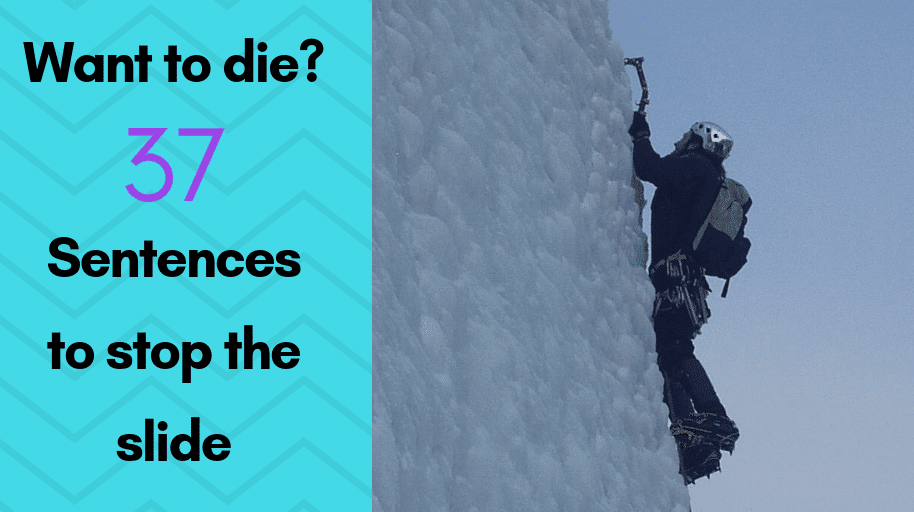
The ice pick slammed into the slope and broke his fall. He clung to that pick with all his might.
He had slipped down this very same slope many times before. At times he had come close to death. But with an ice pick in hand, he could quickly arrest his fall. He was not going to allow himself to fall any further.
The Depression Slippery Slope
When you have depression, the negative blackness can tip you over the edge and send you hurtling down a slippery slope to destruction.
For this man, it seemed like his whole world was crashing around him. Domino blocks the size of whales had fallen against each other, and then the last one fell on him.
The desire to die was so strong. Anger, emptiness, pain, and the futility of it all coursed through his mind.
Then a thought reached out from somewhere.
He reached for the phone and dialled the emergency number.
The emergency person was kind and got him to sit calmly while an ambulance was dispatched. They kept talking to him.
It wasn’t long before the ambulance arrived, and two compassionate officers helped him into the ambulance.
Soon a doctor listened to his story. Compassion flowed, and serious help was given, not just for his brain, but also for his heart. He felt hope slowly trickle in. He wasn’t alone. He wasn’t rejected or abandoned.
The slippery slope is always there, and the top is always connected to the bottom. The bottom is dark and endless, and you don’t want to go there.
To arrest the fall, to stop the slide to suicide, you need to prepare for it ahead of time. You need an ice pick of sentences you can grab and slam into the slippery slope.
Why Simple Self-Talk Sentences Help
When you are in crisis, the ability to concentrate can disappear. Long explanations don’t land. Simple little sentences can refocus the narrative of the brain when nothing else will. Say them once. Say them twice. Say them as many times as needed until help arrives.
These sentences are not a replacement for professional care. They are a handhold, something to grip while you reach for the phone, a friend, or a doctor.
37 Sentences to Stop the Slide
Sentences That Remind You Help Is Near
- This is a dark well, and someone has the help I need. I can reach out to someone who cares.
- There are people out there who understand my pain, and they are as close as a phone call away.
- I don’t need to carry this pain alone. Others want to walk with me and work through the struggles I have.
- Illness comes in many forms. Perhaps my brain is unwell, and it needs some people who know more than I do.
- I don’t know what I don’t know, and there are caring people out there who can help me through my unknowing.
- There are better options than what I am planning, and I need some help to find them.
Sentences That Loosen the Grip of Shame and the Past
- I am not my failures.
- The feelings I have are like echoes of the past and don’t truly represent today.
- Just because they said those things doesn’t make them true.
- Not everything I think and feel is true, and that is normal for everyone. I need the viewpoints of safe others to help me clarify my own.
- When I choose to keep on dancing to the music of my negative thoughts and feelings, I will always be led astray.
- What I am choosing to focus my attention on will get me in the end. What good thing can I focus on for the next 5 minutes?
- What they did hurt, and feeling hurt is normal. I can get through this with the right help.
- Underneath my pain, there are questions that others have the answers for. I can find that person.
- S.H.A.M.E. is Should Have Already Mastered Everything, so I am going to stop ‘shoulding’ on myself and start ‘coulding’. I could have done this or that, but I didn’t. I am like everyone else, and having failures is normal. Good growth can come out of it.
- The choices I made back then were based on various influences that were happening at THAT time and not necessarily happening now.
- More knowledge and understanding of myself can open the door to self-forgiveness. ‘Oh, so my brain was physically unwell and I didn’t even realise it?’
Sentences That Invite Compassion and Growth
- I’ve been under a lot of stress lately. Perhaps I need to give myself the gift of compassion and grace, that which I would freely give others.
- I can learn new ways of handling stress. There are people out there who want to help me learn.
- I can learn new skills, knowledge, and wisdom that will help me when the darkness comes.
- There will always be dark tunnels, but it does not mean I have to leap off the train. I can get help.
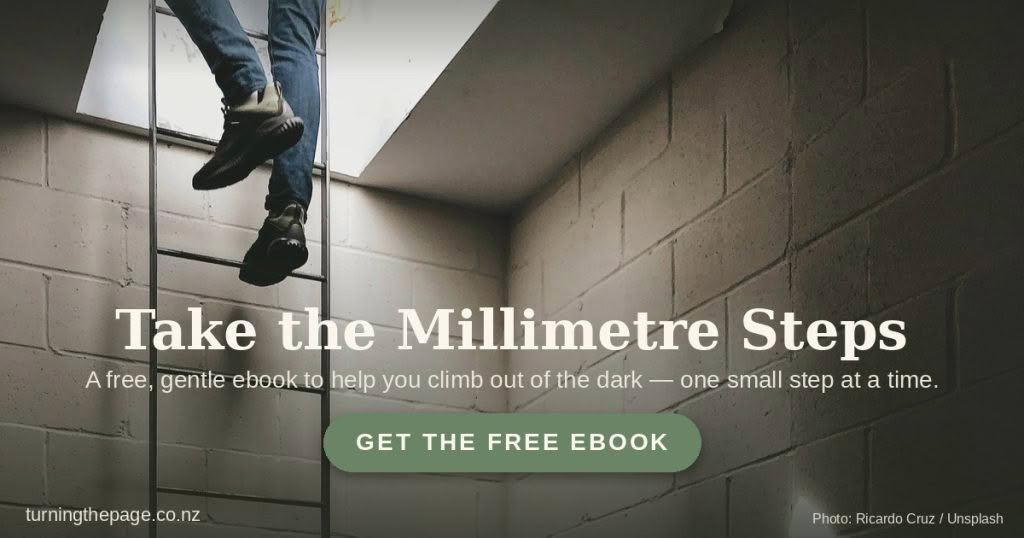
- There is a ladder for my pit, and there is someone who can help me climb it.
- This despair is not permanent. Feelings and thoughts can change. It depends so much on what I choose to focus on.
- Mental health, for everyone, is a fragile thing, and I can grow mental health resilience muscles.
- Everyone is fighting a hard battle. It’s normal, so I am going to be kind to myself and others.
- I can’t control what others think of me; I can only control what I think about myself. So I am speaking kindness and love to myself.
Sentences That Protect Your Worth and Your Future
- Regardless of what I have done or what has been done to me, there are still people who genuinely care about me and love me.
- Their response to me tells me more about them than it does about me.
- Underneath the cruelty of a bully is a small, frightened child. I am not going to let them determine my value.
- Under the rubbish of my life (we all have some), there is beauty and purpose. I can nurture it or nullify it. My choice.
- I am not going to judge my future by the past. I can have a different future with new thinking and new habits.
Sentences That Break Old Thinking Ruts
- Following my negative feelings can be like a dog chasing its tail. A habit of futility.
- When I overthink, I creep away from the connection to the now. I need to stay in the present, stay in the truth.
- My thinking can easily slip into the thinking ruts of the past. It’s a habit. I’m going to grab a spade and start digging new routes.
Sentences of Faith and Self-Understanding
- If God is for me, then I need to be for myself. I am not alone.
- My brain takes shape from what I choose to rest my mind on. What am I resting my mind on? I will rest my mind on things that are true and good and right. Things that are pure and lovely. The fine and good things in others. Everything I can praise God for. (Philippians 4:8, Living Bible, adapted)
- When I am hungry, angry, lonely, tired, stressed, or sick, my willpower and ability to cope with life can take a dive. This is normal for everyone.
Keep These Sentences Close
Keep these close at hand. Write a few on a card for your wallet, save them on your phone, or add them to your emergency mental health grab bag. You might like to share them with a friend or talk them through with a health professional.
Download a PDF of these sentences (no email subscription needed): Download the 37 Sentences to Stop the Slide PDF
If you are supporting someone else, read 6 keys to helping someone who is suicidal. If you find yourself praying that God would take your life, you are not the first, and God, I Want to Die walks through what Elijah and Moses experienced. Staying connected matters too, as explored in how friends and shared activity build mental health.
p.s. Can I ask you to share this post? Every month, many thousands of people type ‘I want to die’ into a search bar. Sharing this post helps them find hope. Thank you on their behalf.
Frequently Asked Questions
What should I do right now if I am having thoughts of suicide?
Reach out now. In New Zealand, call 111 if you are in immediate danger, or free call or text 1737 to talk with a trained counsellor. You can also call Lifeline on 0800 543 354 or the Suicide Crisis Helpline on 0508 828 865. In the US and Canada, call or text 988. In the UK, call Samaritans on 116 123.
Can self-talk really help with suicidal thoughts?
Self-talk sentences won’t cure depression, but they can interrupt a downward spiral long enough for you to take the next step, which is reaching out to a person who can help. They work best when they are prepared ahead of time and kept somewhere you can easily find them.
Is it a sign of weak faith to feel suicidal?
No. Biblical figures like Elijah and Moses asked God to take their lives when they were overwhelmed, and God responded with care, not condemnation. Feeling this way is a sign that you are carrying more than any person can carry alone, and that it’s time to get help.
Further Reading
- God, I Want to Die — Feeling overwhelmed and praying God I want to die? You are not alone. Discover hope, biblical comfort, and practical steps to find a way out.

- I Simply Want the Pain to Stop — Understand how life’s stressors and deep emotional hurts manifest as physical pain, and find healthy ways to rewire your response.

- 18 Insights to Heal the Shame of an Attempted Suicide — Discover how to heal the deep shame and embarrassment after a suicide attempt through curiosity, empathy, and empowering insights.

- What’s in Your Emergency Mental Health Grab Bag — A crisis hits and your world shakes. Learn how to build an emergency mental health grab bag with grounding tools to get you through.

- Your Rehearsal can Change your Mind — Train your brain with positive self-talk. Learn how intentional daily rehearsal can break old thinking tracks and help you overcome anxiety.

- When You Find Yourself in a Dark Hole, Start Digging — Stuck in a dark hole of depression? Discover the power of millimeter steps and daily habits to dig your way back to mental health.

About the Author
Barry Pearman has spent over 30 years as a mental health support worker, community chaplain, and pastor, and has walked through depression himself. His training includes SoulCare Foundations under Dr Larry Crabb, a Bachelor of Applied Theology, spiritual direction training, and certificates in CBT interventions, pastoral therapy, and integrated mental health care. Turning the Page offers a grace-filled path to mental wholeness through faith and hope. Read more about Barry Pearman
Disclaimer: The content on this site is for educational and spiritual encouragement purposes only and is not a substitute for professional medical advice, diagnosis, or treatment.