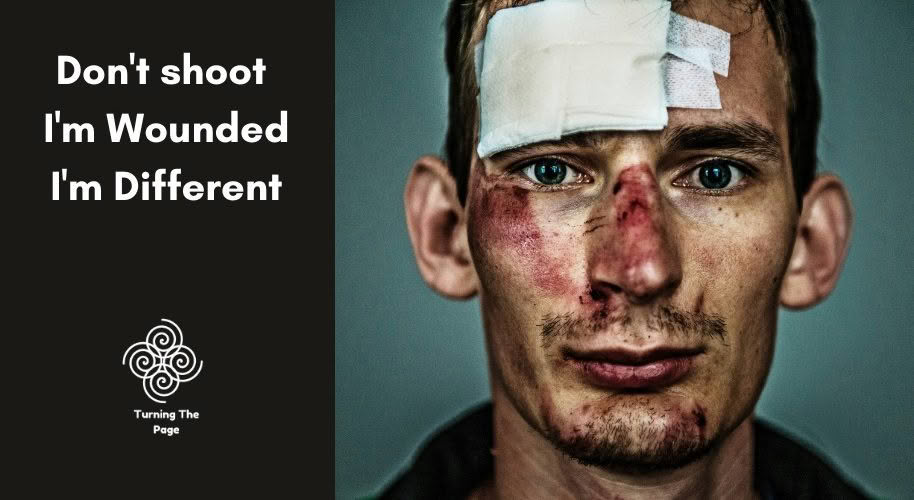
When we don’t slow down and seek to understand, it’s easy to shoot our wounded. My plea is ‘Don’t Shoot. I’m wounded. I’m different/divergent.’
I recently watched this video of a pair of horses being very frightened by a rabbit.
The two horses were walking down a narrow country path. They were being called by their owner, but right in the middle of the path was a small rabbit.
The horses would not go near the rabbit. They were frightened of the rabbit to the point of running away from it.
You would think that an enormous horse should not fear such a small little creature.
Something they could easily stomp on or at least brush aside, but here they were, stopped in their tracks.
Please excuse the expletives.
@ozzymanreviews One of the most suspenseful showdowns ever 🎙🔊 watch ’til the end 👌 #ozzymanreviews #horses #bunny
It’s an irrational fear to us.
But to these horses, it’s very rational. They see something so small as something that could jump out and attack them. That is the way their brains are wired.
We could shout at the horses, offer them sweet apples, and tell them to try harder, but still they would not move. They would avoid at all costs.
Messages we are told
When I saw this video, I thought of some people that I know that have incredible fears of seemingly small things. Of challenges that others consider easy.
They are told to …
- Pull your big-boy/ big-girl pants up
- Man up
- Toughen up
- Grow a thicker skin
- Get over it
- Move on
- Get it together
- Snap out of it
These are messages of shame.
That you are defective in someway and that you just need to …
But instead of making snap judgments, I want to know why.
I want to know why those horses feared a rabbit?
You see when we ask ‘why’ it’s a movement out of judgment – ‘Stupid Horse’ to mercy – ‘What’s going on in those horses to make them react that way’ to grace – ‘I move towards the horse and either help it in its fears or remove that which is triggering its fears.’
Justice to Mercy to Grace. Compassion is the oil that lubricates the movement.
I ‘grace’ the horse and do for it what it cannot do for itself at this moment.
Perhaps with practice and learning, the brain of the horse can grow new neural pathways, allowing it not to fear a rabbit.
Don’t shoot. I’m wounded.
One of the very first books I read when I started working in mental health was a book with the intriguing title ‘Why do Christians Shoot Their Wounded? Helping (Not Hurting) Those with Emotional Difficulties by Dwight L. Carlson.
Published in 1994, it is still as relevant today as it was back then.
Here is the dedication
There are legions of God-fearing Christians who – to the best of their ability- are walking according to the Scriptures and yet are suffering from emotional symptoms. Many of them have been judged for their condition and given half-truths and cliches by well-meaning but ill-informed fellow believers. Dwight Carlson
Maybe you are one of them.
Going to church or even meeting with a few Christian friends can send you into panic.
We trace the pain back and find a wound in the soul.
Relapse
Out of the wound we pluck the shrapnel.
Thorns we squeeze out of the hand.
Even poison forth we suck, and after the pain we ease.
But images that grow within the soul have life
Like cancer often cut, live on below the deepest of the knife
Waiting their time to shoot at some defenseless hour
Their poison, unimpaired, at the heart’s rot,
And, like a golden shower, unanswerably sweet,
Bright with returning guilt, fatally in a moment’s time
Defeat our brazen towers long-built;
And all our former pain and all our surgeon’s care
Is lost, and all the unbearable (in vain borne once) is still to bear. C.S. Lewis
There are the ‘images that grow within the soul’ that a few quick prayers, a merry song, and concerted religious effort will not erase.
Don’t shoot. I’m different/divergent
Then there are those that might have different neurological (brain) functioning from the general population.
Differences that have labels.
Labels that often have the word ‘disorder’ or ‘deficit’ tacked on the end.
Differences that we now call neurodivergent. Brains that operate differently to others
Here is a list of common neurodivergent conditions
- Developmental Neurodivergent Conditions
- Autism Spectrum Disorder (ASD): Differences in social communication, emotional regulation, and repetitive behaviors.
- ADHD (Attention-Deficit/Hyperactivity Disorder): Challenges with focus, impulsivity, and hyperactivity.
- Dyslexia: Difficulties with reading and language processing.
- Dyspraxia (DCD): Issues with motor coordination and planning.
- Dyscalculia: Struggles with understanding numbers and math.
- Dysgraphia: Problems with writing skills.
- Tourette Syndrome: Causes involuntary sounds and movements (tics).
- Synesthesia: Mixing of senses (e.g., hearing colors).
- Other Related Neurodivergent Conditions
- Executive Dysfunction: Difficulties with managing cognitive processes.
- Nonverbal Learning Disability (NVLD): Trouble interpreting nonverbal cues.
- Aphasia & Stuttering: Communication disorders.
- Acquired Neurodivergence
- Traumatic Brain Injury (TBI): Can alter brain function.
- Mood Disorders (e.g., Bipolar Disorder): Affects mood and behavior.
- Anxiety & Obsessive-Compulsive Disorder (OCD): Characterized by persistent worries or compulsive behaviors.
- Schizophrenia: Affects thought, perception, and behavior.
- P.T.S.D. Post traumatic stress disorder
How do you see the world?
My wife Sharon has Dyslexia. When she reads something, she may well skip a word, or find it difficult to read certain words, particularly long words. This does not deter her from the desire to read.
She regularly reads Bible passages in our Sunday morning service.
Before she reads the passage, we practice the reading many times. We look for the words she finds difficult to read and pronounce, and we practice.
Recently, one of the readings we had contained the word ‘arbitrate’.
He shall judge between the nations,
and shall arbitrate for many peoples; Isaiah 2:4
She stood before the congregation and read the passage flawlessly.
She is very brave.
I was talking with her about this post this morning and about the video of the frightened horses. I asked her what she had seen in the video.
She said that she had focused on the rabbit. I was focusing on the horses and their reactions.
Maybe her brain was more interested in the rabbit’s stillness than the fear and panic of the horse.
We live right next to a beach. Sometimes she looks out at the beach and notices the colours of the sky and the sea. Sunsets and sunrises.
I will see other things.
She, through her dyslexic functioning brain, is opening a whole new world of colour and life for me.
Sharon is a very gifted hairdresser. She is able to bring beauty and colour to people’s lives. I wonder if the dyslexic brain functioning helps in this in someway?
But in some situations, she might be labeled as dumb because she has difficulty with reading.
Is it a disability or a difference?
So we adopt and adapt
A key theme throughout the Bible is hospitality.
The welcoming of the stranger into one’s presence.
For the Lord your God is God of gods and Lord of lords, the great God, mighty and awesome, who is not partial and takes no bribe, who executes justice for the orphan and the widow, and who loves the strangers, providing them with food and clothing. You shall also love the stranger, for you were strangers in the land of Egypt. Deuteronomy 10:17-19
Do not neglect to show hospitality to strangers, for by doing that some have entertained angels without knowing it. Hebrews 13:2
I think of some of the people that I have adopted into my life and how I have adapted myself to their ‘divergent’ ways.
They have brought colour and beauty. I wonder how many angels have sat in our conversations?
It Takes an Armando
Larry Crabb shares this story.
Jean Vanier, founder of L’Arche communities across the world that give disabled people the chance to discover their true worth and beauty, tells the following story.
In Rome in 1987, the bishops attending a synod concerned with the role of the laity in the Roman Catholic Church were invited to an unusual gathering. In Vanier’s words,
‘. . . the Faith and Light communities of Rome invited all the bishops to come to a gathering of their communities, made up of people with intellectual disabilities, their parents and many friends, especially young people.
Only a few bishops came.
The community of L’Arche in Rome came also, with Armando, an amazing eight year old boy they had welcomed.
Armando cannot walk or talk and is very small for his age.
He came to us from an orphanage where he had been abandoned.
He no longer wanted to eat because he no longer wanted to live cast off from his mother. He was desperately thin and was dying from lack of food.
After a while in our community where he found people who held him, loved him, and wanted him to live, he gradually began to eat again and to develop in a remarkable way.
He still cannot walk or talk or eat by himself, his body is twisted and broken, and he has a severe mental disability, but when you pick him up, his eyes and his whole body quiver with joy and excitement and say, “I love you.”
He has a deep therapeutic influence on people.
I asked one of the bishops if he wanted to hold Armando in his arms. He did.
I watched the two of them together as Armando settled into his arms and started to quiver and smile, his little eyes shining.
A half hour later I came to see if the bishop wanted me to take back Armando. “No, no,” he replied.
I could see that Armando in all his littleness, but with all the power of love in his heart, was touching and changing the heart of that bishop.
Bishops are busy men. They have power and they frequently suffer acts of aggression, so they have to create solid defense mechanisms.
But someone like Armando [emphasis mine] can penetrate the barriers they—and all of us—create around our hearts.
Armando can awaken us to love and call forth the well of living water and of tenderness hidden inside of us.
Armando is not threatening . . . he just says, “I love you. I love being with you.”’ Jean Vanier, From Brokenness to Community.
Notice how Armando had a soul wound (he no longer wanted to live cast off from his mother) as well as a mental disability.
We can so easily overlook the wounds of the soul, the being shot by life, and focus on the obvious.
To all that you are, you need to hear “I love you. I love being with you.”
Quotes to consider
Everything in spiritual community is reversed from the world’s order. It is our weakness, not our competence, that moves others; our sorrows, not our blessings, that break down the barriers of fear and shame that keep us apart; our admitted failures, not our paraded successes, that bind us together in hope. Larry Crabb. Becoming a True Spiritual Community: A Profound Vision of What the Church Can Be
A spiritual community, a church, is full of broken people who turn their chairs toward each other because they know they cannot make it alone. These broken people journey together with their wounds and worries and washouts visible, but are able to see beyond the brokenness to something alive and good, something made whole. Larry Crabb. Becoming a True Spiritual Community: A Profound Vision of What the Church Can Be
We are not our problems. We are not our wounds. We are not our sins. We are persons of radical worth and unrevealed beauty. Larry Crabb. Becoming a True Spiritual Community: A Profound Vision of What the Church Can Be
Only when the perfume jar is broken in the presence of accepting community is the fragrance released. Larry Crabb. Becoming a True Spiritual Community: A Profound Vision of What the Church Can Be
Questions to answer
- What experiences have you had of being different, ‘divergent’?
- What are the qualities of people who welcome openly those who are different?
- Why do you think we ‘shoot our wounded’? Have you had experience of this happening to you or someone you care about?
Formation exercise
- Imagine yourself as being like one of those busy bishops. Amando is placed in your lap to hold. The angels rejoice. What goes on in you emotionally as you feel this small childs vulnerability and need for love of the soul?
Further reading
Barry Pearman
Contact me