Are you waiting for the other shoe to drop? It’s called anticipatory anxiety, but you can find release and the anxiety can go.
You know it’s going to happen; it’s just a matter of when.
And in that waiting, in that zone of tension, you sit.
How do you hold yourself in that space?
How do you hold others when they’re waiting for the other shoe to drop?
Waiting for the other shoe to drop
This phrase comes from, I believe, when people lived in wooden apartment buildings. The walls and floors were thin, and you could hear everything going on with your neighbour.
The neighbour living above you would take one shoe off, it would land on the floor, and then you would wait for the second shoe to fall.
You’re in anxious suspense. You know it’s going to happen. That second shoe banging down on the floor.
It’s not if, it’s just when.
Unless, of course, something totally unexpected happens in between.
- The person has only one shoe.
- The person goes and polishes the shoe
- They get interrupted by something and place the shoe on the bed.
- They decide to quietly place the shoe on the floor
- The shoe lands on a pile of clothes, and the noise is muffled
What do you do, though, as the one waiting for the second shoe to fall, with the tension?
The time between a couple of shoes falling is probably only a few seconds.
But what if you’re waiting for the second shoe to fall and the tension lingers?
Ok, I’m not so much talking about shoes here, but more so the repeated nature of trauma.
You’ve been hit once, and how you wait for a second blow. When will it come?
You’ve been rejected once, now when will it happen again?
Its days, weeks, years, and you still hold that heightened state of focus.
You’re living in a state of suspended anxiety.
It’s the unexploded bomb that has landed in the neighbour’s backyard, and you’re waiting for it to detonate.
What happens is that you get tired. All that energy held in tension paralyses you.
You’re waiting, waiting, waiting.
The dread.
The uncertainty.
The fear.
There is a name for it. It’s called ‘anticipatory anxiety’
Anticipatory Anxiety
This coming weekend is Easter.
In the context of what I am writing about, I think of Jesus walking through the streets of Jerusalem to the place of crucifixion.
Jesus, knowing the brutality of a crucifixion. Aware of the force of a nail being struck through a hand.
The terror and screams of those being crucified alongside.
The knowing of what comes next in a crucifixion shoe drop.
Yet he remained totally present in the moment of trauma. Even to the point of desiring forgiveness for those trapped in complete unawareness of the drama they were part of.
Are you in a place of anticipatory anxiety? Just waiting for the next shoe to fall, as such?
Living in this troubled, broken world, I wonder what twists and turns are going to hammer down on my fragile existence.
It’s in that tension, in that stretched elastic, that I seek relief.
Elastic rubber band
Imagine yourself as an elastic rubber band that is stretched out.
If stretched for too long, it loses its ability to be elastic.
In myself and in others, I have found that if we are held in tension too long; we grow tired; we lose our form, we lose our life..
Ive been mulling over a definition of anxiety I have written.
Anxiety is the swing of the mind into the future, with the result being anything other than hope.
I enjoy having physical illustrations to use in my teaching.
For my upcoming class on anxiety, I think I will use the metaphor of a child’s swing.
A child’s swing.
We push the swing out, and then through the force of gravity it swings back.
Eventually, after swinging back and forth, it naturally returns to a place of stillness and being centred.
Imagine that you push that swing out, but instead of releasing it, you hold the swinging chair out at its furthest point of movement.
The weight of the chair and the force of gravity want it to return to the centre.
But you are holding it there. All your attention is placed on holding it out there.
It takes energy to keep it suspended there.
You’re anxious about something and you’re keeping your mind out there in the unknown.
You grow tired, and it swings back into a focus on the past, and here depression is ready to greet you.
The mind wants to settle into stillness. Into what is within your control. A grounded awareness of the day.
I get tired if I focus too long on what might or might not happen in the future.
I get tired if I focus too long on what happened in the past.
It’s tiring to focus on things that are out of your control.
Where are you focusing your attention?
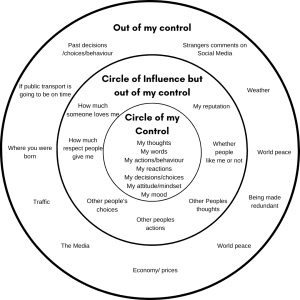
Are you focusing on things out of your control?
Isn’t it better to focus on what you can control in the here and now?
When we come back to the day we have today, we centre the rocking swing to the now. Not the past, not the future, but only the present.
We come back to the now. We focus on what we have control over in the now.
As we focus on what is in our control, we might just discover that the feared ‘second shoe’ might not drop and that there may well be no ‘second shoe’
It takes conscious practice to train the brain into staying within the focus of what is in the now and within one’s control.
A quiet, steadied, centering back on the little swings we experience in the everyday.
Give your entire attention to what God is doing right now, and don’t get worked up about what may or may not happen tomorrow. God will help you deal with whatever hard things come up when the time comes. Matthew 6:34
Quotes to consider
Plan but don’t plan as if it will all happen as you planned it … expect nothing and live frugally on surprise. Alice Walker
The people who are going to be most controlled by their fears are the ones who don’t admit them and deal with them. Richard Rohr -Job and the Mystery of Suffering
The past describes what happened. It does not decide what will happen. Rob Bell
My life has been full of terrible misfortunes, most of which never happened. Michel de Montaigne
Read further
Little by Little: How Small Steps Can Topple Your Biggest Giants
Barry Pearman
Contact me