
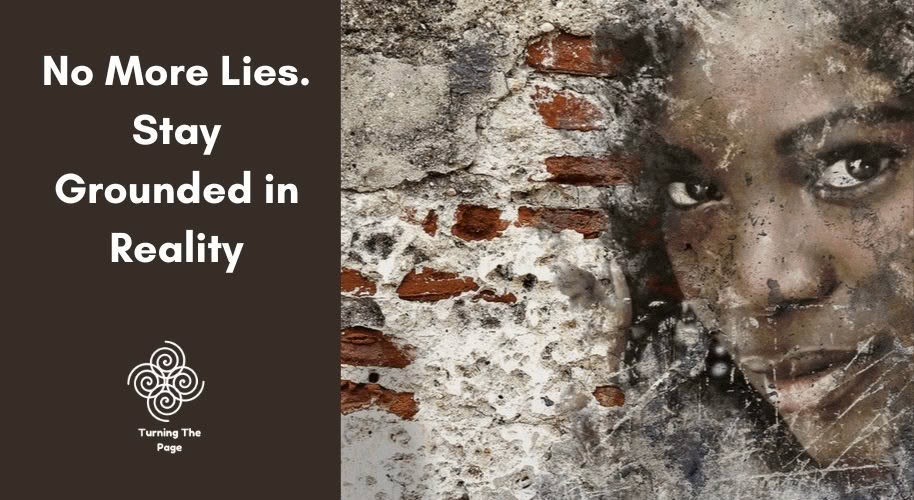
“If you really knew me, would you still love me?” A grounded reality of knowing God speaks, “You are loved no matter what.”
Quick answer: Being grounded in reality means facing life as it truly is, the good and the bad, instead of hiding behind a facade of lies, denial or embellishment. God meets the real you, not the person you pretend to be, and offers immeasurable grace. Four steps help: review where your self-worth comes from, know that God knows and loves you, invite God to chip away the facade, and find someone safe to be real with.
I know someone who lies and embellishes the truth. They want to be known and loved, but the facade of lies they have built up around themselves has become their truth. Sometimes, when they feel safe, they let their guard down, and the honesty flows. It’s beautiful to watch. Here is the real person, the person God knows and loves, and yet this is the person they are most afraid of.
In this post:
- Why We Prefer Comfortable Lies
- What It Means to Be Grounded in Reality
- 4 Steps to Become Grounded in Reality
- God Meets You Where You Are
- Quotes to Consider
Why We Prefer Comfortable Lies
We don’t like being presented with our failings. We prefer a fairy tale with a happy ending. It’s been like this for a very long time. God speaks through his prophet Isaiah about his people:
We want good news, even if it’s false news. Spin doctors have been around a long time. Some of us have lived so long under the lies of guilt and shame that they feel like the truth.
What It Means to Be Grounded in Reality
There is, however, an invitation to be grounded in reality. To be grounded in reality is to be firmly connected with life, both the good and the bad. It’s not avoiding the tough work of day-to-day life in favour of chasing a wisp of a lie.
It’s getting advice, being OK with failures, and giving grace to yourself and others. It’s totally real and thoroughly honest. It’s vulnerable. People who are grounded in reality are lovers of truth.
4 Steps to Become Grounded in Reality
1. Review where your sense of self-worth comes from
We want to impress, to be loved and valued, and so subtly, we place our self-worth into the fickle hands of others. If you’re dancing to another’s tune, you will never discover the beautiful song within yourself. Perhaps your self-worth comes from your own sense of achievement. You’re only as worthy as the success you achieve. If that’s the case, then how do you handle failure?
2. Know your God knows you and loves you
Like the father in the story of the prodigal son, God is waiting for you to decide to come home. There are wide, embracing arms waiting for you to return. What is God like to you? Is God like a hard taskmaster, a fault-finder, a critical judge, or a distant God who is unconcerned with you and distracted by so many other “important” things? God is love. The most grounded reality that God welcomes you into is one of immeasurable love, and meditating on God’s love lets that truth sink in.
3. Invite God to chip away the facade you have been creating
God knows the real you and wants the world to see the creation. Chipping away the old takes time, and that’s OK. Prayerfully ask God to guide you into a truth-filled, grounded reality.
4. Find someone to be real with
Perhaps it’s a friend or maybe a therapist, but we all need “next to them” people. People who will work alongside us. Souls that are OK with the rubble because they know there is a hidden treasure underneath. Then, slowly and carefully, remove the facade and experience love. Our deepest need is to be truly known.
God Meets You Where You Are
Most of us try to make life work by living in denial. We don’t want to explore what’s happening in the soul. We don’t want to feel all the pain we feel, so we anaesthetise ourselves in various self-reliant ways.
God meets us where we are. God doesn’t meet us where we pretend to be or where we wish we were. To be grounded in God’s reality requires a firm commitment to side with the truth.
Quotes to Consider
- “The worst lies are the lies we tell ourselves. We live in denial of what we do, even what we think. We do this because we’re afraid. We fear we will not find love, and when we find it we fear we’ll lose it. We fear that if we don’t have love we will be unhappy.” — Richard Bach
- “Reality is often not what we perceive, especially when we have been hurt and betrayed in our formative years. How damaged is your perception?” — David Riddell
- “The journey into total mental health begins with a commitment to come out of delusion into reality, no matter what the cost.” — David Riddell
- “We all like a nicely padded delusion, only to find eventually that it comes with a sting in its tail. Stay in reality to stay safe.” — David Riddell
- “The warfare the Christian is involved in is the battle between true and mistaken beliefs. It is warring for reality against the delusional world of lies. Which side will you take?” — David Riddell
- “When I believe my feelings and those feelings misrepresent reality, I am headed for a self-referential pit that will get deeper and darker as I dig myself into my home-made delusion.” — David Riddell
Questions to Answer
- What brings people to a place where they must confront the reality of what they have done?
- Why do we create delusional worlds?
- What would it be like to be thoroughly soaked in a sense of being loved by God?
Further Reading
- Tired of Pretending? Find the Ancient Path to Honesty — Exhausted from performing instead of being real? Discover millimetre steps toward honesty on the ancient path
- The Self I Imagined and the Self God Loves — Daydreams of a better you reveal a longing to be loved. Discover how God delights in the real you, just as you are.
- The Ancient Path to Your True Self: Facing Inner Resistance — Why do we hide, defend, or shut down when we’re truly seen? A look at fight/flight/freeze/fawn through the story of Peter’s denial — and the grace that meets it.
- Am I Codependent? You Can’t Earn Love Here — Tired of people-pleasing performance? Explore the signs of codependency and discover how to rest fully in God’s unconditional love.
- The God Who Sees Me: Rewriting the Beliefs We Formed as Children — Childhood rejection shapes what we believe. Hagar’s story and a journaling exercise help you rewrite old beliefs.
- No One Knows Coal Like a Coal Miner: Being Met at the Coal Face — Feeling alone with your pain? Discover why being known, not fixed, matters and how Jesus meets you in the dark.
About the Author
Since 1995, Barry Pearman has worked as a mental health support worker, community chaplain, and pastor, and has walked through depression himself. His training includes SoulCare Foundations under Dr Larry Crabb, a Bachelor of Applied Theology, spiritual direction training, and certificates in CBT interventions, pastoral therapy, and integrated mental health care. Turning the Page offers a grace-filled path to mental wholeness through faith and hope.
path to mental wholeness through faith, hope, and love.