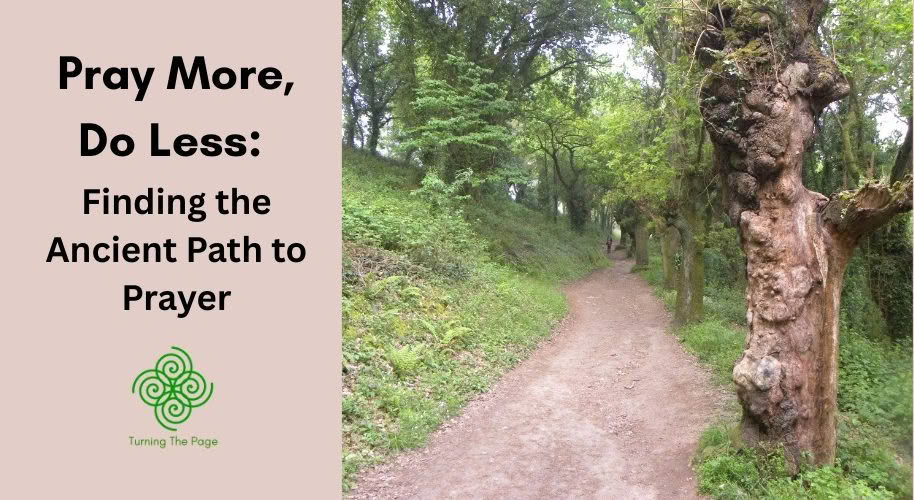
Escape tick-box prayer and comparisonitis. Discover the ancient path that invites you to pray more and do less.
We do like to get things done, don’t we? It feels satisfying to cross things off a list, to put a tick next to that item.
I use paper and pen for the same reason. It gives the brain a message. It’s there. It’s tangible. It’s real. Something has been done.
But how much do we measure ourselves by what we have or haven’t done? How easily do we slip into comparisons. Comparing ourselves to others.
We’re all wired this way to some degree — chasing the tick, the tangible marker, the proof that we did something with the day. That we have value.
Susanna Wesley: A Woman Who Got a Lot Done
Recently, I read about an 18th-century woman who got a lot done, as told by Lectio365.
Susanna Wesley — mother of John and Charles Wesley, the founders of Methodism — endured a difficult marriage to a penniless preacher who was imprisoned twice. Their home burned down twice. Nine of her nineteen children died in infancy. And somehow she raised the remaining ten almost single-handedly, regarding motherhood as a vocation from God.
A Life of Hardship and Purpose
Susanna took education seriously, home-schooling her children six hours a day, and remarkably insisting on teaching her seven daughters the same as her three sons. She also gave an extra hour of exclusive time to every child each week. “I look upon every soul under my charge,” she explained, “as a talent committed to me under a trust.”
Leading a Congregation From the Kitchen
Susanna was a formidable leader long before her sons rose to fame. When her husband, the rector of Epworth Parish Church, was imprisoned for financial mismanagement, and his replacement in the pulpit failed miserably to preach the gospel, Susanna took matters into her own hands.
She launched a Sunday school for her children in the kitchen, which attracted so many neighbours it had to move to the barn. Before long, two hundred people were gathering every Sunday to worship, pray, and listen to Susanna reading sermons.
And so this humble housewife, whose life was hard, and who hailed from a small town in rural England, somehow became the spiritual mother of some eighty million Methodists in more than 130 nations today.
The Order of the Apron
But an interesting feature of Susanna’s life is that whenever she wanted to spend time in focused prayer, she would pull her apron up over her head to signal her need for privacy.
You can imagine that in all the busyness of working through her list of things to be done, there wasn’t much time for quiet. Yet she would stop, pull her apron over her head, and pray.
It was a signal. Do not interrupt. It was a boundary.
Go Away, Shut the Door — Matthew 6:6
It sounds much like what Jesus said:
Go away. Shut the door. Pull the apron over your head.
I brought the story of Susanna Wesley to a small group I’m part of, which meets fortnightly, and I asked everyone to bring an apron.
We sat around looking a bit ridiculous, aprons draped over our heads. But it made the point land: prayer, silent and hidden away, is the place we draw life from. It’s the place Susanna went to find life in the middle of the noise.
Prayer Is the Ground of the Ancient Path
Prayer is the ground of the ancient path. It’s what we walk on. It’s the grounded place where we find the stability to take the next millimetre step.
So what does an ancient-path prayer life actually look like?
From Tick-Box to Ongoing Walk
When I was a child, prayer felt like another tick-box activity.
Kneel beside your bed. Work through the prayer list. Show up to the prayer meeting. Pass prayer requests down a prayer chain. All of that can still be part of a life of prayer, and it’s good and important — but it isn’t the whole picture of what an ancient-path prayer life looks like.
What an Ancient-Path Prayer Life Looks Like
Now I see prayer more as an ongoing, moment-by-moment walk with God. Sometimes it’s focused, like the list above. But more often it’s:
- Singing a song
- Writing a poem
- Silence and listening to the early morning birdsong
- Lectio Divina, first thing
- Walking on the beach, feeling the kiss of God on my face — watch Barry’s reflection on prayer and the beach
Ancient paths call us to pray more and do less. They invite us to ground ourselves in the reality of brokenness over the pain of others, but then they might also invite us to rejoice with a neighbour who has found a lost coin.
Where’s Your Apron?
So — where’s your apron?
Do you have a signal you use, or could use, to say do not interrupt, because you are leaving the noise, the list, and the comparisonitis?
Where’s the door you shut?
Ancient paths invite us to places where output isn’t measured at all.
Where’s your beach? Do you have a place, even under an apron, that you retreat to?
Being Before Doing
Our doing flows out of our being. Silence and solitude aren’t an escape from what matters — they help us focus on what actually does matter, instead of the noise and distraction of everything.
The Ancient Path Prayer of St. Patrick
An ancient path invites us into a living communion with Christ on the path. Christ walking on the beach. Christ in every prayer-filled breath.
I love the prayer referred to as the Breastplate of St. Patrick and pray it regularly each morning.
Christ before me,
Christ behind me,
Christ in me,
Christ beneath me,
Christ above me,
Christ on my right,
Christ on my left,
Christ when I lie down,
Christ when I sit down,
Christ when I arise,
Christ in the heart of every man who thinks of me,
Christ in the mouth of everyone who speaks of me,
Christ in every eye that sees me,
Christ in every ear that hears me.
Honesty, Not Performance
Ancient paths …
- Are more about honesty than performance
- Generally go down before they go up
- Ask us to pray more and do less
- Are well-trodden — worn smooth by others like us who’ve walked them before
- Push back. There’s resistance built in, because there is an invitation to change
Ancient paths call us to pray more and do less.
Barry is a writer, coach, online pastor, and course creator that has a passion for Mental Health and Spiritual Formation.
Quotes to consider
Further reading
- Comparisonitis – The Compulsion to Compare Yourself — Comparisonitis kills joy. Comparing yourself to others robs you. Instead, explore who you are and the work you have been given, and then sink yourself into that.
- An Empty Love Tank — You’ve got nothing left. An empty love tank, weightless and vulnerable. But you want love. Who and what will fill the need?
- Learning How to Stop: Centering Prayer — Our minds can be so busy, but learning how to stop is so crucial to our wellbeing. Perhaps centering prayer offers some help.
- Finding that Still Small Voice — It’s a noisy world with lots of stressors wanting our attention, but there is a still small voice longing to be heard, so quiet yourself and listen.
- It’s not ‘Two Steps Forward and Three Steps Back’ — Progress and change can seem like ‘two steps forward and three steps back’ but maybe the steps need to be millimetres and with gradual gentle sideways movements we can see movement.
- Better to Live in the Corner of a Roof — Contention and stress can become too much. Sometimes it’s better to live in the corner of a roof and the simplicity of nothing than the complexity of strife.
Written by Barry Pearman — Community Chaplain, Mental Health Support Worker, and founder of Turning the Page, a resource walking a grace-filled path to mental wholeness through faith, hope, and love.