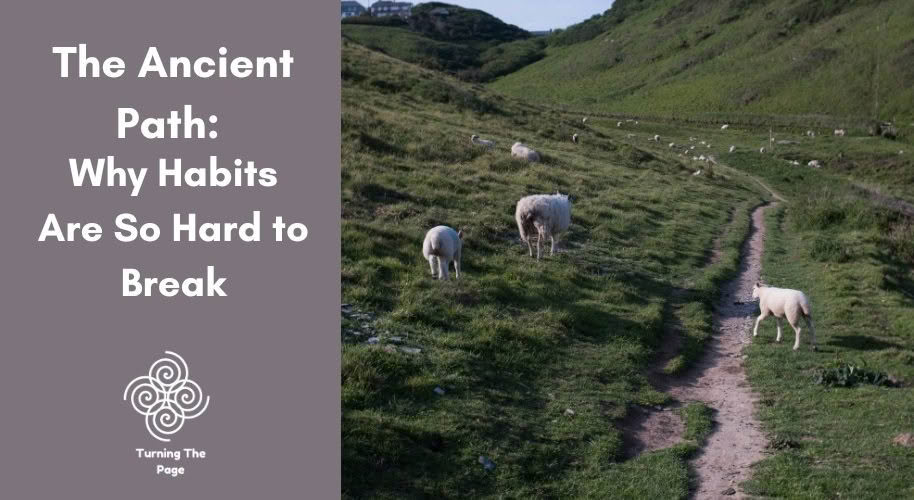
I was brought up on a sheep farm, and one of the most fascinating features of that farm was the tracks the sheep made across the paddocks.
Right in the middle of a field, you’d find this narrow, well-worn path — pressed down by hundreds of hooves, over and over, until the ground itself had changed shape.
One sheep after another walked that path. Each hoof pressed the soil down a little more.
But here’s something that I only learned recently: sheep hooves leave a scent. There are small glands between the hooves that release a faint, smelly fluid as they walk.
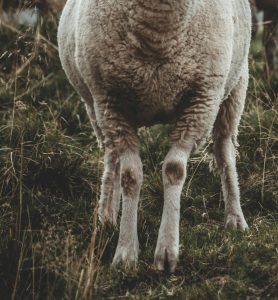
So the sheep aren’t just following what they can see. They’re following what they can smell. Two senses, both saying the same thing: this is the way, walk in it.
That’s why habits are so hard to break. They’re not just a decision you keep making.
They’re a path your whole self has learned to walk — visually, physically, even chemically. By the time you’re trying to stop, the ground is already worn down, and the scent is already there, calling you back to it.
Thought habits are particularly hard to change. There is the little formula E+R=O. Event plus Response equals Outcome.
Something happens to us, and we respond to it in a certain way, and we get a certain outcome. It’s a pathway in our brain. If we want a different outcome, then we have to choose a different response.
Every Path Has Been Walked Before
The Path In Is Well Worn
Ask anyone who has fought an addiction, or tried to break a habit they’re ashamed of, and they’ll tell you exactly how hard it is to get off the path — even when they want to.
It’s not just the obvious things like alcohol, drugs, or porn. It might be shopping, hoarding, comfort eating, procrastination, lying, stealing — the list goes on and on. Different paths, same mechanism. Every time we walk it, it gets a little deeper, a little easier to fall into without noticing, a little harder to climb out of.
The Path Out Is Well Worn Too
This is exactly why groups like Alcoholics Anonymous exist and why they work. They understand something crucial: the path into a destructive hole is well worn, but there is also a path back out. People have walked out of those dark holes before. The way out has been walked so many times that it, too, has become a path — one you can find, and follow, and trust.
To break free from the grip of these old paths, we need others to walk alongside. Other sheep who have been where you are. Others who know the dark valleys and challenges before you hit them, because they’ve been there, done that, and got the t-shirt to prove it.
Not a Single Choice
Here’s the thing that trips most of us up: we treat a habit like it’s a single choice, made fresh each time. But a well-worn path isn’t a single choice — it’s the residue of hundreds of previous choices, compacted into something that now feels automatic, almost involuntary. You don’t decide to walk the sheep track. Your feet just go there.
That’s why simply gritting your teeth and “trying harder” so often fails. You’re not fighting one decision. You’re fighting a groove that’s been dug, one repetition at a time, sometimes over years.
Nothing New Under the Sun
This path is not unique to you. It sounds strange to say, but there’s real comfort in it: there is nothing new under the sun. It’s all happened before.
There is nothing new under the sun.— Ecclesiastes 1:9
You Are Not the First
Scroll the internet and get served “eye candy” — ask Samson or David how that pathway ends.
Feel the pull toward rigid, black-and-white religious control — ask Paul about his life before grace knocked him off his high horse.
Sit in depression, despair, and confusion — talk to Job. Wrestle with fear and anxiety — talk to Gideon.
Need to check your priorities — talk to Mary and Martha. Struggle with taking what isn’t yours — Zacchaeus has a story to tell.
Doubt everything you believe — Thomas is right there with his finger in the wound of Christ.
The path you’re on — whatever it is: depression, anxiety, addiction, fear, panic, grief, a busy and distracted life — has been walked before. You are not the first person to find it hard.
But you can take other paths. You can create new habits — paths that take you to hope.
(You might like to read and put into practice Four Spiritual Exercises from the Bible for Mental Health.)
Let’s Walk It Together
Want to change?
Some of the habit roads we’ve walked are deep and long. Well pounded — but you can get out of them. Changes can be made.
Let’s walk a new path together.
Ancient paths …
- Are more about honesty than performance
- Generally go down before they go up
- Ask us to pray more and do less
- Are well-trodden — worn smooth by others like us who’ve walked them before
- Have push back. There’s resistance built in, because there is an invitation to change.
Quotes to consider
Further reading
- 7 Steps to Change and Regroove Your Thinking Patterns — Around the hillside of the sheep farm where I was raised were grooves worn into the soil by hundreds of sheep following each other. It was the easiest route.
- A Ladder Out of Your Depression Dark Hole — When you want it all to end, you think nothing will change, but what if you had a kind of ladder out of your depression dark hole?
- When You Find Yourself in a Dark Hole, Start Digging — When you’re in a dark hole, it can feel like there is a loss of hope, but you can dig yourself out with some wisdom and encouragement.
- Change the Way You Think and Act — Do you keep making the same bad choices over and over again? You can change, and it all begins with a decision to change the way you think and act.

- The ‘Constant Companion’ of Habit — I am your constant companion. I am your greatest helper or your heaviest burden. I will push you onward or drag you down to failure. (from “The Habit Poem” featured on the page)
- Good Things, Like Mental Health, Take Time — We all want immediate results. A change to our situation, but Mental Health recovery takes time, so let’s be patient
Barry is a writer, coach, and course creator that has a passion for Mental Health and Spiritual Formation.
Photo by Veronica White on Unsplash