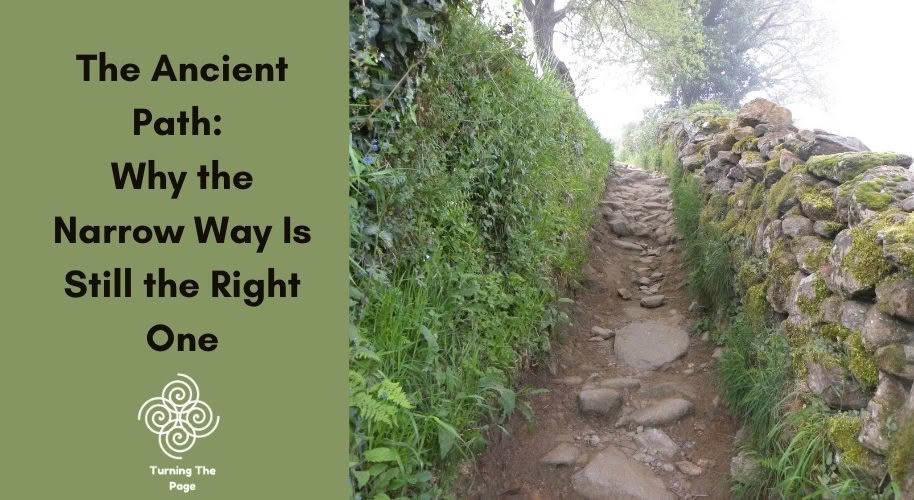
There’s an ancient path — one worn into the ground over thousands of years, easy to trust because so many have walked it before you.
I was watching a program on TV about elephants. The Elephant Queen. It tells the journey of a family of elephants in the African savannah, following a year in their life through all the different seasons.
In a couple of drone shots, high above the savannah, you could see a path. Clearly marked out. Worn into the soil by probably millions of elephants over thousands of years.
It was an ancient path.
I would like an ancient path. One that is clearly seen and easily followed.
One that had signposts that said
“Walk this way.” “Here’s where you take the next step.” “You’re going with others.”
There are so many guides these days, all clambering for your attention, for your dollars. But what you really want is a guide who is old and crusty. One who has taken the pilgrim through this part of the journey thousands of times. You can trust them because they have been there and done that.
What Is the Ancient Path in Jeremiah 6:16?
One of those ancient guides was a man called Jeremiah.
He didn’t have the internet. He didn’t know A.I. but he knew silence, solitude, and sacrifice. He knew rejection and struggle. He is known as “the weeping prophet.”
In his ancient path experiences, his heart was being tuned to hear God and receive words to share.
He wrote this down for us.
Five verbs. Five action words that Jeremiah hears: stand, look, ask, walk, find.
The Five Verbs
- Stand. Stand at the place where you have to make a decision. A crossroad. Left or right. The road less travelled, or the superhighway everyone goes down.
- Look at the paths. The slick, modern, new, shiny “everyone is doing this” path — or the old and ancient path. Narrow, covered in cobwebs, and at times quite dark.
- Ask not for a better, more comfortable life of self-gratification and ease, but for the path where the good way lies: knowing God.
- Walk. Take millimetre steps. Mostly forward, but sometimes the foot slips and you slide back. You stumble, graze your hands, but you pick yourself up and recommence the journey.
- Find rest for your soul. Less striving for things that really aren’t that important. A contentment and peacefulness grows within that is beyond your understanding. Head knowledge becomes heart knowing.
Why We Resist the Ancient Path
But then there is the stubborn response — “we will not walk in it.” My mind goes to a petulant child crossing their arms, stomping their feet, grimacing, and saying “No.”
The parent knows the medicine will be good for them. The child says, “No, we will not.”
Have you ever been like this?
Jesus said this about the ancient path he wants us to take:
Jesus described the narrow gate and the path as being like two giant boulders, where you have to take off all your luggage just to squeeze through.

This squeeze isn’t a punishment. It’s more of an invitation — to shed what doesn’t fit anymore, what certainly won’t help on the next section of the path. Some of those old, stinky, thinky beliefs.
Walking the Ancient Path Together
The important thing to remember is not to walk this path alone. Go with someone else.
I think of Frodo from The Lord of the Rings, and how he had his companion — Sam Gamgee.
Here’s the question for you: you’re standing at the crossroad of decision. There’s the easy, most obvious path — and actually, sometimes it is the best one. But do you take it out of mindless habit, or has there been a well-reasoned consideration? Has there been a prayerful “look” and an “ask”?
The stakes are high. Destruction (a loss of life, real life) or gaining life (an abundant spring of life bubbling up).
Jesus said it is a narrow path and few take it.
Qualities of the Ancient Path
Here is what the ancient path will look like.
- It will be more about honesty than performance
- It generally goes down before it goes up
- It’s going to ask you to pray more and do less
- It’s a well-trodden path because others like you have walked it
- It’s predictable that a resistance to walk it might arise
These ancient paths aren’t so much about rules to follow — though of course there are some rules — but more about a way of being human.
The ancient path is slow and at times difficult. But it can be relied on.
A Quote to Consider
- Our generation has lost the concept of finding joy in unfulfilled desire. We no longer know what it means to hope. We want what we want now… . Impatient Westerners prefer quick sanctification. Take your car into the shop and drive it again the next day. Bring your soul to a counselor or pastor and get fixed right away. But wisdom understands that souls are not broken machines that experts fix. Wisdom knows the deep workings of the hungry, hurting, sin-inclined soul and patiently follows as the Spirit moves quietly in those depths, gently nudging people toward God. There is no Concorde that flies us from immaturity to maturity in a few hours. There is only a narrow, bumpy road where a few people walk together as they journey to God.” — Larry Crabb, Shattered Dreams: God’s Unexpected Path to Joy
- “Love? Yes, God loves us. But his love is passionate and seeks faithful, committed love in return. God does not want tame pets to fondle and feed; he wants mature, free people who will respond to him in authentic individuality. For that to happen there must be honesty and truth. The self must be toppled from its pedestal. There must be pure hearts and clear intelligence, confession of sin and commitment in faith.” ―
- The difficult pastoral art is to encourage people to grow in excellence and to live selflessly, at one and the same time to lose the self and find the self. It is paradoxical, but it is not impossible. ―
- There are many that follow Jesus as far as the breaking of bread, few as far as drinking the cup of suffering; many that revere his miracles, few that follow him in the indignity of his cross. Thomas A Kempis
- One of the first things that strikes us about the men and women in Scripture is that they were disappointingly non- heroic. We do not find splendid moral examples. We do not find impeccably virtuous models. That always comes as a shock to newcomers to Scripture: Abraham lied; Jacob cheated; Moses murdered and complained; David committed adultery; Peter blasphemed. ―
Further reading about the ancient path
- 7 Reasons Why Waiting Patiently is Good for You — Discover the power of waiting on God. Explore the meaning of patience through Psalm 40 and learn how to move from a cry to a song of praise.
- It’s Not ‘Two Steps Forward and Three Steps Back’ — Stop the cycle of two steps forward, three steps back. Discover “Millimetre Ministry” for gradual, gentle, and realistic personal growth.
- Is the Load Too Heavy? Watch With Me — The load we carry can get too heavy, and we can breakdown. But we can grow through it when we have others who will watch with us.

- When God is like a Drill Sergeant — For many, God can be like a drill sergeant, demanding and harsh, but that is a flawed understanding of God.

- There are None So Blind as Those that Will Not See — Stop chasing false promises. Discover how the allure of “shortcuts” leads to self-deception and how to break free from a prison of your making.

- The Reason Why So Many People Walk the Camino de Santiago — Discover why thousands walk the Camino de Santiago. Explore the deep human need for shared meaning, community, and mental health recovery.
-
We All Need a Batman: The Power of Loyal Friendship in Tough Times — We all face life’s battles, but we can’t do it alone. Discover the historic role of the “batman” and why loyal friendship changes everything.

Barry is a writer, coach, online pastor, and course creator that has a passion for Mental Health and Spiritual Formation.