Discover the life-changing power of Sabbath rest. Learn how to stop the busy traffic of life, plan ahead, and fill your cup today. Keep the Sabbath and the Sabbath keeps you.
I live right next to a beautiful beach.
Kawakawa Bay is very tidal, and at low tide it sweeps out a long way and then at high tide it’s deep enough to swim, but it’s still quite shallow.
Fish come into the bay, and sometimes we see them jumping out of the water in dance.
We also have these birds called Terns that fly above the water looking for little fish, and then they suddenly dive into the water and get some takeaways.
If it’s low tide at night and the wind is still, you can hear all the little bivalves shell fish making a ‘plopping’ sound as they emerge from under the sand and breathe. It’s gloriously noisy.
At low tide, birds cruise over the sandy mudflats looking for food. In the summer months, we have birds called Godwits who have flown non-stop from Alaska to be here on our doorstep.
It’s alive. Time and tide. It’s always on the move, always something happening.
But there is a road between our home and the bay.
At times, a very busy road.
Trucks, buses, cars, motorbikes, tractors and even sheep use this piece of pathway to get from A to B.
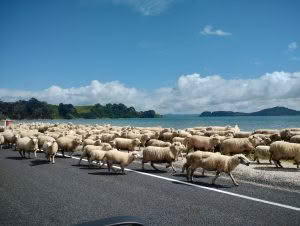
We have a speed limit. It’s 50 km/hr (30 ml/hr), but more often than not this is ignored.
Just along the road from us is a sign that measures speed, and if people travel faster than the speed limit, it flashes up a warning.
I see some drivers going through our little place of beauty at incredible speeds.
Sometimes I want to stop the traffic.
People scream past the beauty. I want them to stop and take it all in.
To ‘Shabbat’, which is the Hebrew word for stop, cease, or rest.
Sabbath means to cease.
In the story of God, we find that the very first spiritual exercise/ discipline that God commands (yes, it’s that serious) is to have one day in seven when you stop.
In the Ten Commandments, it’s ranked at number four of the ten.
“Remember to observe the Sabbath as a holy day.
Six days a week are for your daily duties and your regular work, but the seventh day is a day of Sabbath rest before the Lord your God.
On that day you are to do no work of any kind, nor shall your son, daughter, or slaves—whether men or women—or your cattle or your house guests.
For in six days the Lord made the heaven, earth, and sea, and everything in them, and rested the seventh day; so he blessed the Sabbath day and set it aside for rest”. Exodus 20:8-11
Look at all the words contained around this command. God wanted us to know that this is important.
We are to cease, stop, finish, rest, play, worship.
It’s a saying “No ” to the commercial, busy business of a 24hr non-stop world.
It’s a putting down the pen, closing the computer, turning off the tools; it’s a resting from the regular.
This requires planning and preparation.
In the exodus story, we find God saying to the people of Israel to collect their food on the sixth day, the day before the ceasing, make their meals, and on the seventh enjoy.
No work.
So how does this play out in our day?
Something that my wife and I try to do is to prepare the Sabbath meals ahead of time. We celebrate the Sabbath on Sunday.
On Saturday, we prepare food for the next day. Ok, there might be a little preparation on the Sabbath, but there is no pondering over ‘What shall we have for lunch or dinner’. It’s already done.
It’s a work in progress. Sometimes, due to unforeseen circumstances, we might have to prepare a meal, but it’s the exception, not the rule.
What this teaches us is the value of planning. Thinking ahead and organisation. This mindset flows into other areas of our lives.
Budgeting for meals for the next day leads into planning for the next week in other areas of our lives.
It teaches self-responsibility.
It also promotes an awareness that God is providence for the whole of the seven days. God can provide on the seventh day as much as, or maybe even more, than for the other six.
This teaches my anxious brain that I can rest.
A Sabbath Centric life.
I like the idea of a spiral, and I actually have a spiral as my logo for Turning the Page.
I want to grow in my life what I call a ‘Sabbath Centric’ lifestyle.

To have my energy and life coming from that special time when I am grounded in Sabbath awareness.
From this place I move out and around and into my world. I then spiral back to the centre. Back into the grounded place of the Shabbat.
How to keep the Sabbath centric
Plan to
- Cease. Plan to stop all your normal, everyday work type activities
- Rest. Plan how you will rest. Sleep, napping, taking a walk. Birdwatching???
- Enjoy. Dive in deep, savour the tastes of your food, eat slowly, drink slowly, smell the roses.
- Worship. Give worth and praise back to God who brought all of this together.
Further notes
- Notice the pulls. Notice the pull of things that ‘need to get done’. What are they? Could they be done tomorrow? Could planning during the week help relieve the tension?
- There maybe be ‘donkeys down the hole’ (more about this next week) emergencies that need immediate attention. Show grace to yourself and to others. Don’t get all legalistic about this.
- Take millimetre movements. If you have not been part of a culture that keeps the sabbath this will be a new thing to learn. Take millimetre movements with this. Try little things and make progress.
- Connect with others. Not for accountability or comparison (that is sure to kill the joy) but to celebrate.
- Make some time for reflection on your cup. One of the metaphors I like to share with people is the picture of a cup. We have cup drainers and cup fillers. Sabbath is a time for reflection on your cup of life and particularly to focus on those activities that will fill your cup.
- Sunset to sunset. A day, according to Genesis, started at sunset and went through to the next sunset. Start your Sabbath at sunset.
Stop the traffic
What would happen, I wonder, if for one day, in my little bay, everyone stopped driving past all the beauty and walked the beach.
They learned to be quiet and watch the dance of nature in front of their eyes.
Picnics on the beach. Swimming, paddleboarding, sailing.
I wonder that would what happen to people’s mental wellness, relationships, and work for the next week if they simply had a full restorative day of Sabbath.
Perhaps the swing of our attention, which seems to be pulled to the future or the past, to the ‘shoulds’ and the ‘should haves’, might become more grounded in the now.
Quotes to consider
I have come to think that the fourth commandment on sabbath is the most difficult and most urgent of the commandments in our society, because it summons us to intent and conduct that defies the most elemental requirements of a commodity-propelled society that specializes in control and entertainment, bread and circuses … along with anxiety and violence. Walter Brueggemann, Sabbath as Resistance: Saying No to the Culture of Now
A great benefit of Sabbath keeping is that we learn to let God take care of us — not by becoming passive and lazy, but in the freedom of giving up our feeble attempts to be God in our own lives. Marva J. Dawn, Keeping the Sabbath Wholly: Ceasing, Resting, Embracing, Feasting
To say “I am going to church” both reveals and promotes bad theology. Marva J. Dawn, Keeping the Sabbath Wholly: Ceasing, Resting, Embracing, Feasting
The only parameter that is to guide our Sabbath is delight. Will this be merely a break or a joy? Will this lead my heart to wonder or routine? Will I be more grateful or just happy that I got something done? Dan B. Allender, Sabbath
We will never know Sabbath delight unless God delivers us from drowning in the noise and grime of our soiled days. Dan B. Allender, Sabbath
Sabbath is the time set aside to do nothing so that we can receive everything, to set aside our anxious attempts to make ourselves useful, to set aside our tense restlessness, to set aside our media-satiated boredom. Sabbath is the time to receive silence and let it deepen into gratitude, to receive quiet into which forgotten faces and voices unobtrusively make themselves present, to receive the days of the just completed week and absorb the wonder and miracle still reverberating from each one, to receive our Lord’s amazing grace. Eugene H. Peterson, Tell It Slant: A Conversation on the Language of Jesus in His Stories and Prayers
If you don’t take a Sabbath, something is wrong. You’re doing too much, you’re being too much in charge. You’ve got to quit, one day a week, and just watch what God is doing when you’re not doing anything. Eugene H. Peterson
Further reading
Barry Pearman