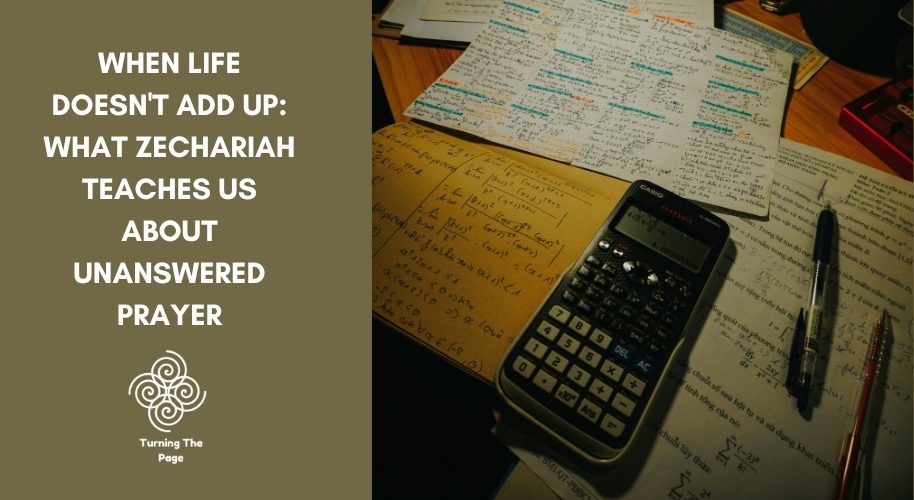
I like a life with a logic to it. If you do this, you get that. Play by the rules, and you get the reward. That’s why unanswered prayer hurts so much: the logic stops working.
It’s very linear, very logical, very A+B=C. You reap what you sow. So if you sow tomato seeds, you get tomatoes.
That works fine until it doesn’t. You sow the tomato seed, and nothing comes up. Then, you scratch your head and go looking for reasons. Why didn’t A+B give me C?
Maybe you’ve worked hard all your life and followed the rules. Yet now the dream you once had feels more like a nightmare.
We’ve all had that moment where we say, “I just don’t understand. I did everything right.”
In this post:
- Do we have an unwritten contract with God?
- Zechariah, Elizabeth, and unanswered prayer
- What’s your deal with God?
- A people whose lives don’t add up
- Questions about unanswered prayer
Do we have an unwritten contract with God?
I think we all carry an unwritten contract with God. It says that if I do my part, life will go reasonably well.
So we raise our children carefully and believe they’ll turn out fine. We work hard and expect to keep our jobs. When someone is ill, we pray and expect them to get better. And we stay in a hard marriage because we trust it will come right.
Then it doesn’t.
We crash, and we find ourselves sitting next to Job on the rubbish heap, throwing dust and tearing our clothes.
So we hold out two hands. In one hand: God is good, and I’ve followed Him as best I can. In the other hand: the mess.
We even have scripture that seems to sign the contract for us:
When life doesn’t add up
Psychologists have a name for the gap between the two hands: cognitive dissonance. It’s the clash between what we believe and what we’re actually living. In other words, it’s a life that doesn’t add up.
Cognitive Dissonance – the mental discomfort or tension experienced when a person holds two or more conflicting beliefs, values, or attitudes at the same time, or when their behavior clashes with their beliefs.
Christmas can make it worse. Everyone else seems to be singing “Joy to the World” around a happy family table. But all you can see is the empty seat. Or the cancer diagnosis, the job that’s gone, the child who has run away.
When life doesn’t add up, most of us default to one of four things:
- We explain it away. “God must be teaching me something, so I shouldn’t feel this.”
- We blame ourselves. “I must have done something wrong.”
- We go quiet with God. Sure, we still turn up, but we’ve stopped really hoping.
- We slowly harden.
Which one is your default?
What C.S. Lewis learned in his grief
C.S. Lewis knew this place. After his wife died, he kept a journal of his grief, later published as A Grief Observed. He wrote about his experience of God.
I don’t want to agree with Lewis there. Maybe that’s because I don’t want to go down a hole that dark. After all, dark holes can swallow you until your mind shuts out the light.
But Lewis also wrote something else in that same book:
So maybe our deal with God is one of the ideas that God has to shatter and rebuild.
Zechariah, Elizabeth, and unanswered prayer
The Christmas story doesn’t begin with joy. Instead, it begins with a couple in exactly this place. Cognitive dissonance – a life that doesn’t add up.
Were they childless because they did something wrong?
Luke tells us they were right with God. They were careful and faithful, and they kept God’s ways their whole lives (1:6). Then in the very next breath, he tells us they had no children, and now they were old (1:7).
Luke never says they were childless because they’d done something wrong. Instead, their faithfulness and their sorrow sit side by side, unexplained. Like Job, they weren’t suffering as punishment from God for some hidden sin. Like us, they had a life that didn’t add up.
In their culture, childlessness carried shame as well as grief. Later, Elizabeth talks about God taking away her disgrace among the people (1:25). For decades, this couple did everything right, and still the prayer they prayed most went unanswered.
We like this story because it has a happy ending, and it comes quickly. Childless couple, miracle baby. Done. But what the story doesn’t show is the years and years of two hands held out in prayer. God, we bring you our deepest need, and you are silent.
Why did Zechariah doubt the angel?
One day, the lot falls to Zechariah to burn incense in the temple. A priest might get that honour once in a lifetime. Then, an angel appears and tells him that God has heard his prayer: Elizabeth will have a son (1:8–13).
You’d expect joy. Instead, Zechariah asks, “How can I be sure?” (1:18). He wants the positive pregnancy test in his hands first.
Zechariah has had his hopes dashed so many times that he’s lowered the bar to zero. This is what hope deferred does to a heart. Hope has become too painful to keep holding. So when good news finally comes, he can’t let it in.
He isn’t alone. There are others in the larger story of the Bible. Sarah laughs. Naomi turns bitter. Job sits picking at his wounds. Scripture doesn’t hide people whose lives didn’t add up, and God doesn’t drop any of them. In fact, faith and doubt can sit side by side in the same heart.
Why was Zechariah struck silent?
Zechariah can’t speak until the baby comes (1:20). That sounds harsh, but in those nine months, he watches.
He watches Elizabeth’s body change. Week by week, he watches a God-mystery grow. There’s no deal to negotiate, no formula to check. Just grace, growing week by week.
When the baby arrives, the family expects to name him Zechariah, after his dad. But Elizabeth says no: his name is John. So Zechariah asks for a writing tablet and writes, “His name is John” (1:59–63). Straight away, his voice returns, and the first thing he does is praise God (1:64).
John means God is gracious.
The silence didn’t punish his doubt. Rather, it made room for a hope bigger than the deal.
Zechariah’s tidy A+B=C picture of God lay shattered. And what replaced it wasn’t a better formula. It was a name: God is gracious.
What’s your deal with God?
Here’s something to try. Grab a piece of paper and finish this sentence:
“If I live right, God should…”
Then don’t stop. Be as blunt, demanding and honest as you can because nobody else will read it.
After that, read back what you wrote. The deal you’ve been carrying around may surprise you.
Once you’ve seen it, hold it out to God with open hands. You might pray something like: God, this is the deal I thought we had. I’m handing it back. Teach me to trust that You’re gracious even when life doesn’t add up.
Linear thinking wants a clear yes or no. But the Christmas story is full of things that don’t add up: babies born to old folk, and a virgin giving birth. I’d much rather live an adventure of God’s surprises than a set of man-made mechanics.
So here’s the question: are you open to the unexpected?
A people whose lives don’t add up
Think about the stir Zechariah and Elizabeth caused. An elderly couple having a baby! Imagine that happening in your street. People would talk about it for months, wondering what God was up to (1:65–66).
That’s the other side of this story. When we stop living by the contractual deal and start living by grace, our own lives stop adding up to the people watching.
The world runs on getting what you deserve. You must have done something wrong, so you’re childless. You did this, so you get that. But God’s kingdom runs on grace. It’s a creative generosity, not a constrained logic.
A Christmas tree on the letterbox
I live right next to a busy road. Three years ago, someone at church brought along a wooden cut-out Christmas tree, the kind you stand on a table.
In our area, there’s a competition for the best-decorated Christmas letterbox. So I had a random idea, one I think the Spirit dropped into my brain noodle soup. Why not screw the Christmas tree on top of the letterbox?
Soon, another thought wormed its way in. Why not turn the letterbox into a collection point for the Auckland City Mission food bank?
So that’s what I did, and I posted about it on Facebook. People dropped off cans, packets of biscuits, noodles and all sorts of goodies. Some gave cash. Others went to the supermarket specifically to buy groceries to give away.
I’m doing it again this year.
That doesn’t ‘add up’ in a world of getting what you deserve. Strangers giving to strangers, for nothing in return. Yet that’s how God breaks the law of linearity: through creative acts of generosity.
Imagine if an entire community lived like that for this Christmas. Our neighbours would scratch their heads, and then they’d face a choice. Keep walking the straight line where they’re in control? Or trust a bigger story, one God works out in ways nobody expected?
Grace has the final word
If your life doesn’t add up right now, you’re in good company. You’re sitting with Zechariah and Elizabeth, with Sarah, Naomi and Job.
God didn’t give Zechariah an explanation. Instead, He gave him a son, and a name to say out loud: John. God is gracious.
So life doesn’t run on a deal with God. It runs on grace.
Questions about unanswered prayer
I followed God and my life still fell apart. Did I do something wrong?
Not necessarily. Luke calls Zechariah and Elizabeth righteous and blameless, yet they were still childless into old age (Luke 1:6–7). Scripture lets faithfulness and sorrow sit side by side without blaming the sufferer.
Does the Bible promise that life will go well if I obey God?
Verses like Deuteronomy 12:28 link obedience with blessing, but the Bible never turns that into a formula. Job, Naomi and Zechariah all show faithful people whose lives didn’t add up. In the end, God’s kingdom runs on grace, not a transaction.
Why was Zechariah struck silent?
When the angel Gabriel announced John’s birth, Zechariah asked for proof (Luke 1:18–20). His silence lasted until John’s birth. It was less a punishment than a season of watching God’s promise grow. And it ended with Zechariah praising God (Luke 1:64).
What does the name John mean?
John comes from the Hebrew Yochanan, meaning “God is gracious.” So when Zechariah named his son John against family expectation, he declared that grace, not a deal, had the final word.
How can Christians cope with Christmas after a loss or disappointment?
Start by being honest with God about the gap between what you believed and what you’re living. After all, the first Christmas story begins with a couple carrying decades of unanswered prayer, so grief belongs in the season too. Hold out both hands to God: your faith and your mess.
Quotes to consider
- Faith is not the opposite of doubt. Faith is the opposite of certitude. – Richard Rohr, podcast: Trust is a Rock You Can Build Upon
- Poets do not go mad; but chess-players do. Mathematicians go mad, and cashiers; but creative artists very seldom. I am not, as will be seen, in any sense attacking logic: I only say that this danger does lie in logic, not in imagination. – G.K. Chesterton, Orthodoxy
- Faith, in the sense in which I am here using the word, is the art of holding on to things your reason has once accepted, in spite of your changing moods. – C.S. Lewis, Mere Christianity
- Grace shows up where logic breaks down. – Richard Rohr, The Universal Christ
- The moment God is figured out with nice neat lines and definitions, we are no longer dealing with God. Rob Bell
Further reading
- Three Ways God Answers Prayer — Frustrated by unanswered prayer? Discover how God’s “No” or “Wait” might be the stretching and folding needed to develop a stronger faith.
- Is This Punishment from God? — Are your struggles payback for past mistakes? Unpack the story of Job and discover why your suffering is not a punishment from God.
- God, I Still Have Doubts: Where Faith and Doubt Meet — Faith and doubt can live together. Even the disciples doubted. Calm your emotional brain and build a memorial.
- Money Falling From The Sky and a Hope Deferred — Stop waiting for magic solutions. Learn how to heal a heart sick from deferred hope by finding small, meaningful blessings in the present.
- Where are you God? — When God feels distant in your pain, God hasn’t moved. Discover how to find Gods whisper in the “sheer silence” even when life is a storm.
- A Comfort at Christmas — Struggling this holiday season? Find deep comfort at Christmas as we explore how a close, loving God interrupts our grief and pain.
About the Author
Since 1995, Barry Pearman has worked as a mental health support worker, community chaplain, and pastor, and has walked through depression himself. His training includes SoulCare Foundations under Dr Larry Crabb, a Bachelor of Applied Theology, spiritual direction training, and certificates in CBT interventions, pastoral therapy, and integrated mental health care. Turning the Page offers a grace-filled path to mental wholeness through faith and hope.