Part five (final part) of the series Glory Days in the Mind: When Escaping Inside Keeps You From Living.
Quick answer: Loneliness and maladaptive daydreaming often go together. So does the pain of people judging, fixing or advising us instead of hearing us. The way out isn’t a better daydream, an addiction or more busyness. It’s a real person who will sit with you without judgment. Even Jesus asked friends to stay with him in Gethsemane, so needing people is not weakness.
Contents
- A Safe and Kind Space
- Why Loneliness and Maladaptive Daydreaming Go Together
- I Worship a Vulnerable God
- The Invitation: Walk and Talk
- Communities That Heal
A Safe and Kind Space
I had lunch with a friend last week. Next year, he will turn 80. He had a long career as a therapist, particularly a trauma therapist. He helped severely traumatised men and women find hope in and through Christ.
Now, he is reflecting on his years and what he has learned. What truly helped the people he supported? What would he like to have given more of?
We’re writing up a list that I hope one day to share with you.
But one of his key learnings was the vital importance of creating both a safe and a kind space for the other. A space where we honour them, and they are the most important person in the room. Where there is deep heart connection, not head intellectualism. Engagement with compassion and wisdom.
I think of my deepest relationships, and they are ones where people accept me and love me deeply. Where kindness is more important than knowledge. Grace trumps all.
At times, I’ve hidden from people, and I’ve needed to. Then there have been the times when people have found me. Being found is better.
I like it when people ask gently curious questions. It feels like we are on the same path together.
As I’ve said before, “No one knows coal like a coal miner.” That’s why it’s beautiful when you find someone willing to meet you at the coal face of your struggle. They want to know you without judgment and help you hold onto truth.
Why Loneliness and Maladaptive Daydreaming Go Together
This post is the final part of a series about maladaptive daydreaming which is a compulsive retreat into vivid inner worlds for hours at a time. In fact, it can reach the point where it disrupts daily life (Cleveland Clinic on maladaptive daydreaming).
Perhaps it’s the repeated experiences of being judged and FASSed (Fixed, Advised, Saved, Set Straight) that drive us inward. When people rush to fix, advise and save instead of listening well, we learn to keep our inner world to ourselves. Loneliness, a lack of connection, can spin us off to being anywhere but here.
For some it’s a daydream that lingers on. Maybe it’s into the world of control. Perhaps, an addiction gives our loneliness some relief.
Deep down, we have an archetypal desire for Garden of Eden in-to-me-see. Yet when we have revealed our vulnerability, we have met with rejection and revulsion. So we run, we hide, we create something safe where we are in control. We keep people at a distance. Busyness keeps us distracted. Shallow feels safer than deep. Helping others feels less vulnerable than admitting we need help. We become the helper, but never the helped.
A Christmas Dinner Lesson
I once pastored a church that focused on people with serious mental illness. Our community had people with schizophrenia, bipolar, personality disorders, depression, anxiety, addictions and more. Our group was part of a larger church community.
Above all, a common feature was loneliness.
Each Christmas, we would have an end-of-year Christmas dinner. I remember well when some people from the larger church approached me. They wanted to cook the meal for us.
I thanked them and explained that we did it all ourselves. We as a community went and bought the groceries, cooked the meal, and served it. There was a lot of fun, healing and community building in the process.
But we did have a need for people to provide transport each Tuesday night to our church service. They didn’t offer to help with this. I believe that’s because then they would have had to connect and talk.
We banish loneliness by connection.
I Worship a Vulnerable God
God needed someone. The fully divine, fully human Jesus had needs. Relational needs.
You would think that God would have no needs: fully contained, fully self-sufficient. And yet love, if it is truly to be love, has to be vulnerable.
My mind goes to the story where Jesus, fully human yet fully divine, invited a few of us mere humans to be with him.
Then they would have watched him. Another version of the story tells us of Jesus sweating drops like blood in his anguish (Luke 22:44).
Maybe the anxiety came from knowing that a crucifixion was coming. But perhaps his deepest fear was that, for a moment, he would feel forsaken, lost and abandoned.
Not Alone in Our Gethsemane
The Christ has experienced every feeling known to humanity, including deep, profound loneliness. He can meet you in yours.
In our loneliness, in our gardens of Gethsemane, we need others. We need people who will watch with us when the load is too heavy and not go to sleep.
People who say ‘I will sit with you and listen. You will not be alone.’
We weren’t designed to be alone. God’s answer to Adam’s aloneness wasn’t an imagined companion. It was a real person.
If Jesus asked for company in his anguish, it’s not weakness for us to need people.
That’s why church, at its best, is meant to be a place where people help each other up when they fall.
God’s answer to “it is not good to be alone” was never a better daydream, addiction, or distraction. It was a real person.
The Invitation: Walk and Talk
Recently, someone invited me to join them in a certain activity. It completely surprised me that they would want me along.
I think that deep down, they want to walk with someone but don’t know how to ask. They have done this a few times before.
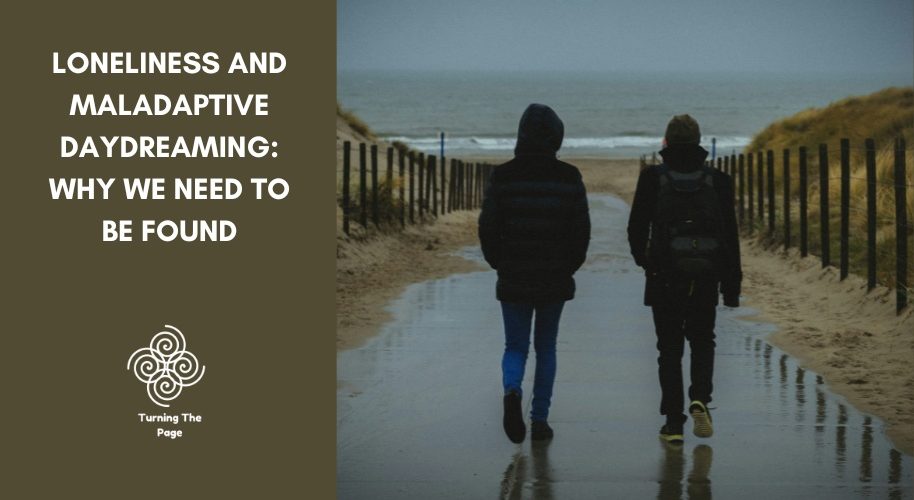
We often like to walk and talk. “Walk” means doing some activity together, such as walking. But it could also be working on a car, building a fence, painting a bedroom or making a meal. A conversation ensues. Connections form.
Perhaps, a very tangible interruption to the drift is to do something with someone else. To take that walk, make that meal together, weed that garden, paint that fence.
After all, Jesus invited others to walk with him, and the talk flowed out of the walk.
The invitation is for you to ask someone to do something with you.
A “with me” walk banishes loneliness.
Communities That Heal
We started this post with my friend. He was the therapist I first went to for supervision. In our very first session, he introduced me to the work of Dr Larry Crabb. His book Connecting: Healing Ourselves and Our Relationships became the foundation of everything I did and continue to do. I’ve written more about this in my tribute to Dr Larry Crabb and his vision of true community.
Crabb believed that ordinary Christians whose lives regularly intersect could offer much of the healing we now seek from professionals. They do it by pouring into one another what God has put in them. He wondered whether going to church might mean, more than anything, relating to a few people differently.
He saw the problem beneath many of our struggles as a disconnected soul. Neither exhortation nor scolding can heal it. But a community of connected people can begin to nourish it.
So here is my vision for Turning the Page, and for you. A community where the heart of God is at home, where people lock arms and journey on together.
Quotes on Loneliness, Connection and Being Known
- The greatest lie believed today is that one can know God without being known by someone else. — Larry Crabb, Soul Talk
- This means finding a person, or ideally a group of significant others, whom we are willing to trust. — John Bradshaw, Healing the Shame that Binds You
- When you speak to me about your deepest questions, you do not want to be fixed or saved: you want to be seen and heard. — Parker J. Palmer, A Hidden Wholeness
- There is a solution to “unspeakable loneliness”: it needs to be spoken, to be shared. — Ron Rolheiser
- No one person can fulfill all your needs. But the community can truly hold you. — Henri Nouwen
- The person who loves their dream of community will destroy community, but the person who loves those around them will create community. — Dietrich Bonhoeffer
Read Other Posts in This Series
- Part one: Maladaptive Daydreaming: When a Daydream Becomes a Place to Live
- Part two: The God Who Sees Me: Rewriting the Beliefs We Formed as Children
- Part three: The Self I Imagined and the Self God Loves
- Part four: When Life Feels Unreal: Returning to the Present with God
- Part five: We Weren’t Made to Heal Alone: Loneliness, Daydreaming and Being Found (this post)
Further Reading
- Six Qualities of People that Restore the Soul — Exhausted and burnt out? Discover the six lifegiving qualities of safe people who can help restore your soul without trying to fix you.
- You Can’t Make It On Your Own — Stop trying to do it all alone. Discover why rugged independence fails in dark times and how true biblical encouragement can heal a lonely heart.
- Do You Feel Alone in Your Struggle? — Struggling with a deep unspeakable loneliness Explore how isolation impacts mental health and find hope through real masked love and community
- I Need a Safe Place — Discover how to build safe spaces and practice unhurried listening. Learn to avoid fixing others and cultivate a truly good soul refuge.
- Church and Mental Health — Is a church for the 5% possible? Exploring how faith communities can move beyond compliance to truly support those with serious mental illness
- You’re Being Too Naked in Your Vulnerability — Discover the “Eden desire” to be fully known and loved. Learn why true vulnerability requires time, respect, and healthy boundaries.
- God Sets the Lonely in Families — Feeling isolated in your struggle? Discover how God sets the lonely in families of shared experience, prayer partners, and true belonging.
- Throwing Pearls to Pigs: Finding Safe People for Your Vulnerability — Learn why oversharing your deepest struggles with the wrong people hurts, and how to find safe people who honour your vulnerability
About the Author
Since 1995, Barry Pearman has worked as a mental health support worker, community chaplain, and pastor, and has walked through depression himself. His training includes SoulCare Foundations under Dr Larry Crabb, a Bachelor of Applied Theology, spiritual direction training, and certificates in CBT interventions, pastoral therapy, and integrated mental health care. Turning the Page offers a grace-filled path to mental wholeness through faith and hope.
Photo by Pourya Gohari on Unsplash