When guilt isolates, “I am with you” is the only bridge back to hope. The power of solidarity helps us in the face of judgment and shame.
How are they going to respond?
How will they react?
They had done some things they knew would go against what everyone thought was right and proper. Now they were hiding.
There is a kind of loneliness that we have in anxiety. It’s a loneliness where we feel isolated from hope.
It’s just us and the fear bearing down on us, and telling us that everything will be ok doesn’t help.
You want to say
- Are you walking in my shoes?
- Have you been where I am?
- Are you the one who is carrying my guilt and shame?
To say ‘I know what it’s like’ is shallow comfort when you’re drowning in fear.
Better to say ‘I am with you’
I am with you
With you is a connection. A binding of solidarity.
Solidarity connects to a unity of knowing, or at least a desire to know even in one’s body what it is like to be the other.
It’s not only ‘I am with you’ in this moment. It’s also ‘I am with you’ in the moment of tomorrow and however long it is needed to get you out of the quicksand pull.
I’ve been there.
In your most fear laced moments, it is the ‘with you’ people that will get you through.
People who don’t judge, condemn, and excommunicate from the naked vulnerability exposed.
This ‘with you’ concept is one that repeats itself throughout the pages of the Bible.
Every time there is any form of connection between the divine and our dust, there is a reassurance ‘Do not be afraid. I am with you.’
Jesus bent down
David Hayward captures one of those moments of isolating loneliness in this piece of art.

It’s an image portraying the Jesus story of a woman caught in adultery.
Jesus went across to Mount Olives, but he was soon back in the Temple again. Swarms of people came to him. He sat down and taught them.
The religion scholars and Pharisees led in a woman who had been caught in an act of adultery.
They stood her in plain sight of everyone and said, “Teacher, this woman was caught red-handed in the act of adultery. Moses, in the Law, gives orders to stone such persons. What do you say?”
They were trying to trap him into saying something incriminating so they could bring charges against him.
Jesus bent down and wrote with his finger in the dirt.
They kept at him, badgering him. He straightened up and said, “The sinless one among you, go first: Throw the stone.”
Bending down again, he wrote some more in the dirt.
Hearing that, they walked away, one after another, beginning with the oldest.
The woman was left alone. Jesus stood up and spoke to her. “Woman, where are they? Does no one condemn you?”
“No one, Master.”
“Neither do I,” said Jesus. “Go on your way. From now on, don’t sin.” John 8:1-11 (The Message)
The painting amplifies loneliness.
- Black and white.
- The harsh and solid temple wall.
- Myriads of small rocks to be thrown lay scattered before their feet.
- Beauty
- Colour
- Judgment
The artist desires to stir up emotions in the viewer.
Noticing
What did you notice first?
What was not captured in the painting was the closeness of the Christ.
The ‘withness’ of the witness.
Maybe Jesus was just to the right.
Or maybe he was kneeling down, writing in the dust and stones.
Would you stand next to a naked, vulnerable woman?
Would you exhibit ‘I am with you’ with someone about to be stoned?
It takes guts to do that.
Or do you tense against tenderness? Giving and receiving.
Jesus sided with the condemned.
Later, possibly in the same temple courtyard, he would be the one under judgment.
Others would not stand beside him.
No ‘I am with you’ connection for him.
He would go it alone.
We lose connection with something of our shared humanity when we isolate ourselves from others naked loneliness.
‘I am with you’ is an invitation to be judged by others as being one with the condemned.
That we too are made of dust and dirt, have moral failures, have hidden flaws and failings that we would do anything to hide. That we are also not without sin.
Jesus, the only one who got the whole life thing perfect, experienced the lack of ‘With you’ connection.
Circles of control and influence.
We come to the circles.
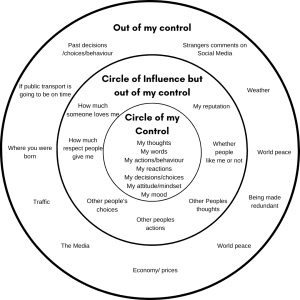
You can’t control other people’s centre circle. You can’t control people’s thoughts, words, behaviours, etc.
But you can influence. You can be with them.
We can bring what’s within our control, our thoughts, words, behaviours, etc as an influence to the other.
We do it with grace and tenderness. Like you are walking on holy ground, because you are.
Even if Jesus had said nothing at all, his very presence would have tenderly said, ‘I am with you’ to the naked soul.
Fear isolates.
Faith connects.
Faith to see something beyond the current dirt we find ourselves in.
Quotes to consider
When you throw dirt, you’re doing nothing but losing ground. Zig Ziglar
In the moments of insecurity and crisis, “shoulds” and “oughts” don’t really help; they just increase the shame, guilt, pressure, and likelihood of backsliding. It’s the deep “yeses” that carry you through. Focusing on something you absolutely believe in, that you’re committed to, will help you wait it out. Richard Rohr When Things Fall Apart
Shame is the raincoat over the soul repelling the living water of Jesus that would otherwise establish us as the beloved of God. Andrew Comiskey
I think that is God’s plan – to meet me where I am, in all my ugliness, not where I pretend to be or wish I were; to meet me in my weakness and shame and fear and to give me hope that God loves me, that He can change me, and that He can use me. Dr. Larry Crabb, Real Church
In order to be healed we must come out of isolation and hiding. This means finding a person, or ideally a group of significant others, whom we are willing to trust. This is tough for shame-based people. John Bradshaw, Healing the Shame that Binds You
Read further
Little by Little: How Small Steps Can Topple Your Biggest Giants
Barry Pearman
Contact me