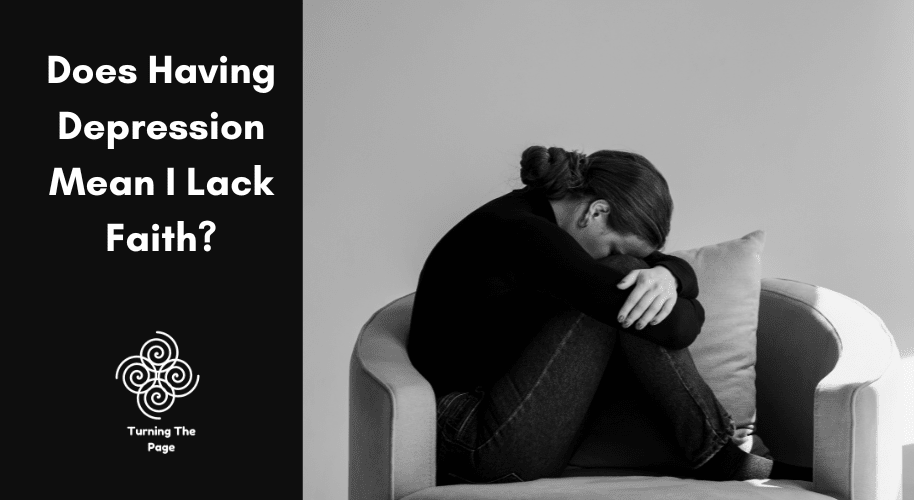
Is depression caused by a lack of faith? Find hope through grace and self-compassion, leaving toxic church shame behind.
Where are you, God?
I thought that if I prayed more, read my Bible more, attended church more, gave more money, then I would feel better.
I look at everyone else, and they seem genuinely happy. They don’t have the problems I have.
I open myself up to some of them and tell them just how depressed I am, and they seem to skip past my pain and just tell me to do all these things. To try harder.
Some tell me there must be sin in my life. That I haven’t forgiven, and that this is causing me to be depressed.
Ive even been told that I have to ‘obey my way out of depression’
I must lack faith.
I must be living in ‘disobedience’.
I’m sure that if they only knew some of the suicidal thoughts that went through my head, they would scold me. ‘
‘You shouldn’t be thinking like that!’ they would say.
Ive heard them say that to others, so I think I will hide that little bit more.
God, meet me in my depression.
This struggle is why I compiled a core resource collection,
Finding Hope in the Dark: A Faith-Based Approach to Depression
Have you ever been there?
Have you ever questioned whether your depression is because of a lack of faith?
The Toxic Myth of ‘I Must Lack Faith’
It seems a reasonable conclusion.
Because when you look at others, they all seem to have their lives together. On the outside, life looks good. Others are happy and successful (whatever that means to you).
But I would suggest that humanity is very good at masking the internal world of struggle. Put under enough pressure and stress, the mask cracks, the walls fall down, and our true human fragility is shown.
Added to this, I have found that many of our church services can create a disconnect with real world reality.
A hyped up worship experience, prosperity teaching, and ‘try harder’ sermons on Sunday fall flat in the middle of the night when the waves of depression and anxiety crash on the brain.
‘I must lack faith’ is a common response.
Or ‘God must be angry with me and so is punishing me’ is another.
The answer is not in self-condemnation or trying harder.
The answer is in self-compassion, understanding the self, and changing millimetre by millimetre.
At least that is what I have found, and thousands of others would agree.
Meet me in the cave
The Bible is a book full of stories of real people, just like you, living real lives and taking millimetre steps of hope.
We find a lady called Naomi bitter in grief.
A man broken in loss called Job, sitting in the town rubbish dump, throwing dust over himself, and questioning his existence.
The great prophet Elijah, after doing incredible miracles, ran exhausted to a cave and asked God to take his life.
O Lord, take away my life. 1 Kings 19:4
Real people have real experiences, that need real love and real grace. They don’t need condemnation, shame, and told to try harder.
Healing comes in the knowledge of what the real world struggles we have are and growing millimetre by millimetre in wisdom in how to face them.
Had I been in the cave
I think that if I had been in the cave when suicidal and depressed Elijah stumbled in, the soultalk conversation would have attended to these needs.
1. Physical Wellbeing
I would ask about his sleep, his diet, and when he had last had a drink of water and how much. In fact that was the very first thing God for Elijah.
2. Identifying Stressors
We would then list his recent stressors, naming them one by one. I would explain the Stress-Vulnerability Model and how any human body will crack if you put it under enough pressure.
3. Biological Factors
We would look at family history. Depression often has genetic links that have nothing to do with ones faith.
4. Creating a ‘Millimetre Plan’
Recovery from depression or any mental illness doesn’t come solely from wishing and praying. It comes from applying wisdom and doing the practical work, step-by-step. A holistic recovery plan might involve:
-
Seeing a doctor for a general checkup, blood tests, or medication.
-
Problem-solving manageable stressors.
-
Creating a thinking compass to read everyday
-
Building a nest of supportive relationships that can help recovery
Recovery from depression or any other mental illness does not come from wishing, hoping, and praying, but from wisdom, understanding, and doing the work millimetre by millimetre.
So where does faith come into it?
I think we have got tripped up in our thinking by considering that ‘faith’ is purely about what we believe, have confidence in, trust in. It’s measured in terms of ‘getting our beliefs right’ and then trusting in willpower to make it happen.
I remember years ago that a pastor said in front of the church I attended that I lacked faith.
It deeply wounded me. It was spiritual abuse, and I soon left that toxic church.
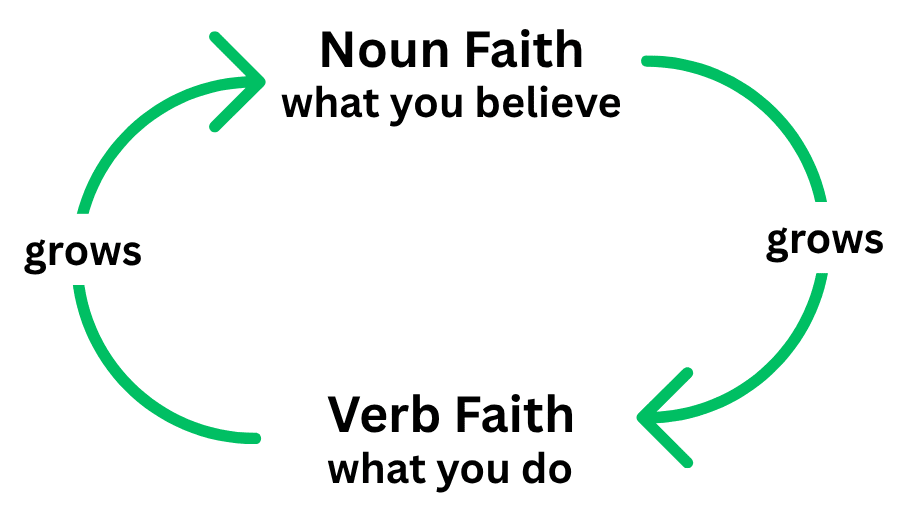
I believe that faith is both a noun and a verb.
Faith as a noun is a trust or confidence in someone or something. It is what you believe.
Faith as a verb is an action, an occurrence, a state of being. It is what you are doing.
The story I believe where we so often get this idea of a ‘lack of faith’ is from where Jesus said the words ‘Your faith has made you well.’
There are two Jesus’ stories where he says these words.
Your Faith has made you well
And a great crowd followed him and thronged about him. And there was a woman who had had a discharge of blood for twelve years, and who had suffered much under many physicians, and had spent all that she had, and was no better but rather grew worse.
She had heard the reports about Jesus and came up behind him in the crowd and touched his garment.
For she said, “If I touch even his garments, I will be made well.”
And immediately the flow of blood dried up, and she felt in her body that she was healed of her disease.
And Jesus, perceiving in himself that power had gone out from him, immediately turned about in the crowd and said, “Who touched my garments?”
And his disciples said to him, “You see the crowd pressing around you, and yet you say, ‘Who touched me?’” And he looked around to see who had done it.
But the woman, knowing what had happened to her, came in fear and trembling and fell down before him and told him the whole truth.
And he said to her, “Daughter, your faith has made you well; go in peace, and be healed of your disease.” Mark 5:24-34
As he was leaving Jericho with his disciples and a great crowd, Bartimaeus, a blind beggar, the son of Timaeus, was sitting by the roadside.
And when he heard that it was Jesus of Nazareth, he began to cry out and say, “Jesus, Son of David, have mercy on me!”And many rebuked him, telling him to be silent.
But he cried out all the more, “Son of David, have mercy on me!”And Jesus stopped and said, “Call him.”
And they called the blind man, saying to him, “Take heart. Get up; he is calling you.”
And throwing off his cloak, he sprang up and came to Jesus.
And Jesus said to him, “What do you want me to do for you?” And the blind man said to him, “Rabbi, let me recover my sight.”
And Jesus said to him, “Go your way; your faith has made you well.” And immediately he recovered his sight and followed him on the way. Mark 10:46-52
I believe that both the woman and the man had some noun faith. Maybe it was only the size of a mustard seed. But then they turned that noun faith into verb faith and took action.
The woman pushed and struggled through both the stigma and the crowd to touch Jesus.
Blind Bart cried out, sprang up, came to Jesus and asked to healed.
I believe that noun faith grows our verb faith, and verb faith grows our noun faith, and this cycles around and around.
We have a mustard sized piece of noun faith, and this grows into verb faith, and this grows our noun faith.
And it all grows by sowing millimetre mustard seeds.
He put another parable before them, saying, “The kingdom of heaven is like a grain of mustard seed that a man took and sowed in his field.
It is the smallest of all seeds, but when it has grown it is larger than all the garden plants and becomes a tree, so that the birds of the air come and make nests in its branches.” Matthew 13:31-32
What does Faith look like in Depression
Faith as a verb, as a course of action, may look like this.
- Making an appointment with your doctor
- Brushing your teeth. (Finding achievement in little things)
- Reading a chapter of ‘Out of the darkness’ – Free ebook that I would like to give you.
- Watching a video in the course ‘Dig yourself out of the hole’ (free course I would like to share with you)
- Reading some other posts. Read posts about depression here.
Little acts of verb faith add up and will help you leave the dark hole.
Quotes to consider
If it’s a noun, then our faith is primarily about what we should believe. Creeds, catechisms, statements and formulations of faith, and so on.
Faith understood primarily as a noun stresses the cognitive dimension of our faith. And while this is important, it can easily devolve into concerns not simply about what we believe, but about believing the “right” things and, if truth be told, about whether our neighbors (especially those with whom we disagree) are believing the right things.
More than that, over-stressing the cognitive dimensions of faith – faith as a noun – can lead to a rather static faith, one focused on getting your theology in order rather than actually doing anything.
Faith understood as a verb is about our daily activities and practices and stresses acting on our faith rather than just thinking about it.
This kind of faith, in other words, invites us to get out of our theological armchairs and get into the game – the game of life, of loving neighbor, of trying to do the best you can in any given situation and then hurrying back to church on Sunday for confession, absolution, encouragement, and sending. David Lose
To me, Faith is not just a noun but also a verb. Jimmy Carter
Just as love is a verb, so is faith. Nannie Helen Burroughs
Faith is not a noun; it’s a verb – an action verb. The greatest and truest statement of faith is a life well lived. Mark Batterson
Faith is better understood as a verb than as a noun, as a process than as a possession. Faith is not being sure where you’re going, but going anyway. Frederick Buechner
Further reading
Barry Pearman