I think it was one of the hardest times of my life.
It was a loss.
Like something had been sucked out of my heart. Something that could not be replaced by anything known to man.
It was the loss of a still to be born child.
I still remember the deep groans of my father.
The memory whispers of that moment remain. Re-energised a few years ago when I visited the little grave where we lay our child’s shoe box sized coffin.
But grief not only clings to moments of death but also to losses related to health, relationships, finances, etc.
I heard Rob Bell say this recently.
Grief is the passing through you of what was. It’s a full body affair. Rob Bell
I have rolled that brief sentence around in my head for sometime now.
I suppose it’s about time.
A time to cry;
A time to laugh;
A time to grieve;
A time to dance; Ecclesiastes 3:4
Grief is the passing through
I imagine the digestive system of my body.
A loss passing through the stomach, intestines, bowels, etc.
The passing through of a connection, a moment, a hope, a dream.
It’s the hope of …
- a child
- a relationship
- a financial security
- a dream
- a safe home to live in
- a physical wellness
- an opportunity
There will always be loss, and it will feel raw at times.
This ‘passing through’ has to take its natural and normal path.
Sorry about the imagery, but if it passes through quickly with laxatives, then it isn’t processed well.
Masking up with ‘I’m fine’ and displaying ‘happy faces’ can extend the loss. Creating hidden and locked off places of ungrieved grief.
Whereas if you hold it all in and be constipated with the loss, then this too is not healthy. It shapes yourself.
There is a natural flow to this passing through.
There are stages to this grief process.
Not linear, but more jumbled and random.
A moving from one dance stage to another and then another and then back again. You wonder when it will stop.
It’s messy and random, and it helps if you do it with others.
The Dance floor stages of grief
I think of music festivals and the multiple stages they have where people can listen to various types of music.
Perhaps in the grief journey, we have the stages that Elisabeth Kübler-Ross gave us.
- Denial
- Anger
- Bargaining
- Depression
- Acceptance
Stages, not to perform on, but that we find ourselves on and wonder how we got here.
Stages that are there not for us to put on a show, but maybe a place that invites us to be.
Maybe a stage where a few safe friends come and give witness to our place. They Shiva with us in our mess.
The Metaphor of the Locked Garden
I once cared for a large garden.
In part of it there was a wall, and on the other side of the wall there were roses. The perfume of the roses would waft up and over the wall, and you knew that just on the other side of the wall there was a party going on. A party of creation.
Because I was the gardener, I had a key to enter through the locked gate. I was able to enter and enjoy. To care for and love those roses and their beauty.

That was a few years ago, and I no longer care for that garden. I no longer have an association or connection with it.
I drive past that property most weeks and wonder how the garden is going.
In fact, I drove past it yesterday and noticed that an area I had planted with beautiful flowers was now full of weeds.
It’s grief. There is a passing through me of the experiences that I once had and now can no longer have.
We look back at a garden and long for its life.
A Biblical Perspective on Grief: The Archetype of Eden
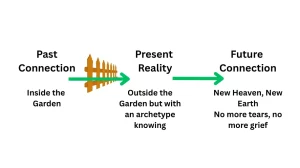
My grief, I believe, connects to another loss of garden delight.
The Lord God sent him forth from the garden of Eden, to till the ground from which he was taken.
He drove out the man; and at the east of the garden of Eden he placed the cherubim, and a sword flaming and turning to guard the way to the tree of life. Genesis 3:23, 24
I think of Eve and Adam leaving the garden. But then still smelling the wafts of delight spilling over to meet them.
They remember back, and this connection has to pass through.
They recall the decisions and choices, and this has to pass through as well.
They have an archetype lodged within their consciousness.
What is an archetype?
An archetype is something that is woven into the consciousness of every human being.
archetype, (from Greek archetypos, “original pattern”), in literary criticism, a primordial image, character, or pattern of circumstances that recurs throughout literature and thought consistently enough to be considered a universal concept or situation. Britannica
I believe we have an archetype of Eden perfection. It’s been woven into us.
We see a beautiful sunrise, smell a rose, see a couple in love, taste the delight of freshly picked fruit, and something deep within us remembers.
It is still there.
- A longing for relational connection.
- A desire to be known, loved, and held.
- A need for a place to be fully seen and not experience anything but wonder and delight.
It’s still there. Deep within our DNA.
But now, like Adam and Eve, we are on the other side of the wall.
Finding Hope in the Slow Dance of Lament
We have wafts of this delight.
We want more; in fact, we can at times demand more. We feel an entitlement to more.
‘This isn’t how it’s meant to be,’ and so we get angry and then depressed because it’s all a mess.
The child leaves the parent and goes on a prodigal journey.
The parent is full of grief; the loss has to pass through, but still the parent waits in hope for the return.
So it passes through
We notice the losses
We see vacant seats at the dinner table for Christmas.
It passes through.
Stages of anger, denial, depression, bargaining, and acceptance are lament danced upon.
We find God comes and dances with us no matter what stage we find ourselves on.
- Psalm 34:18: The Lord is near to the broken-hearted, and saves the crushed in spirit.
- Psalm 147:3: He heals the broken-hearted, and binds up their wounds.
- Lamentations 3:24: ‘The Lord is my portion,’ says my soul, ‘therefore I will hope in him.’
- Matthew 5:4: ‘Blessed are those who mourn, for they will be comforted.’
And so this is grief.
It’s a dance, a slow dance on various stages for however long the music needs to play.
A passing through you of what was.
A connection between what is deepest in our humanity (perfect love) and the fragility of what is the now.
We slow dance our way through, and we offer something of what we know of Eden’s delight to the broken.
Quotes to consider
- The journey to God will always, at some point, take us through darkness where life makes no sense. Life isn’t easy; it’s hard, sometimes very hard. Larry Crabb Shattered Dreams
- Those who do not turn to face their pain are prone to impose it. Terrence Real, I Don’t Want To Talk About It
- If we find ourselves with a desire that nothing in this world can satisfy,
the most probable explanation is that we were made for another world.- Trace any heartbreak back and back, and you will find love is the genesis of every grief. It has always been this way. Love and loss are all part of the same circle, forever sisters in kindred circumference. Stephanie Duncan Smith
- Grief, I’ve learned, is really just love. It’s all the love you want to give, but cannot. All that unspent love gathers up in the corners of your eyes, the lump in your throat, and in that hollow part of your chest. Grief is just love with no place to go. Jamie Anderson
- Grief is a cruel kind of education. You learn how ungentle mourning can be, how full of anger. You learn how glib condolences can feel. You learn how much grief is about language, the failure of language and the grasping for language. Notes on Grief
- Mourning is indeed a brutal form of emptiness. But in this emptiness, if we can remain open, we discover that a mysterious “something” does indeed reach back to comfort us; the tendrils of our grief trailing out into the unknown become intertwined in a greater love that holds all things together. To mourn is to touch directly the substance of divine compassion. And just as ice must melt before it can begin to flow, we, too, must become liquid before we can flow into the larger mind. Tears have been a classic spiritual way of doing this. Cynthia Bourgeault
Further reading
-
If you are feeling overwhelmed by trials, discover what Jesus meant when he said, “You will have trouble.”
-
Learn how to support a grieving friend by Sitting Shiva with them in their mess.
-
Understand why, to reap in joy, you must first be willing to sow in tears.
-
Find out how God is picking up the broken pieces of your life to create a mosaic.
- You Will Have Trouble
Barry Pearman