
The first time I heard the Polish proverb “Not my circus, not my monkeys,” I felt quite shocked. But digging deeper, I understood what they were saying.
I heard it said by a husband about his wife. It felt callous. It felt cold, and I still think it was. He did not want to engage with the struggles she was facing.
To say “Not my circus, not my monkeys” is to declare that you don’t want to be dragged into the drama of another person’s issues—that you’re not getting involved.
I get the boldness of the statement, and the need at times to be quite cold and confrontational. Some people seem to want to pass on the drama of their own life to others.
They throw little manipulation munitions and word grenades over your boundary lines, including:
- “I thought you were a Christian…”
- “Didn’t Jesus say…?”
- Sentences loaded with heavy “oughts” and “shoulds.”
- Classic “Poor Little Old Me” (P.L.O.M.) routines.
Over the years, I have known people who seem to have grown into professional circus owners and monkey minders. Have you had people want you to take control and responsibility for their monkeys?
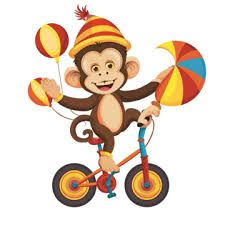
Or maybe you see a need, the circus, and the monkeys. You want to help, so you adopt them and make them your own. But in the end, if the person doesn’t want to change and face the chaos, all you are left with is exhaustion and a pile of monkey poop.
Not My Circus, Not My Monkeys: A Biblical Perspective
Did Jesus ever say anything like this? Not directly. But Jesus told a parable about a young man who had a circus, had monkeys as such, and had a loving parent who let him have his trip.
It’s the story of the prodigal son and the loving father.
The son had a dream of running away with the circus. Monkey thoughts of hedonistic pleasure filled his life. The father gave the son his inheritance and watched him and his circus monkeys wander away.
He still loved his son and longed for his return, but he knew that the son had to tame his own circus lusts and desires. The son did eventually return, and the father welcomed him home.
The story has many lessons for us, but the allowance of free will and its consequences is a major lesson. I know for many of us, including myself, there is a strong desire to rescue and help. However, the pattern will continue until the person decides that the monkeys in their circus are their own responsibility.
How to Help Someone Else’s Circus and Monkeys
1. Stand Back and Observe
Stand back from the situation and take a long, considered look. See the circus; see the monkeys. What is really going on? Ask lots of gently curious questions. Practice No F.A.S.S. — No Fixing, Advising, Saving, or Setting Straight.
2. Express Empathy
Help them know that you understand what is going on for them. Let them know they are not alone in their struggle.
3. Draw the Boundary Line
Express your line clearly: This is what I can do; this is what I cannot do. For example: “I can’t give you any money, but I can take you to a budgeting service.”
4. Empower Self-Responsibility
Empower the ownership of the problem back into their hands. Typically, I do this through the use of a problem-solving sheet and then building a S.T.A.N. plan.
Learning Your Boundary Lines
It’s about boundaries. It’s about lines. Lines to establish, and lines to rehearse and say over and over again to yourself.
If you’re a rescuer or trapped in people-pleasing, you need to learn some internal scripts. Here are a few to remember:
- Not my circus, not my monkeys. I have my own circus to enjoy.
- Not my circus, not my monkeys, but I can offer them a net to catch the monkeys.
- How will they ever learn if I keep rescuing them?
- Am I enabling this to happen in some way?
- Everyone has a nest, and I am but one strand.
- I will do what I can do, they will do what they can do, God will do what God will do. I am not God.
The Poem: Not My Circus
It’s not my circus
They’re not my monkeys
They’re not my clowns
Dancing around inside
I’m not your circus ringmaster
I’m not going to take control
That’s for you to step up and do
But I will stay by you
I will offer you some help
If you want to make a change
I’m not the rescuing kind
It may feel kind of strange
I’m not here to take control
That’s your life in your hands
Your body, mind and soul
Isn’t it time to make some plans
If you want my help
I will problem solve with you
I will do what I can do
But mostly it’s up to you
How will you learn
How will you grow
If you haven’t learned
To take control of the show
Dancing clowns
Prancing ponies
I really don’t want to see
Some lame circus phony
It’s not my circus
They’re not my monkeys
Doesn’t mean
I care any less for you
Don’t pout
Don’t cry those tears
Don’t try and manipulate my heart
I really do care
I’m here to help
To do what I alone can do
For you to be all that can you be
You must take responsibility for you
Together we will see
Those monkeys back in control
Together we will find
A new incredible you
Quotes to Consider
- “It is usually most helpful to ask questions that are more about the person than about the problem.” — Parker J. Palmer
- “If you choose not to deal with an issue, then you give up your right of control over the issue, and it will select the path of least resistance.” — Susan Del Gatto
- “We always hope for the easy fix: the one simple change that will erase a stroke problem. But few things in life work this way. Instead, success requires making a hundred small steps go right – one after the other, no slip-ups, no goofs, and everyone pitching in.” — Atul Gawande
- “If I am not for myself, who will be for me? But if I am only for myself, who am I? If not now, when?” — Hillel
- “Every ‘rescuer’ needs to know that sometimes people will need to feel worse before they can feel better.” — D. Riddell
- “Only those willing to stand close enough to listen will ever hear those closest to the problem.” — Jim Wallis
- “Compassion for yourself is where you start when things are tough, not where you stop.” — Rick Hanson
Questions to Answer
1. What is your first response to the proverb “Not my circus, not my monkeys”? Why do you think you have that response?
2. What experiences have you had where you felt others wanted you to take control of their circus?
3. What is the downside of rescuing and people-pleasing? What is the upside?
Formation Exercise
- Journal about your own circus, monkeys, clowns, and trapeze artists. Where does more order need to be brought so that your circus is healthy and enjoyable?
Further Reading
- Are You Trying to Control the Uncontrollable?
- Am I My Brother’s Keeper? Guilt Trip Alert
- Understanding the P.L.O.M. (Poor Little Old Me) Mindset
Barry Pearman
Photo by Becky Phan on Unsplash