
We face struggles, so we try to control the uncontrollable — but this only brings more stress. It’s better to stay in the zone of what we can actually control: ourselves.
Quick answer: When we try to control people, outcomes, or circumstances outside our power, our stress and anxiety rise. Psychologist Stephen Covey’s Circles of Control model separates life into what we can control (our own responses), what we can influence (but not control), and what is genuinely outside our control. Focusing attention on the inner circle — our own response — is what reduces stress and builds resilience.
Table of Contents
- Are You at the Mercy of Other People’s Judgment?
- Who or What Are You Trying to Control?
- Could Jesus Have Controlled the Uncontrollable?
- What Are the Circles of Control, Influence, and the Uncontrollable?
- What Is the One Thing You Can Actually Control?
- Quotes on Letting Go of Control
- Reflection Questions
- FAQ: Trying to Control the Uncontrollable
Are You at the Mercy of Other People’s Judgment?
It was out of my control. The decision on how they would treat me was beyond my control.
Have you ever been in that situation? You are at the mercy of other people’s judgment of you.
We see it all the time in the legal system. The defendant awaits the decision of the judge. Everyone in the courtroom has an opinion, but none of those opinions matter because the judge sitting in their seat of power has the final say. Guilty or innocent.
But we are all judges to some degree. We all make judgments about various people. We are presented with evidence, and we weigh it against our own experience and values. We pronounce a verdict.
It’s a verdict we hold on to until we’re presented with more evidence. Then we have to retry the defendant, and because we’ve already made a judgment, changing our opinion means acknowledging we had gotten it wrong.
“Know me before you judge me” is a line from a Mental Health promotion here in New Zealand many years ago — but how many of us are genuinely willing to get in the ditch of another life and know the story that shaped the soul?
Who or What Are You Trying to Control?
I want to control certain situations and some people, because I think I know best. In my human pride, I believe I know how things should work out — so I manipulate, deceive, and lie to try to get the outcome I want.
We all do it. We want to control the other person or the situation so it goes well for us. We have this “turned/curved inward on oneself” bias. In Latin, it’s called Incurvatus in se. It’s like a gravitational pull affecting everything I do.
I want people to like me, so I present a certain reality I think people will find attractive. I want to control the narrative of what they think about me. It’s foolishness, because you can’t control another person’s opinion.
You can influence it — and politicians and pop stars know exactly which techniques to use — but in the end, people will think what they think: love, hate, or indifference.
So much stress is generated when we try to control the story out of ulterior motives that aren’t self-sacrificial for the pure benefit of others.
Some people, often without knowing it, want to treat others like hand puppets — the hand goes up inside and manipulates the person to do whatever the puppeteer wants. Or it’s the “strings attached” version, pulling you this way and that through overt or covert manipulation.
Claim, stated plainly: we want to be in control because we want a safe world that complies with our needs, on our terms. That includes wanting to control God, because we have needs that aren’t being met in our own time and way.
Could Jesus Have Controlled the Uncontrollable?
With all that divine superpower, Jesus could have controlled the uncontrollable — us. He could have snapped his fingers and made his followers do exactly what he wanted. But he wasn’t a dictator.
Instead of demanding mindless loyalty, he said to some fishermen, “Come, follow me.”
When on the cross, he let the crucifiers have their way. He even prayed to forgive them: “Father, forgive them, for they don’t know what they are doing.”
There was a bigger story going on that nobody could understand — we still struggle with it today. Christ’s security was found in something greater than the opinions and judgments of others.
What Are the Circles of Control, Influence, and the Uncontrollable?
Let’s think about what we can control, what we can influence, and what is completely out of our control. This is based on Stephen Covey’s Circles of Influence model.
The Three Circles
- The Inner Circle: What we can control.
- The Middle Circle: What we can influence but cannot completely control.
- The Outer Circle: What is completely out of our control.
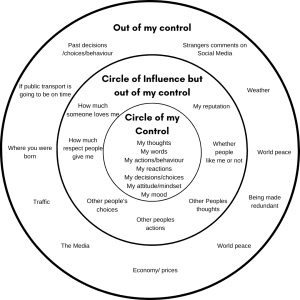
See Claire Newton’s guide to the Circles of Control model for a further breakdown.
The question to answer is: how much focus time do you spend in each circle? Where you focus is where you will go.
What I focus on gets me.
- Focus on the negatives and challenges will always take me down.
- Focus on the positive and good things will always give me hope.
Anxious and Depressed Thinking Both Live in the Outer Circle
Anxious and depressed people tend to spend a lot of time dwelling and ruminating in the circle of what they can’t control.
- The depressed ruminate on the past with Mr. Could Have and Mrs. Should Have.
- The anxious fret with Mr. Might Happen and Mrs. What If.
Often we pendulum swing between the two. Centredness brings us to a place of what is within our control and what we can influence — a place of mindful awareness of the now.
Jesus teaches us to focus on what is within our control and to use it in a healthy way for where we can influence. Very rarely did he step into the zone of the humanly uncontrollable.
We’d like to have miracle power to change what’s beyond our control, and we pray for it — but healthy, mindful people stay in the inner circle and leave the miracles up to God.
What Is the One Thing You Can Actually Control?
It’s raining outside as I write these words. I have work to do outdoors and wanted it to be fine, but I have no control over the weather. I want to find the weather tap and turn it on and off according to my desires — I even pray for this at times. Then when it’s hot and dry, I pray for rainy days like this one.
I can’t control the weather, but I can control my response to it. Will I dance in the rain or drown in it? Will I wear a coat and think of the water filling the vast reservoirs below my feet, or will I soak in grumpiness at getting wet?
The World Is More Curved Than Straight
I sit within a room of straight lines — the doors, windows, and desk are all neat and straight. I find order according to a kind of safety and familiarity. I know where everything is, and I am secure. But I step into nature, and it’s round, curved, and irregular. There’s a kind of disordered beauty.
This world, and especially other people, are more curved than straightforward. If I’m honest, I am more curved and jelly-wobbly in my own life than straightforward, exact, and in control.
Others want to control me — to put me in a box of categories so they feel safe and secure, to march me under precise parade-ground orders. But I want to dance a combination of Disco, Waltz, and some Morris dancing for good measure.
Claim, stated plainly: the only thing you are actually in control of is your response to other people and the world around you.
Even then, our bodies are fragile. Under stress, the brain can become so unwell that its cognitive functions lose connection to reality — ask anyone who has experienced psychosis about the loss of control, and you’ll realize there’s a fragility to our lives that should sober us into humble prayer.
How much stress do you carry from trying to control others? How much stress do you carry from others trying to control you? Take responsibility for what is within your control, and the stress load begins to fall off.
Quotes on Letting Go of Control
“God grant me the serenity to accept the things I cannot change, courage to change the things I can, and wisdom to know the difference.” — Serenity Prayer
“When we are no longer able to change a situation, we are challenged to change ourselves.” — Viktor Frankl
“Everything can be taken from a man but one thing: the last of human freedoms — to choose one’s attitude in any given set of circumstances, to choose one’s own way.” — Viktor Frankl
“Make the best use of what is in your power, and take the rest as it happens. Some things are up to us, and some things are not up to us.” — Epictetus
“At the head of all understanding is realizing what is and what cannot be, and consoling what is not in our power to change.” — Solomon ibn Gabirol
“Blessed is he who has learned to bear what he cannot change, and to give up with dignity what he cannot save.” — Friedrich von Schiller
“Stay in your own territory. Do all that you can do, but leave the miracles to God.” — David Riddell
“Don’t try to change others, work on yourself instead. Your response to others is always your responsibility, and the right response ensures respect all around.” — David Riddell
Reflection Questions
- Which circle do you tend to spend the most time in?
- We want miracles — the uncontrollable to be brought under our control — but how much stress does chasing that induce in our bodies?
- Who do you spend the most time with: Mr. Could Have and Mrs. Should Have, or Mr. Might Happen and Mrs. What If?
FAQ: Trying to Control the Uncontrollable
What does it mean to “try to control the uncontrollable”?
It means spending mental and emotional energy trying to manage people, outcomes, or circumstances that are genuinely outside your power — such as other people’s opinions, decisions, or reactions. This drains energy and increases stress because the effort rarely changes the outcome.
Why does trying to control other people increase anxiety?
Trying to control others keeps your attention fixed on things you can’t actually manage, which the mind experiences as ongoing threat. Anxious thinking often shows up as “what if” rumination about future events you can’t control, while depressive thinking often shows up as “should have” rumination about a past you can’t change.
What is Stephen Covey’s Circle of Influence?
It’s a model that divides your attention into three zones: an inner circle of what you can control (mainly your own choices and responses), a middle circle of what you can influence but not control, and an outer circle of what is entirely outside your control. The model suggests focusing your energy on the inner circle to reduce stress and increase effectiveness.
How can I stop trying to control other people?
Start by naming what’s actually within your control — your own words, actions, and responses — and separating that from what belongs to the other person. Practically, this looks like expressing your needs honestly, setting boundaries, and then releasing the outcome rather than manipulating or pressuring someone toward the result you want.
What did Jesus model about control?
Even with the power to compel obedience, Jesus consistently chose invitation over control — inviting people to follow rather than demanding it, and surrendering his own outcome (“Father, forgive them”) even while being wrongly judged.
Further reading
- The Swing and the Now: How to Ground Your Thoughts — Stop the wild swing between past regrets and future fears. Learn how to ground your thoughts in the “Now” by binding truth to your heart.
- Have You Been Put In A Box? — Break free from the boxes others build for you. Discover how God enters your confinement to explode the walls of judgment from the inside out
- What’s on the Throne? What is Keeping you Anxious? — Who is on the throne of your life? Explore how serving the “charms” of status and opinion triggers anxiety and how to find peace in Christ.
- Learning to Detach Helps with Anxiety — Anxiety can make you want to control, but learning to detach can bring peace. Perhaps you care too much and its time to let go.
- The Gentle Art of Letting Go — Explore the “gentle art of letting go” through biblical wisdom, nature’s metaphors, and practical steps to find healing and transformation.
- It’s Time For You to ‘Give it a Rest’ — The most loving thing you could do for others, and yourself, is to let them go. To shut the gate on the work you have been doing and give it a rest.
Barry Pearman
Photo by Sivani B on Unsplash

Barry is a writer, coach, and course creator who has a passion for empowering Mental Health through Faith, Hope, and Love.