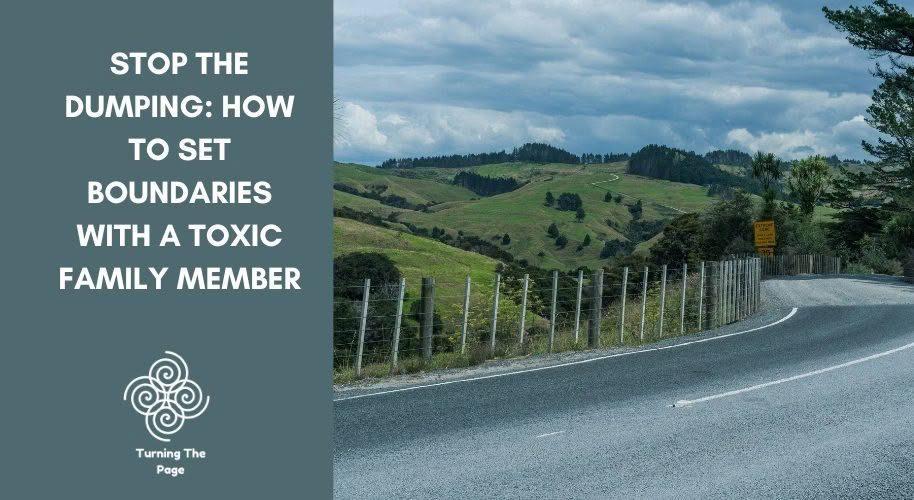
On the farm I grew up on, a road ran along the boundary. Part of the roadside had slipped away, but the fence still stood, and everyone could see where the road ended and our property began.
One day my father came home and told us someone had dumped rubbish over the fence onto our land: tin cans, paper, and invoice statements with a name printed on them. It was one of our neighbours. They’d driven along the road and emptied their trash onto our farm.
I can’t remember exactly what happened next, but I think my father went and saw them and told them to clean it up, perhaps mentioning he’d report it to the council if they didn’t. They cleaned it up.
My father valued that land: its soil, its grass, the stream that ran through the fields. Toxic waste dumped on it was abhorrent to him. It didn’t belong there, and he wasn’t going to pretend it did.
This post is about how to set boundaries with a toxic family member, and why it starts with seeing your own worth.
In this post
Were You the Family Scapegoat?
Have you ever been a dumping ground? The scapegoat, the whipping boy, the one blamed whenever anything went wrong?
The Sweet Church Lady Who Drove a Rubbish Truck
I know a woman who was sugar and sweet to her church friends, but at home she was something else entirely. She demeaned her children, bullied her husband, and controlled everyone with put-downs, Bible verses, and fear. Those who tried to stand up to her were beaten back with threats, guilt trips, and twisted logic.
If I could give her a job, it would be rubbish truck driver. She had collected rubbish, generations of it stored up in her soul, and whenever a suitable dumping site appeared, she unloaded. When her children were old enough, they ran. But they’d already been stained by what was dumped on them.
Many of us know what it’s like to be the dumping site. If this is your story, you may also find six suggestions for living with a narcissist helpful.
Why Do We Keep Accepting Toxic Behaviour?
Here’s how the rubbish becomes part of us.
How the Scapegoat Role Becomes Your Identity
If it happens young enough and often enough, you stop seeing it as rubbish and start seeing it as truth. Family therapists describe this as the “scapegoat” role: one person in a family becomes the designated carrier of everyone else’s problems. It’s a role, not an identity, but it often follows people well into adulthood. I’ve written more about how to stop being the family scapegoat, and about how generational trauma gets passed down through the words spoken over us.
When Church Teaching Keeps You Taking the Abuse
Add toxic church teaching that says you must always “turn the other cheek” and “go the extra mile,” and you can end up believing you’re supposed to keep taking the abuse. It was never meant that way. Read what “turn the other cheek” really means for people facing abuse.
Learned Helplessness: Why We Stop Fighting Back
Why don’t we just stop it? Psychologist Martin Seligman found that when people and animals repeatedly face something painful they can’t escape, many stop trying, even after escape becomes possible. He called it learned helplessness. We get used to it. It becomes “just who we are.”
But it isn’t who we are, and that’s exactly why it wears us down. Carrying something that doesn’t belong to us leads to exhaustion, unwellness, burnout, and compassion fatigue.
Worth Comes Before Boundaries
So where does change begin? Not with fixing the other person. You can’t control their behaviour, only your own response. Change begins with seeing your worth, because we don’t protect what we don’t value. My father didn’t challenge the neighbour because he enjoyed conflict (far from it). He challenged the neighbour because the land mattered to him.
Worth comes before boundaries.
How to Stand Up to a Verbally Abusive Family Member
So what do you do? Start with what’s within your control.
Mental Illness Is Not an Excuse for Abuse
I’ve recently been walking alongside someone whose relative, living with a severe mental illness, is harsh and nasty towards her. I told her what I’ve learned over the years: mental illness might explain behaviour, but it doesn’t excuse it.
When I’ve challenged people with a mental illness about shouting or verbal and physical violence, it wasn’t easy, but it had to be done. They had no right to dump their rubbish on other people’s land. When that happens, the person causing harm is challenged to change, and the person being harmed is empowered to grow. I saw the same thing play out on my own street, and wrote about it in what to do when verbal abuse crosses a line.
What to Say: The B.G.E.S.C. Method
Together we’re crafting words to say, using an acronym from David Riddell: B.G.E.S.C.
- Brief. Keep it short. Don’t go on and on.
- Gentle. Don’t yell, and don’t whisper meekly. Look at them and speak calmly.
- Early. Respond as soon as you can, so anger doesn’t fester. As Paul writes, “Don’t go to bed angry” (Ephesians 4:26).
- Specific. Deal with this issue only, not past hurts.
- Consequences. Say how it affected you, and what you’ll do if it happens again.
For more on using B.G.E.S.C. in the moment, see how to respond when a bully shouts at you.
Write It Down
I would suggest you write it down for them. Ink on paper gives your words weight. Something like:
Start With Little Wins
A small win with one problem gives you strength for the next. When Israel entered the promised land, God didn’t clear everything at once:
There’s no magic wand, just millimetre steps of growing self-worth.
Find a Champion
Find someone who’ll stand beside you when your knees start trembling and you want to run. Someone who can see past the current mess to who you could be once the dumping stops.
What Happens When the Dumping Stops
Imagine what happens when the rubbish truck is turned away.
The land that was a dump becomes a garden full of flowers, fruit, and vegetables. And a garden doesn’t just feed its owner; it nourishes the whole neighbourhood. When you stop collecting other people’s rubbish, you have more to give others. The cycle that ran for generations can end with you.
My father’s fence was there because the land behind it was worth protecting. So is yours. Worth comes before boundaries.
Your worth is real, and your fence is there for a reason.
It’s time to stop the dumping.
Quotes to consider
- No one can make you feel inferior without your consent. — Eleanor Roosevelt
- The most important things are what God did before I was conceived, before I was born. He knew me, therefore I am no accident; he chose me, therefore I cannot be a zero; he gave me, therefore I must not be a consumer. — Eugene Peterson, Run with the Horses
- If I let someone abuse me verbally, I have done neither one of us a favor. — Anne Katherine
- An important decision I made was to resist playing the Blame Game. The day I realized that I am in charge of how I will approach problems in my life, that things will turn out better or worse because of me and nobody else, that was the day I knew I would be a happier and healthier person. And that was the day I knew I could truly build a life that matters. — Steve Goodier
- If I am not for myself who is for me? And being for my own self, what am ‘I’? And if not now, when? Hillel the Elder
- Other peoples’ reaction to you might be telling you more about themselves, than about you. Don’t take it so personally. D. Riddell
- Shame scripts are what we say to ourselves about ourselves when we experience shame, and they can become embedded. Common scripts include: I don’t matter, I’m not smart enough, I’m not attractive enough, I’m not worthy of attention/connection/love. Even though shame scripts hurt us and our relationships, sometimes they become entrenched in our interactions, and we behave in ways that perpetuate and reinforce disconnection. Steve Call – reconnect: insights and tools for cultivating meaningful connection in your marriage
Further reading
- How to Stop Being the Scapegoat. Six Keys — Stop being the dumping ground for others’ rubbish. Discover 6 transformative steps to reclaim your worth and silence the scapegoat’s voice.
- To ‘Turn the other cheek’ mean I have to keep taking abuse? — Stop being a doormat. Discover the true meaning of “turn the other cheek” as a radical act of equality, dignity, and inner spiritual strength.

- Stop The Bully. Stop The Shouting. — Recover from the words of a shouting bully. Discover your worth, conquer shame, and use the smart B.G.E.S.C. strategy to respond gently.
- She Crossed a Line — Verbal abuse can be as damaging as physical violence Learn how to define your boundaries and reclaim your identity after words cross a line
- Can you Live with a Narcissist? Six Suggestions — Trapped by a narcissist? Discover 6 strategies to protect your soul, set boundaries, and find a “flint-like focus” on your own spiritual path.

- The Sentences We Carry: How Generational Trauma Shapes Who We Are — Words spoken over us can become verdicts we live inside. Discover how generational trauma shapes our DNA — and how faith can write a new sentence.
About the author
Barry Pearman has spent almost 30 years as a mental health support worker, community chaplain, and pastor, and has walked through depression himself. His training includes SoulCare Foundations under Dr Larry Crabb, a Bachelor of Applied Theology, spiritual direction training, and certificates in CBT interventions, pastoral therapy, and integrated mental health care. Turning the Page offers a grace-filled path to mental wholeness through faith and hope.
Photo by Gaurav Kumar on Unsplash