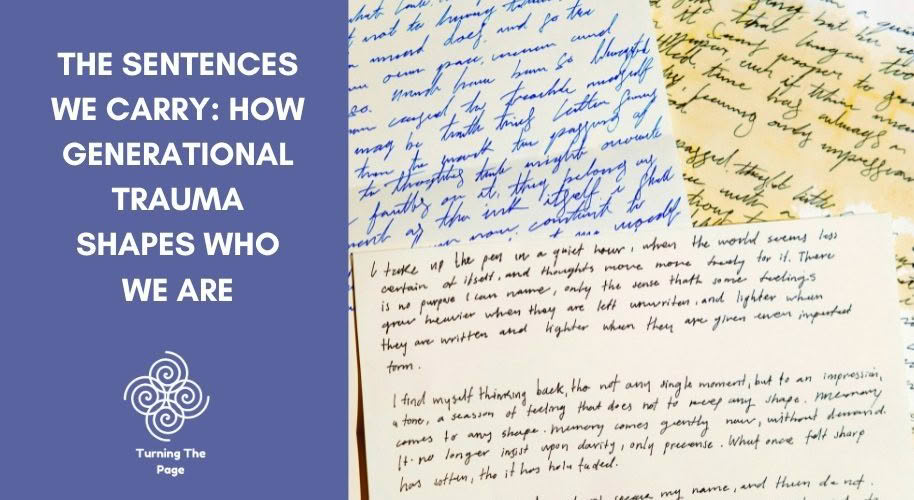
Words spoken can become sentences we carry. Verdicts we live inside. Discover how faith rewrites generational trauma.
Jump to:
- What Is a “Sentence”?
- Generational Trauma Isn’t Just Personal — It’s Cultural
- Where Faith Meets Generational Trauma
- How to Break the Cycle: Trace It, Face It, Replace It
- You Are Not a Puppet to Your Past
I was listening to an audiobook the other day, and the author kept using the word “grimaced.” It was sprinkled all the way through the novel. It actually got quite annoying after a while.
When you’re listening deeply to others, you begin to notice certain sentences repeated. Phrases, words, sentences, even non-verbal cues — they all point to something worth being gently curious about.
In my Soultalk conversations, I listen for sentences. Strings of words someone says that seem to link to stories and patterns.
A sentence of words can become a sentence of prison-cell confinement.
What Is a “Sentence”? (And Why We’re All Carrying One)
There are two ways to hear the word “sentence.” One is grammatical — the kind you just read. The other is judicial — the kind a judge hands down after a verdict.
I’ve been sitting with both meanings lately because I think all of us carry sentences of both kinds. Words spoken become verdicts we live inside. Words we speak about others become frames we hold them in. Grammatical sentences and judicial sentences.
Do Sentences Get Passed Down Through DNA?
I’ve been reading Mark Wolynn’s It Didn’t Start with You, and one paragraph grabbed my attention.
When your grandmother was five months pregnant with your mother, the precursor cell of the egg you developed from was already present in your mother’s ovaries.
This means that before your mother was even born, your mother, your grandmother, and the earliest traces of you were all in the same body — three generations sharing the same biological environment.
This isn’t a new idea: embryology textbooks have told us as much for more than a century.
Your inception can be similarly traced in your paternal line.
The precursor cells of the sperm you developed from were present in your father when he was a fetus in his mother’s womb. ― Mark Wolynn, It Didn’t Start with You: How Inherited Family Trauma Shapes Who We Are and How to End the Cycle
What happened to your grandparents is imprinted on the DNA you now carry and will pass on.
A couple of initial responses come to mind:
- Is this an excuse to dodge responsibility for my own choices?
- Surely the good got imprinted too, not just the wounds.
- Is this Exodus 20:5-6 dressed in modern genetics — the iniquity and blessing of the fathers visited on the children?
You shall not bow down to them or worship them; for I the Lord your God am a jealous God, punishing children for the iniquity of parents, to the third and the fourth generation of those who reject me, but showing steadfast love to the thousandth generation of those who love me and keep my commandments. — Exodus 20:5-6
Generational Trauma Isn’t Just Personal — It’s Cultural
I don’t believe this is only a personal story — it’s a human one. Sentences don’t just live in individuals; they live in families, tribes, and nations. The oral history of one generation gets handed to the next like a baton in a relay, and the pain rides along with it.
What War, Violence, and Inherited Wounds Have in Common
This past weekend I stood in a war zone — a place scarred by murder, rape, and pillage.
Listening to those stories, I was reminded there is a “curved-in” nature to all of us, an inclination toward evil that Genesis names bluntly: every inclination of the thoughts of their hearts was only evil continually (Genesis 6:5-6).
Both the ones who did violence and the ones who suffered it are carrying sentences now. Rehearsed wounds that get picked at over and over are never allowed to form a scar and heal.
We all inherit something. None of us wrote the first sentence ourselves.
Where Faith Meets Generational Trauma
But I believe that into every upper room of doubt, recrimination, fear, and self-loathing, the Christ steps in and speaks a different sentence: “Peace be with you.” A sentence to be carried and rehearsed.
What Does the Bible Say About Generational Sin and Healing?
Scripture doesn’t deny the weight of inherited sentencing — Exodus 20 speaks plainly of consequences passed to the third and fourth generation. But it also promises something greater: steadfast love to a thousand generations of those who love God.
God writes a new sentence, into our hearts.
The DNA of our past doesn’t get erased by pretending it isn’t there. It gets rewritten — cleansed, re-inscribed, re-sentenced. It’s the same cleansing I write about in washing trauma memories clean — a picture of Christ pouring pure water over the neural pathways that hold our pain.
How to Break the Cycle: Trace It, Face It, Replace It
Behind every despairing and fearful moment there’s a wrong belief. Trace the lie, face the lie, and replace the lie with a new insight. — D. Riddell
Here’s the practice: trace it, face it, replace it.
I listen for the sentences I am saying to myself. The vows I have made. The commitments to self-protect, self-manage, self-define.
I listen for them in others.
Then I trace. I go back and look for the origin story where they first appeared, and the events where those sentences still speak in the present. They are echoes from a past time and don’t truly represent the now. If that was then, why am I still reacting that way now?
Is there an invitation to a new ancient path?
Perhaps that old sentence is not true, or good, or worthy of carrying anymore. Is it serving you or enslaving you?
Face it. Own it. Look deep into it and know it’s yours. Grieve, weep, accept your flaws.
Grief is a passing through of what was. — Rob Bell
Then we replace that old sentence with a new one — one based on extending mercy and grace to others and ourselves, not raw, hard, try harder justice. That’s the same shift explored in the signs you’ve truly forgiven rather than simply stuffed the pain down.
What Sentence Are You Carrying Right Now?
What sentence are you carrying right now that isn’t actually true anymore?
After visiting the war zone and hearing the stories, I heard these words.
‘I will never be vulnerable again.’
I’ve heard these words said to me by a victim of rape. They had closed themselves off to letting anyone in.
The more they said the words, the thicker the walls became. I believe it got into their DNA. It may well have been there before. It’s the same internal vow behind “I’m never going to trust my heart to you again” — a sentence made once in childhood and repeated ever since.
But love knocked on the door. Gentle curiosity looked through the peephole, and the shutting out turned to opening up, just a little.
You Are Not a Puppet to Your Past
We are not puppets tied to our history. What was scripted into us doesn’t have to be what we script into those who come after us. If it didn’t start with us, it can still stop with us — not through denial, but through the ancient path of tracing, facing, and replacing.
That’s also what it looks like to step out from under the generational shadows that hang over us, or to stop living caged by sentences other people have spoken over you.
The sentences of yesterday, both good and bad, shaped who we are today. But the choices we make with today’s sentences are what our children and grandchildren will inherit tomorrow.
Perhaps we can hand off peace instead of a verdict — a blessing instead of a wound. And the words we choose to say matter here too — there’s real power in the healing power of words spoken with grace instead of judgment.
Here are three new sentences I’d suggest you say to your heart:
I am loved. I am held. I am known.
Quotes to Consider
Check every over-reaction in the present for an echo from the past. Trace it, face it, replace it, or live on in all-out reaction to others. — D. Riddell
A single word has the power to influence the expression of genes that regulate physical and emotional stress. — Andrew Newberg and Mark Robert Waldman, Words Can Change Your Brain
When family members lead unhappy lives or suffer an extremely difficult fate, it’s often easier to reject them than to feel the pain of loving them. Anger is often an easier emotion to feel than sadness. ― Mark Wolynn
When our early experience with our mother is disrupted by a significant break in the bond, shards of pain and emptiness can shred our well-being and disconnect us from the fundamental flow of life. ― Mark Wolynn
What I failed to realize at the time is that when we try to resist feeling something painful, we often protract the very pain we’re trying to avoid. ― Mark Wolynn
Sometimes, the heart must break in order to open. ― Mark Wolynn
Ignoring the pain actually deepens it. What is hidden from sight often increases in intensity. ― Mark Wolynn
Further reading
- Words that heal — Words carry energy. Move beyond “fixing” and discover the healing power of Spirit-led words that provide nourishment for a disconnected soul.
- There’s a Gum Tree Shadow Hanging Over Me — We can live warped lives because of a shadow hanging over us, but that shadow can be removed if we face what’s causing it and allow the light to flood in.
- Washing the Memories Free of Trauma — Some trauma memories keep us locked into our past. We need to bring ourselves to the presence of one who will wash us pure.
- Four Signs you have Truly Forgiven and You’re not Stuffing it Down — Is it true forgiveness or just stuffing it down? Discover four signs of genuine release and how to move past the pain with God’s help.
- I’m Never Going to Trust my Heart to You Because … — We open the heart and then find our trust is broken, but trust is fragile at the best of times, so we are wisely careful with the gift.
- Caged By the Opinions of Others — Trapped by the opinions of others? Discover how faith, scripture, and owning your struggle story can break the shackles of social anxiety.
Written by Barry Pearman — Community Chaplain, Mental Health Support Worker, and founder of Turning the Page, a resource walking a grace-filled path to mental wholeness through faith, hope, and love.