
For anyone carrying tears that won’t come.
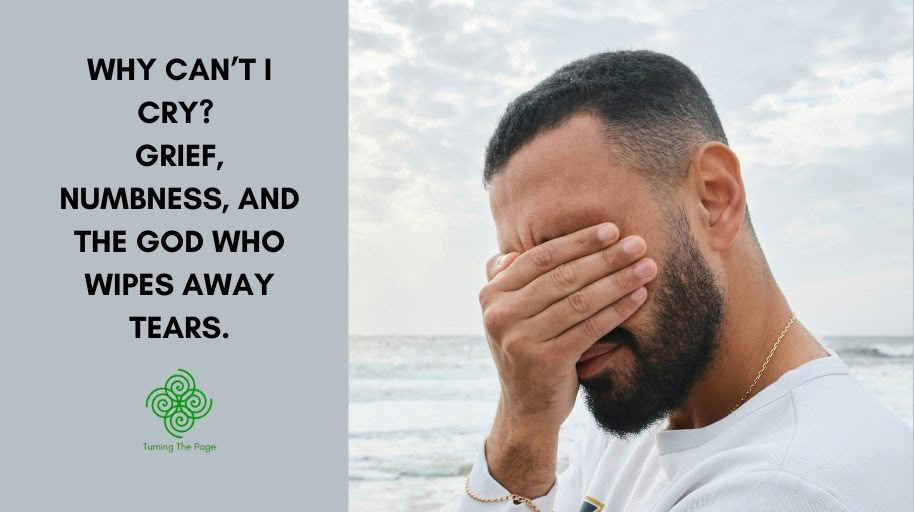
Quick answer: Not being able to cry while grieving is common. Shock, exhaustion, the pressure to keep functioning, and the fear of never stopping once you start can all build an inner “dam wall.” You haven’t failed. Isaiah 25 pictures God wiping the tears from every face, and in the meantime, healing often comes through someone safe who will simply sit with you.
In this post:
- The dam wall: when tears are stuck inside
- Why can’t I cry when I’m grieving?
- You don’t have to wipe your own tears (Isaiah 25)
- Let someone sit with you
- Until that day
The Dam Wall: When Tears Are Stuck Inside
I recently sat with someone who wanted to cry but couldn’t.
There were tears buried deep within them, heavy and unshed. Something was holding the flow back, like a dam wall.
I asked them to describe what it felt like, as best they could. They said it was like an invisible heaviness had been slung over their life.
It was grief, loss, and deep sadness. A loss of life and of living. It was like sitting at a crowded party and just wanting not to be there. To be anywhere but there.
Instead, they wanted to be left alone. I remembered Job in the Old Testament, who tore his robe and sat down among the ashes when everything was taken from him. His cry might have sounded something like this:
No pat on the back was going to fix that. No platitude was big enough for that loss.
Why Can’t I Cry When I’m Grieving?
Maybe you know that feeling.
Something has happened. A death, a diagnosis, a marriage ending, a dream lost. A heaviness that seems to have clung forever. The tears are somewhere inside, and they just won’t come.
Feeling loss without being able to express it is common. You’re not alone. Dam walls are built even without our awareness.
We have to keep working, keep parenting, keep holding it together. We’re afraid that if we start crying, we’ll never stop. So we stay in control. We stay self-sufficient. We stay dry-eyed.
Many of us walk around with shrouds over our heads and bodies: veils of grief, shame, guilt and loss. I’ve written before about waiting for the shroud of grief to be lifted. But under the shroud there is still, I believe, beauty and movement. There are still desires and hopes, dreams and plans. The unshed tears haven’t erased you. They’ve only covered you for a while.
You Don’t Have to Wipe Your Own Tears (Isaiah 25)
In my lectio reading today, I listened to a lectio divina reading of Isaiah 25:6–8.
a feast of rich food, a feast of well-matured wines,
of rich food filled with marrow, of well-matured wines strained clear.
And he will destroy on this mountain
the shroud that is cast over all peoples,
the sheet that is spread over all nations;
he will swallow up death for ever.
Then the Lord God will wipe away the tears from all faces,
and the disgrace of his people he will take away from all the earth,
for the Lord has spoken.
Isaiah 25:6–8 (NRSV)
Isaiah sees a grand feast ahead of us, the very best food and wine. There’s a party coming, and you’re invited.
On that mountain, God will destroy the shroud that covers every people. The heaviness that hangs over your life will be lifted and thrown away. Death itself will be swallowed up.
Then comes the line I dwelt on. God himself will wipe the tears from every face.
Notice what God doesn’t say. God doesn’t say, “Cry properly first, and then I’ll come.” God doesn’t ask you to break your own dam. God moves into the most vulnerable place, your face, and tends to the tears themselves. I explored this tenderness more in Who will wipe away my tears?
I think of people who can’t care for their own faces. Some have no arms or hands. Some have lost movement through injury. They rely completely on others for the most sensitive and most closely watched part of their appearance.
That’s the picture Isaiah gives us. If you can’t make the tears come, you’re not failing. You’re in exactly the place where God does the gentlest work: relying on someone else to do what you can’t do for yourself.
But we’re not at the feast yet.
When I was a child, we drove two hours every Christmas Day to my grandparents’ home. I’d sit in the back of the car asking, “Are we there yet?” My parents would say, “Soon. Have some patience. Let’s play I spy.” Some days grief feels like you’re in the back seat of that car and the journey is taking forever. The feast is real. It just isn’t here yet. That ache of the in-between is what I call the inner groan of the now and not yet.
Let Someone Sit With You
So what do you do while the tears are still stuck?
If you are the one supporting them, you don’t try to fix anything. You sit shiva with them. You sit in silence and listen to their complaint. They may be in full victim mode, and that is okay. They might complain, moan, and declare the injustice of it all.
Their pain is valid. The trauma was real, and their emotions need to go somewhere that is kind.
There is silence, a groan and perhaps tears.
They may well try to hide them, but the dam has broken, and once that happens nothing can stop the flow.
You quietly pick up a piece of cloth and dab their face. Soaking up the tears. What had been inside is finally outside.
They are shaken, weak, washed out and empty. They are able to sleep.
The dam didn’t break because they tried harder. It broke because someone was there.
If you’re carrying tears that won’t come
- Stop trying to force them. Tears aren’t a test you have to pass. They’ll come when they’re ready.
- Say the complaint out loud. Tell God, or a trusted friend, how unfair it all feels. Lament isn’t a lack of faith. It’s often where the dam begins to crack.
- Find one safe, kind person. Ask someone to simply sit with you. You don’t need their advice, just their presence.
- Let them say “here, let me.” When the tears finally come, don’t rush to hide them. Let someone help you carry them.
If the numbness ever turns into thoughts of hurting yourself, please don’t wait. Tell someone you trust today, or talk to your GP or a helpline. In New Zealand you can call or text 1737, the free national helpline, any time. You can also send me a message through my contact page.
Until That Day
Imagine a community of friends where no one has to cry on cue, and no one has to hide their tears either. Where numbness isn’t judged, grief isn’t rushed, and people move toward each other with a cloth in hand.
We’re still in the car. The journey is long, and some days we’ll ask, “Are we there yet?” But we don’t travel alone. As the psalmist says, those who sow in tears will reap in joy. One day God will wipe every tear from every face. Until then, you don’t have to break the dam by yourself. Let someone sit with you while you wait.
Quote to Consider
- One of the deepest sources of my own loneliness is that so few people seem to have much of an interest in exploring my interior world. Larry Crabb, SoulCare
- Redeemed pain is more impressive to me than removed pain. Philip Yancey
- A vision we give to others of who and what they could become has power when it echoes what the spirit has already spoken into their souls. Larry Crabb, Connecting
- Strength is not the absence of vulnerability. Strength is knowing what your weaknesses are and working with them. Terrence Real
- Grief is a passing through of what was. Rob Bell
- Opening up your soul to someone, letting them into your spirit, thoughts, fears, future, hopes, dreams… that is being naked. Rob Bell
- Don’t let grief dominate who you truly are. Peter Anderson
Further Reading
- Who Will Wipe Away My Tears? Divine Comfort in Our Brokenness — Discover comfort in your pain. Explore how God meets us in our tears with gentleness, making all things new through divine compassion.

- I am Waiting for the Shroud to be Lifted — Feeling covered by a heavy shroud of depression or grief? Discover hope in the waiting and the promise of a comforting divine embrace.

- Sitting Shiva is to say ‘I am with you’ — Grief is hard, but grieving alone is a torment. Learn the power of sitting Shiva—offering silent presence to those in their deepest pain.

- The Slow Dance of Grief: Passing Through What Was — Grief is the full-body experience of processing what was. Explore how to navigate loss, the stages of grief, and finding hope in God.
- To Reap in Joy you Need to Sow in Tears. Psalm 126 — The only way to healing is through the pain. Discover how sowing tears leads to a harvest of deep, unshakable joy and why you shouldn’t journey alone.
- The Inner Groan: Why Do I Feel So Broken Inside? — Feeling broken inside? Discover the birth pangs metaphor from Romans 8 and find hope in the sacred waiting between now and not yet.

About the Author
Barry Pearman has spent almost 30 years as a mental health support worker, community chaplain, and pastor, and has walked through depression himself. His training includes SoulCare Foundations under Dr Larry Crabb, a Bachelor of Applied Theology, spiritual direction training, and certificates in CBT interventions, pastoral therapy, and integrated mental health care. Turning the Page offers a grace-filled path to mental wholeness through faith and hope.