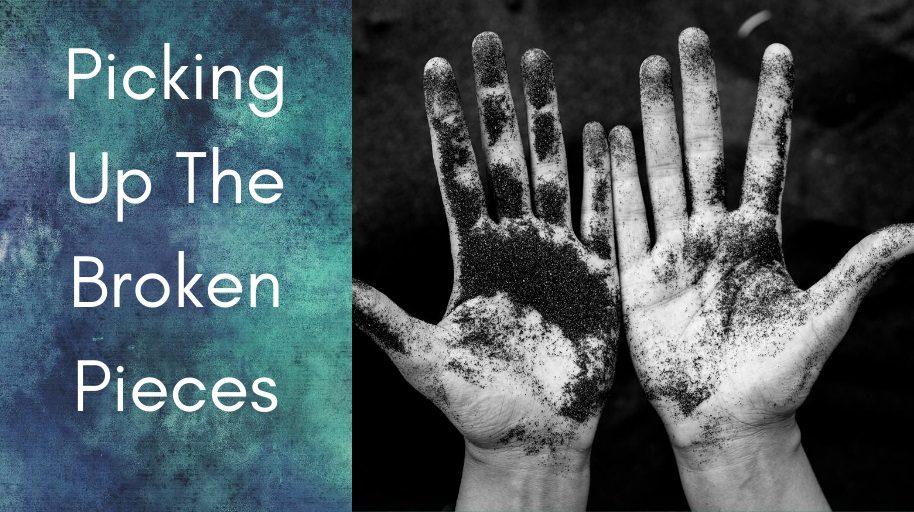
It was tasting the dust of devastation. The broken pieces. But those fragments can be brought together, and so we quietly form a new mosaic.
When something in your life is shattered — by grief, failure, or disaster — the broken pieces left behind aren’t the end of the story. Faith has long taught that these fragments can be gathered, with grace, into something new: not to erase the pain, but to slowly shape it into unexpected beauty, the way an ancient mosaic is pieced together from scraps. This is a call to patient rebuilding, not rushed recovery.
Table of Contents
- What does it feel like to lose everything?
- What happened to the leftover pieces after Jesus fed the 5000?
- Why do we only want the nice parts of the story?
- What do your own broken pieces look like?
- Why did this small detail matter enough to write down?
- Can broken pieces really become a mosaic of beauty?
- What is God inviting you to rebuild?
- Quotes on Brokenness and Grace
- Questions to Reflect On
- FAQ: Picking Up the Broken Pieces
- Related Reading
What does it feel like to lose everything?
Broken pieces. That’s all that was left behind.
It was a moment that captured the world’s attention. A massive explosion of ammonium nitrate brought a city to a pile of rubble in Beirut in August 2020. But amidst the dust, 79-year-old May Abboud Melki sat down and played “Auld Lang Syne” on her piano, inside her broken apartment. She was playing in her pain.
She then went on to play Arabic hymns, and those around her began to gather and worship. Her granddaughter, May-Lee Melki, described it this way in an interview with CNN: seeing her lean into her faith was a strong message to her family and community.
Most of us will never face devastation on the scale of an explosion. But an earthquake, a hurricane, a tornado, a flood, or a bush-fire can bring anyone to the same place: picking up the pieces.
As you read this, tap into the emotions of loss. Something has swept through your life, and now everything feels turned upside down, shaken around, and thrown to the four corners of the universe. You’re left with a few fragments to rebuild from.
What happened to the leftover pieces after Jesus fed the 5000?
As part of my devotional life, I find it helpful to meditate on scripture through the ancient practice of Lectio Divina — a way of listening quietly to a passage and allowing God to speak personally through it. I use a podcast called Daily Lectio Divina.
One reading this week covered the feeding of the 5000 — Jesus turning a few loaves and fish into a banquet for the multitude. At the very end of the story comes a small mention of the cleanup crew:
I could picture the crowd fanning out to collect the scraps — joy, amazement, and songs of thanks all around. But I found myself wondering what they actually did with all those pieces of fish and bread. Did they get creative and make some sort of fish cake? There were no freezers to store it for later, so they probably gave it away. As they traveled on, following Jesus, they likely told the story and shared the bread and fish — feasting, again and again, on the leftovers.
Why do we only want the nice parts of the story?
It’s a nice Jesus story, isn’t it? Everyone is happy. Full stomachs and the needs of the heart met. We like it that way.
In that moment, Jesus had thousands of happy followers — ministerial success, the leader of what we might now call a mega-church. Yet a few years later, after walking a narrow path of costly discipleship, only a handful of friends remained.
I sometimes wonder how long Jesus would last in our modern, image-conscious church culture. Political correctness and pastoral correctness might see him quietly excommunicated, even while the crowd kept singing him their happy songs.
What do your own broken pieces look like?
Life is full of broken pieces — leftovers after a storm. A marriage fails. A child dies. Cancer moves through the body. Redundancy arrives after years of faithful service, and suddenly you’re no longer needed. A pandemic sweeps through your town.
You sit and look at all the shards of debris, and grandma moves to the piano. She’s been there before. She knows the grit and grind of what life is actually about. There is a time to lament and mourn, and there is a time to pick up the pieces. We needn’t rush from one to the other.
Why did this small detail matter enough to write down?
As I sat with the passage, I wondered why the Holy Spirit gave Matthew the nudge to record this small detail of the story.
Perhaps it was to show just how astonishing the miracle was — that there was so much left over. Or perhaps God wanted us to know there is a divine interest in the broken pieces: those small things most of us would discard as worthless, the scraps of our lives.
Your broken pieces — the things that look like leftovers and trash to everyone else — may still have a purpose as you rebuild out of the devastation. The pieces of a jigsaw might come together and form a new mosaic. A picture of new beauty.
Can broken pieces really become a mosaic of beauty?
Years ago I visited the ancient city of Ephesus. It was a city of ruins, but it was also a place where I knew the apostle Paul had walked and talked.
As we walked the streets, our guide called us over to the sidewalk, took out his water bottle, and squirted water onto the pavement. With the dust washed away, a beautiful ancient mosaic appeared. Colours burst out from under the dirt and washed over us with delight.
Broken pieces of various colours, all arranged into a pattern. Someone, thousands of years before, had collected some broken pieces and, with Spirit-led creative celebration, made art for us to enjoy.
What is God inviting you to rebuild?
As you’ve read this, you may have felt nudged about the broken pieces in your own life. I hope so. What is the invitation God is whispering to you?
Can you pick up a few broken pieces and form them into a mosaic that helps you make sense of it all? Do it slowly, with the sense that this artwork can take as long as it needs to take. There’s no rush and no demand to perform — for anyone, including yourself.
Your broken-piece artwork may be exactly the gift another person needs as they sit in their own broken-world experience. The challenge is simple to name and hard to live: are you willing to look at your broken pieces, own them and their pain, and then invite the Jesus of miracles to co-create a new mosaic with you?
Mental health is acknowledging the broken pieces in our lives, and then, with Spirit-led creative design, joining them together as a gift to yourself and others.
Quotes on Brokenness and Grace
Questions to Reflect On
- Where have you had a broken-world experience?
- There is a time for everything. How much time do you allow yourself, or give yourself permission for, to own the fact that you have broken pieces?
- What would be an example in your life where a few broken pieces have come together to form a mosaic of beauty?
FAQ: Picking Up the Broken Pieces
What does “picking up the broken pieces” mean in a faith context?
It’s the idea that the leftover fragments of a hard season — grief, failure, loss, disaster — aren’t worthless. In scripture and in lived experience, these scraps can be gathered and, with grace, reshaped into something new rather than simply discarded.
How do I find hope after a devastating loss?
Hope often starts small: naming the loss honestly, allowing time to grieve without a deadline, and looking for the “leftover pieces” that can still be gathered and used, rather than expecting everything to be rebuilt at once.
What is the significance of the mosaic image in this story?
A mosaic is made entirely from broken pieces of tile, stone, or glass arranged into a new pattern. It’s used here as a picture of how a broken life can be re-formed into something with its own beauty, without pretending the breakage never happened.
Does the Bible say anything about broken pieces?
Yes. In Matthew 14:20, after Jesus fed the 5000, his disciples collected the leftover broken pieces of bread and fish rather than letting them go to waste — a small detail this post uses as a picture of how God treats the broken pieces of a life.
Related Reading
- A Time to Grieve and a Time to Prepare — Grief and loss are always on the horizon, but we can prepare to grieve well. This can help with the grief we are carrying now.
- Who Will Wipe Away My Tears — Discover comfort in your pain. Explore how God meets us in our tears with gentleness, making all things new through divine compassion.
- Sitting Shiva Is to Say ‘I Am With You’ — Grief is hard, but grieving alone is a torment. Learn the power of sitting Shiva—offering silent presence to those in their deepest pain.
- Rebuilding – Poem by Joy Lenton — When our internal walls crumble, a “tenderest touch” remains. Explore Joy Lenton’s poem on redemptive healing and the beauty of spiritual rebuilding.
- I Say ‘Resurrection’ to the Mocker — Do you get mocked at or ridiculed? Perhaps you need to shout/whisper ‘RESURRECTION’ for your Mental Health.
- Give Grace to Failure and Rethink Expectations — Stop the “performance trap.” Learn how to set lines of love, embrace grace in failure, and find restoration through realistic expectations.
Written by Barry Pearman, a writer, coach, online pastor, and course creator with a passion for mental health and spiritual formation. Turning the Page offers faith-based mental health resources, courses, and a weekly newsletter to help people walk a grace-filled path to mental wholeness.
Photo by Sabine van Straaten on Unsplash.