
There is a self-centeredness to ourselves, a turned/curved inwardness, incurvatus in se, but there is one who shows how to break the gravity, the pull of the curve.
There is a pull on me all the time.
On this page
- What is Incurvatus in Se?
- God Is Compassionate About Curves
- Going Against the Curve
- Breaking the Pull of Gravity
- There Is a Taste: 6 Steps to Find the Spring
- Quotes to Consider
- Questions to Answer
- Further Reading
It’s in the lyrics of the eighties pop hit:
I’ve had enough now I want my share
Can’t you see I wanna live
But you just take more than you give.
— Garry Frost and Frances Swan, “What About Me”
There is a demand for others to meet my needs. They should know that my life is the most important thing in the universe. It’s all about me.
Meet my needs; then, I might move on to listening to yours.
There is a curve, and all our thoughts run into it. When we run into others’ curves, their demands for a better life, then there is a clash.
There is a fancy theological term for this gravitational pull. It’s “Incurvatus in se.”
What is Incurvatus in Se?
“Incurvatus in se” is Latin for “turned/curved inward on oneself.” It’s like a gravitational pull affecting everything I do.
I love others, but deeply I wonder “what’s in it for me.” I give to others but wonder if I will receive back.
I am an empty vessel, and I demand you fill me.
Tell me pleasant things, nice things, affirm me. Fill me with water. I am hungry so feed me.
I am determined to see my pain relieved, and I will do whatever it takes to meet that need.
Some may give it a diagnosis such as Narcissism, but it’s in all of us. This inward curving towards ourselves. For some, you can easily see their curve, but with most, it’s more hidden, subtle, and manipulative.
Of course, no one can ever completely meet the need of the curve. Because, well, they are also under the gravitational pull of the curve too.
Perhaps sometimes, they offer a few drops of presence that somewhat alleviates the pain. But for the most part, we are so thirsty and determined for pain relief that it becomes automatic to reach for the chocolate bar, bottle, online shopping, or porn site. We have a curve that takes us to a cistern.
Where does your curve take you?
God Is Compassionate About Curves
Are you feeling somewhat down now?
I may well have woken you up to the reality of something of yourself that you may not like. But isn’t an awareness of the battle better than living in a foggy dream world?
We need someone who fully knows the power of the gravitational pull to self-centredness to somehow push against the trend.
I read this recently:
— Larry Crabb, Inside Out
Jesus never slipped down that slippery slope of “Incurvatus in se.” Fully human, fully divine, there was always the option to shift his focus, but he never did.
— Simone Weil, Waiting for God
Oh, to have the Christ focus that says “Father forgive their ‘curved in on themselves gravitational pull’ for they don’t know what they are doing.”
Going Against the Curve
I’m sure you’ve run into the curve of others. Maybe you can see the “Incurvatus in se” pull in your life.
What is it that you are truly after? Is it love? What about affirmation and value? Worth and acknowledgment?
Deep needs are only satisfied by deep springs.
Having nice words said to me is good, but it soon leaks away. Like a water tank with holes in it, I need to keep having it filled.
I want a spring and not a cistern. There is a distinct difference between the two:
- A spring is a gush of water coming up out of the ground from who knows where and is out of my control. It’s always there, and it’s fresh, new, sparkling, and full of energized particles. There is movement, and there is life.
- A cistern is a storage container. It’s a tank, a jug, a dam that I have made. It’s in my control. Accessible on my terms. Water is flat, stale, unmoving, and a potential place for ugly stuff to grow in.
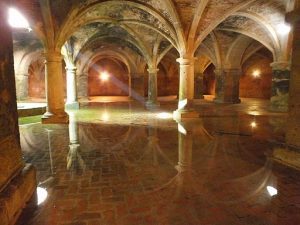
El Jadida cistern
God comes to speak to us through the mouth of a man under the power of the curve:
They have forsaken me,
the spring of living water,
and have dug their own cisterns,
broken cisterns that cannot hold water.”
— Jeremiah 2:13
In other words, God is saying:
If you want to go against the curve and to handle the curves of others, then you need to learn how to sip at the spring and stop swimming in a cistern.
Breaking the Pull of Gravity
Can I point you towards the spring?
I love to take people who are used to the stale waters of a cistern and let them experience the sparkling freshness of the spring.
It’s up the hill. We have to defy gravity and push against every natural instinct to retreat to the ease of a cistern, but it’s up there, and we can swim and splash.
— Larry Crabb
I’ve seen people discover it. It’s always through prayer, quietness, being still, and noticing the whispers of God.
Jesus broke the power of gravity. There was no “Incurvatus in se” dragging him away from his one focus – the Father and I are one (John 10:38).
A woman with pain comes to a well. Jesus, in typical Jesus style, creates a learning story:
— John 4:13-14
There Is a Taste: 6 Steps to Find the Spring
I loved it the other day when I was talking to someone, and I could sense the pull of the curve. Then, as we quietened ourselves, there was the unmistakable sound of a spring bubbling nearby.
We set out in prayer to find the source. When we found it, we sat and gave thanks. We dipped our toes in and then jumped wholeheartedly into the bubbles.
Have you got a taste for something better? Tired of stale water? Here are some little steps to find the spring:
- Acknowledge your ‘Incurvatus in se.’ We all have this pull. Even the most generous of souls has a curve to it.
- Ask where does it take you? What is the need you are hoping to fulfill?
- Long for the spring. I think of David hiding in a cave, longing for a sip of water from the well in Bethlehem (2 Samuel 23:15). It wasn’t so much for the physical taste. It was more for the times of presence and spiritual refreshment.
- Listen quietly for the trickle. Quieten yourself, meditate on scripture, discover stillness, solitude, silence. Then when you discover a droplet of Spirit’s presence, savor it.
- Keep coming back. When you have a taste, then keep coming back for more. Build it into your daily rhythm.
- Look through the curves of others. Others are curved in on themselves. They, too, need a spring and not a cistern. Yes, they hurt you in their ‘Incurvatus in se,’ but forgiveness flows when we see the power of the curve they are probably unconsciously engaged with.
To be in community is to have a few others who will guide you to a spring and not a cistern. Safe others who know their “Incurvatus in se.”
Quotes to Consider
— Larry Crabb, Inside Out
— Richard Rohr
— Philip Yancey
— Larry Crabb, Inside Out
— Larry Crabb, Inside Out
Questions to Answer
- When we talk about being curved in on one’s self, what comes to mind for you?
- What is a cistern for you?
- Where have you tasted the sweet waters of a living spring of water?
Further Reading
- Narcissism: A God-Shaped Hole
- How to Pray for a Narcissist: 10 Biblical Ways to Find Peace
- Can You Live With a Narcissist? Six Suggestions
- What Perfect Narcissism Looks Like: Satan and the Bible
- Praying Against Yourself: The Abusive Art of Self-Deprecation
- No More Penance to Pay
Photo by Clay Banks on Unsplash