Quick answer: As children, we make sense of pain by reaching conclusions about ourselves, such as “I’m behind,” “I don’t belong,” or “I’m not enough.” Those conclusions often stay with us into adulthood, and a present-day rejection can trigger the same old feelings. Hagar’s story in Genesis 16 shows that God sees us in the wilderness. What happened to you was real. What you decided about yourself because of it may not be true, and those conclusions can be revisited.
In this post:
- How childhood experiences shape our beliefs
- Imaginary worlds: shelter or prison?
- Hagar and the God who sees me
- Are your conclusions chiselled in stone?
- A journaling exercise for old beliefs
Loneliness and rejection are cruel. Shunned from the group, we can feel deficient or lacking in some way.
How Childhood Experiences Shape Our Beliefs
As a child, I had terrible asthma and eczema. I was prescribed prednisone, and it stunted my growth until I came off it in my early teens and shot up like a rocket.
All of this meant I didn’t do well in sports. I also missed a lot of school, so I often felt behind the rest of the class. I also have an egg allergy. My body has an anaphylactic reaction to eggs or anything made with eggs. (I’ve written about the character bruises an egg allergy left on my soul.)
These conditions, and the experiences they brought into my life, have shaped me. They formed how I thought about myself and about my world.
I doubt I would do this kind of writing and ministry, in the way I do it, without that moulding and shaping. So I am thankful. But I have had to, and still do, review the conclusions I reached as a child.
When an old rejection echoes in the present
The apostle Paul writes that as a child, he thought like a child, but as an adult, he put away childish things.
Some of those childish conclusions hang around like decaying food in the back of the pantry. A rejection now can feel exactly like being left out of the basketball team back then. Triggers, echoes of old memories, and off we go down that old path.
An event happens. We come to a conclusion, and that’s it. We are locked into a thinking pattern until we cognitively reassess whether our childhood conclusions were correct.
Perhaps, the struggle back then shaped me into something good I never would have become without it. I suppose what I learned back then means I can connect with others who have felt a similar exclusion. Redeemed pain is more impressive than removed pain.
We carry sentences, and some of them aren’t helpful. They need to be edited, revised, and re-scripted. (I’ve written more about this in the sentences we carry and how they shape who we are.)
Imaginary Worlds: Shelter or Prison?
Perhaps as a way of coping, we build imaginary worlds where all is perfect and good. In mine, I am the captain of the sports team. I have an extroverted nature and exciting friends. And of course, I can eat eggs without being quizzed about what happens if I do.
What’s your imaginary world like?
An escape from reality can become a disconnection from life, real life. When a daydream stops being a short visit and becomes a place to live, it has a name: maladaptive daydreaming.
Childhood coping mechanisms are creative acts of survival
As children, we may simply need to escape the realness of the world. Trauma, isolation, abuse: it’s too much for a child’s brain to cope with. So God has given us the ability to create.
Most of us found something as children to get through what we couldn’t change: retreating into books, being the good kid, being the funny one, disappearing into our room or our head. These were creative acts of survival.
But in the long term, they can be destructive because we stay stuck in childish ways.
The ways a child copes with harm are often brilliant and courageous. They deserve honour before they’re changed, and they need to be grieved for what they’ve cost.
Before the inner world was a prison, it was a shelter, a place of refuge.
Where do you retreat to? Is it healthy and helpful?
Hagar and the God Who Sees Me (Genesis 16)
I want to be seen. I want to have impact.
There is a story in Genesis that is both traumatic and reassuring.
Abraham had been promised a family, a very large family, but no children were born to his wife Sarai. So, as was the custom of the day, Sarai gave him her Egyptian slave, Hagar. He could have chosen not to. He could have said, “No, I’m trusting God to provide.” But easy, man-made ways have a temptation to them.
Then it all fell to pieces.
When she knew she was pregnant, she began to despise her mistress. Then Sarai said to Abram, “You are responsible for the wrong I am suffering. I put my slave in your arms, and now that she knows she is pregnant, she despises me. May the Lord judge between you and me.”
“Your slave is in your hands,” Abram said. “Do with her whatever you think best.” Then Sarai mistreated Hagar; so she fled from her.
The angel of the Lord found Hagar near a spring in the desert; it was the spring that is beside the road to Shur. And he said, “Hagar, slave of Sarai, where have you come from, and where are you going?”
“I’m running away from my mistress Sarai,” she answered.
Then the angel of the Lord told her, “Go back to your mistress and submit to her.” The angel added, “I will increase your descendants so much that they will be too numerous to count.”
The angel of the Lord also said to her: “You are now pregnant and you will give birth to a son. You shall name him Ishmael, for the Lord has heard of your misery. He will be a wild donkey of a man; his hand will be against everyone and everyone’s hand against him, and he will live in hostility toward all his brothers.”
She gave this name to the Lord who spoke to her: “You are the God who sees me,” for she said, “I have now seen the One who sees me.” — Genesis 16:4–13
Millennia later, there is still conflict among the descendants of Abraham, and it all started with a convenient solution to a question of faith and trust. Sentences have been carried down the line.
What does El Roi mean?
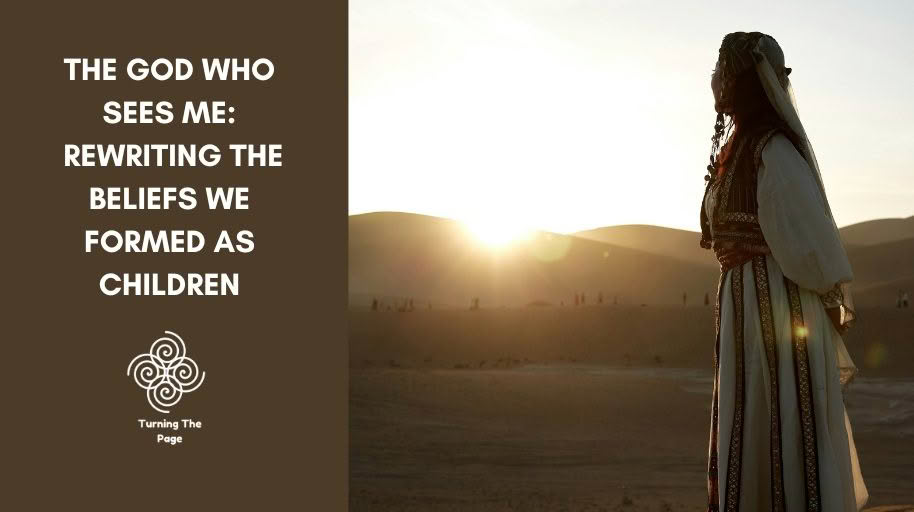
The beautiful part of this story, and something we can take from it, is that God sees. Hagar is seen. She names God El Roi, “the God who sees me.”
The chief fear of a woman, I believe, is invisibility: that the godly beauty within her is not seen or delighted in. God comes to Hagar’s heart and says, “I see you.” She has now seen the One who sees her.
The chief fear of a man is impotence: that what he does has no impact, that no footprint is left for all he does. Abraham moved into Sarai’s world with no result, so he moved into another’s and found one.
God comes and sees it all, knows it all, and can make good out of it all.
God meets us where we are
God doesn’t scold Hagar for fleeing, for running from the soap-opera mess. God was there in the wilderness, seeing her. God meets us where we are, not where we pretend to be. (That’s what it means to be met at the coal face of our pain.)
Hagar’s experiences were real: favouritism, loneliness, unnoticed struggles. And she had a creative solution: run and flee. But God comes with comforting truth. You are loved, you are held, you are known. Even when you feel rejected, God gathers you up, because there is no rejection in God.
What happened to you was real. What you decided about yourself because of it may not be true.
Can we bring the conclusions we have reached into the light of God’s presence?
Are Your Conclusions Chiselled in Stone?
What conclusions have you made about life? And what is a conclusion, anyway?
A conclusion can be the end point of a journey. We have concluded our journey. End point.
A conclusion can also be an opinion or deduction we reach after thinking through all the information or evidence we have at hand at that moment. Some of those conclusions turn out to be lies we have lived under for years. And often the problem was the problem, not the person.
I suppose that is why I think Turning the Page is an apt name for a website about mental health. A good book is one you read many times, gleaning something new each time. When I don’t understand a particular part of the story, I turn back the pages and gather more information. My understanding changes. My conclusions alter and adjust.
So what conclusions have you reached about life? Are they chiselled in stone, or are they open to new information?
A Journaling Exercise for Rewriting Childhood Beliefs
1. Two columns
Draw a line down a page. On the left, write what happened (keep it brief and factual). On the right, write the conclusions you made about yourself and life. Then look at the right-hand column and ask: Is this true? Who says so?
2. A letter to your younger self
Write a short letter to the child who built some conclusions that now need reassessing. Be gracious to that small child, and gently tell them what they didn’t know back then.
3. Thinking compass sentences
Create some thinking compass sentences to retrain your brain with. Read them daily, and you begin building new rope bridges in your thinking. Hagar had one: “You are the God who sees me… I have now seen the One who sees me.”
For Your Thinking Compass
- What happened to me was real. What I decided about myself because of it may not be true.
- God sees me. I am not invisible to God.
- My childhood ways of coping kept me safe then. I can honour them and still choose new ways now.
- That was then. This is now. I can turn the page.
- I am loved. I am held. I am known.
Part of the Maladaptive Daydreaming Series
This post is part of a series on maladaptive daydreaming. Read the other parts:
- Maladaptive Daydreaming: When a Daydream Becomes a Place to Live – Everyone daydreams, but for some it becomes a place to live. A Christian look at maladaptive daydreaming and hope.
Quotes to Consider
- Stuck? The painful double-bind of contradictory beliefs blocks personal growth. New truth is required to integrate your cognitive discord. David Riddell
- “I don’t want to remember that incident because it’s too painful” means that it must be recalled in order that you may ‘think again’ and reassess old conclusions. David Riddell
- When I believe my feelings, and those feelings misrepresent reality, I am headed for a self-referential pit that will get deeper and darker as I dig myself into my home-made delusion. David Riddell
- Love wins over guilt any day. It is sad that we settle for the short-run effectiveness of shaming people instead of the long-term life benefits of grace-filled transformation. Richard Rohr
- In the moments of insecurity and crisis, “shoulds” and “oughts” don’t really help; they just increase the shame, guilt, pressure, and likelihood of backsliding. It’s the deep “yeses” that carry you through. Focusing on something you absolutely believe in, that you’re committed to, will help you wait it out. Richard Rohr
Further Reading
- 6 Steps to Take the Power out of an Unbearable Feeling — Discover how to break free from an unbearable feeling and heal the deep wounds of your soul using practical steps and God’s truth.

- A Life Controlled by Lies — Free yourself from the lies of guilt and shame. Find healing from trauma and childhood wounds through the unconditional love of Jesus Christ.
- The Problem is The Problem – Not the Person — Stop seeing yourself as the problem. Learn how to externalize struggles, break the cycle of self-blame, and find hope in your true identity.
- There is No Rejection in God — Find true comfort from the icy sting of human rejection by discovering a safe, unconditional home in God’s arms and relational nests.
- How to Create New Rope Bridges in our Thinking — Learn how to rewire your brain for hope. Discover 7 steps to build new neural pathways and move past “I can’t change” into mental health.

- Redeemed pain is more impressive than removed pain — Learn how surrendering your emotional wounds to God can transform bitter, heavy heartaches into a beautiful source of hope and resilience.

- The Sentences We Carry: How Generational Trauma Shapes Who We Are — Words spoken over us can become verdicts we live inside. Discover how faith rewrites generational trauma.
- When You Feel Rejected — Feeling rejected? Discover how God gathers up what others cast aside. Find hope in Psalm 27 and the beauty of being seen by a constant friend.
About the Author
Barry Pearman has spent almost 30 years as a mental health support worker, community chaplain, and pastor, and has walked through depression himself. His training includes SoulCare Foundations under Dr Larry Crabb, a Bachelor of Applied Theology, spiritual direction training, and certificates in CBT interventions, pastoral therapy, and integrated mental health care.
Turning the Page offers a grace-filled path to mental wholeness through faith and hope.