Week 4 of the series Glory Days in the Mind: When Escaping Inside Keeps You From Living.
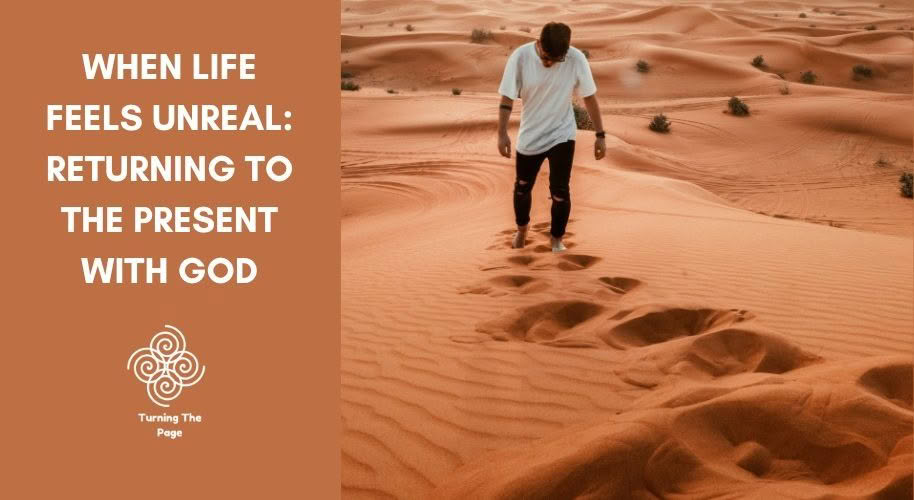
Quick answer: When years of daydreaming or rumination leave real life feeling flat or unreal, the way back is not to fight your mind but to return, gently and often, to the present. God meets us here. At the burning bush, Moses turned aside, answered “Here I am,” and learned that God’s name is present tense: I AM. Small daily practices, like savouring one good moment, grounding through your senses, and a simple breath prayer, retrain the brain to find its rewards in real life.
In this post
- Here, but not here
- A shepherd on an ordinary day
- Living in the now: four practices
- An ordinary Tuesday
- Questions to answer
A Rainy Morning
As I write this, it’s early in the morning. It’s dark outside, and it’s raining. My mind has just been drifting away and off to the land of “possible scenarios”. That’s the place where I think about this or that happening. My mind, my focus, my attention swings out into the future and ruminates on an event. Anxiety frames the picture; depression lies behind it.
My mind drifts, then a waft of breeze floats through the door. There’s a gentle rain outside, and I listen to the tapping of rain on a tin roof. I’m back in the present. A bird squawks outside. I notice the now.
I was living somewhere that doesn’t exist, but God wanted me to come back to the now. A gentle breeze, a drop of water, a bird sharing its existence. I came back to holy ground.
I’ve been at plenty of places without really being there.
My mind drifts. I create different futures and scenarios. I can be anywhere without truly being here.
A small piece of chocolate can be eaten quickly, greedily, lustfully, or it can be placed on the tongue and left to melt into the taste buds, where you savour every nuance of flavour and richness.
I can walk past a sunset lost in ruminations of the past or future, or I can stop and focus on the colours and hues of a never-to-be-repeated portrait.
The inner world taught us to live somewhere else, but God meets us here, and learning to be present, one small good moment at a time, turns ordinary life back into holy ground.
Here, But Not Here
We all do this.
The here but not here. The scrolling of social media. The replaying of conversations while in the shower. The forecasting of events in the future while lying in today’s bed at 3am.
We mind-drift like a swing between past and future. Up and out to the future, hold it there, energy goes there; then we swing back to the past, hold it there, draining; then we swing back into the future. Every time, going briefly through the present.
We stop now and then and feel the breeze, hear the rain, notice a sunset pink.
This is normal. But living in other lands for long periods, without being fully present in this one, can lead to a flatness and a loss of colour.
For some people, that flatness runs deep. One reader who wrote to me described years spent in a vivid inner world. Now holidays, festivals and birthdays pass without joy. It’s as if part of her isn’t quite in her body. Nothing feels real, and she doesn’t feel real either.
We have been doing a little series about daydreaming.
- Week 1 named the inner world: Maladaptive Daydreaming: When a Daydream Becomes a Place to Live
- Week 2 found where it began: The God Who Sees Me: Rewriting the Beliefs We Formed as Children
- Week 3 named the belief behind it, and heard God singing over the real you: The Self I Imagined and the Self God Loves
This week is about coming back.
The brain learns from what we repeatedly do. It can be retrained to find its rewards in real life, but only by slowing down long enough to let real good moments sink in.
A Shepherd on an Ordinary Day
It was an ordinary workday for this shepherd when something quite extraordinary grabbed his attention and brought him to being grounded in the here and now.
Moses was keeping the flock of his father-in-law Jethro, the priest of Midian; he led his flock beyond the wilderness, and came to Horeb, the mountain of God.
There the angel of the Lord appeared to him in a flame of fire out of a bush; he looked, and the bush was blazing, yet it was not consumed.
Then Moses said, ‘I must turn aside and look at this great sight, and see why the bush is not burned up.’
When the Lord saw that he had turned aside to see, God called to him out of the bush, ‘Moses, Moses!’ And he said, ‘Here I am.’
Then he said, ‘Come no closer! Remove the sandals from your feet, for the place on which you are standing is holy ground.’
He said further, ‘I am the God of your father, the God of Abraham, the God of Isaac, and the God of Jacob.’ And Moses hid his face, for he was afraid to look at God.
God said to Moses, ‘I am who I am.’ He said further, ‘Thus you shall say to the Israelites, “I am has sent me to you.”’
It was a typical workday. Walk the sheep, feed the sheep, and make sure that the sheep weren’t attacked by lions.
Perhaps, he was daydreaming back to when he had murdered a man and then how he had fled to this desert to hide. Perhaps he was ruminating over past failures and possible scenarios of what might happen to him if he ever went back to Egypt.
A preparation
He had been raised as a prince of Egypt and knew the likely outcomes, and they weren’t good. He also knew of his family and the nation of his people who were enslaved back in Egypt, and how he had fled from them.
Moses may also have been a stutterer; he found it hard to string a sentence of words together. Scripture says he was “slow of speech and slow of tongue” (Exodus 4:10). Maybe this once mighty prince was now, through all the trauma, but a lowly outcast shepherd hiding in the vast desert of Sinai.
Perhaps this desert lifestyle was preparation for a future time when desert living skills were going to be needed.
He wanders, and lost in his mind wanderings, he sees something unusual. A bush burning without being consumed. It’s on fire, but it’s not becoming less.
It grabs his attention, and he turns aside to look further and understand.
Presence often begins right there, with simply noticing. The bush may have been burning for a while. What changed was that Moses turned aside.
The voice of today
The pendulum swing rests in the middle, in the now, and focuses totally on the now. The heat, the light, the warmth, and then the voice.
God calls his name, and Moses answers, “Here I am.” Not there, not back then, not one day. Here.
“Come no closer! Remove the sandals from your feet, for the place on which you are standing is holy ground.”
What I think God was saying is that he did not want anything man-made to come between the natural ground, the sand, stones, grit, and Moses’ existence. No protection, layers, no self-made constructions.
All ground is holy, and a connection to its reality keeps us grounded.
Daydreaming, ruminating, mind-wandering to past and future sweeps us away from the reality of the dirt, mud and mire we might be in.
The inner worlds we build are a kind of sandal too: a self-made layer between us and the ground of our real lives. God invites us to take them off.
God said to Moses, “I am who I am.”
God’s name is present tense. God isn’t the God who was, in our memories, or the God who might be, in our daydreams. God is the God who is, here, now.
He tells Moses to tell the people of Israel enslaved in Egypt that the God of the present is with them.
God’s name is I AM, not I WAS or I MIGHT BE. God is in the here and now.
Living in the Now: Four Practices
We daydream. Our mind and attention swing out into the future. We play out different scenarios. Then we swing back to the past, dwell on past mistakes and lock in on hopelessness.
Here are four steps that, if you practise them daily, can help you come back to the present and train the brain to find good in reality.
1. Take in the good (HEAL)
This practice comes from psychologist Rick Hanson’s HEAL method (video). Once a day, pick one small real good thing: a cup of tea, sunlight on your face, a kind word. Then:
- Have it: Notice a positive moment that is already happening (such as a warm cup of tea, a kind word, or a safe environment) or actively create one.
- Enrich it: Stay with it for 5 to 20 seconds. Boost it by opening up to multiple senses, intensifying the feeling, and recognising why it matters to you.
- Absorb it: Intend and sense the positive experience sinking into your body and mind, like water into a sponge or warmth into the bones, allowing it to register in your emotional memory.
- Link it (optional): While holding the positive experience in the front of your mind, allow it to connect with or gently soothe older, painful memories or stress in the background.
I’ve written more about this in how to take in the good and let it nourish you.
2. Take off your sandals
When you notice a drift, come back through your senses: name three things you can see, two you can hear, one you can touch. Feel your feet on the ground.
3. Breathe a prayer
Breathe in “Here I am,” breathe out “You are here.” “Here I am” is what Moses said at the burning bush.
4. Give your imagination a home
Choose one real-world outlet this week, such as writing, drawing, music, gardening, carpentry, or cooking, so that your imagination serves your life rather than replacing it. Make sure these are tangible and tactile activities, e.g. pen and paper, not digital and computer.
A gentle word: if feeling unreal or disconnected is constant, or it makes things like driving unsafe, please talk with your GP or a counsellor. You don’t have to manage it alone. In New Zealand, you can free call or text 1737 any time to talk with a trained counsellor.
An Ordinary Tuesday
I’ve finished writing the first rough draft. It’s still raining, and I’m thinking about the day ahead.
How am I going to ‘ground myself’? I think I might go for a walk along the beach in the rain with my wife. Both tasting raindrops on tongues, talking about the bird life we see, picking up seaweed for our vegetable garden.
It’s an ordinary Tuesday, but perhaps God wants to meet with us in an unordinary way.
Quotes to Consider
Questions to Answer
- Where did you notice something real and good today?
- Which way does your pendulum usually swing: out to the future, or back to the past?
- When does real life feel most flat or unreal to you?
- What would it look like for your imagination to serve your real life rather than replace it?
Further Reading
- The Swing and the Now: How to Ground Your Thoughts — Stop the wild swing between past regrets and future fears. Learn how to ground your thoughts in the “Now” by binding truth to your heart.
- The Tangible and Tactile Way to Better Mental Health — Feeling burned out by a digital world? Discover how tangible, tactile activities can ground your soul and restore your mental health.
- Look at the Birds of the Air. Help with Your Anxiety — Look at the birds of the air. Break the “magnetic” grip of anxiety. Discover how looking and considering nature can ground your brain in providence
- Healing Echoes: Grounding Your Soul Through Lectio Divina — Learn to quiet the echoes of trauma and anxiety. Discover how the grounding practice of Lectio Divina and Psalm 23 can restore your soul.
- Anticipatory Anxiety and Waiting for the Other Shoe to Drop — Stop waiting for the other shoe to drop. Learn how to release the tension of anticipatory anxiety and find peace in the present moment.
- Glory Days: Why the Old Life Keeps Calling You Back — Tempted to go back to the old life? Learn why we romanticise the glory days and how to stay on the path.
Barry Pearman has worked since 1995 as a mental health support worker, community chaplain, and pastor, and has walked through depression himself. His training includes SoulCare Foundations under Dr Larry Crabb, a Bachelor of Applied Theology, spiritual direction training, and certificates in CBT interventions, pastoral therapy, and integrated mental health care. Turning the Page offers a grace-filled path to mental wholeness through faith and hope.