Quick answer: Maladaptive daydreaming is a compulsive retreat into vivid inner worlds for hours at a time, often to escape loneliness or pain, until real life starts to suffer. Underneath it usually sits a belief: the real me isn’t enough to be loved. Fighting the daydream rarely works. Naming that belief, noticing what you needed when the drift began, and finding God’s love for your real self in honest relationships is what loosens its pull.
In this post:
- A short visit or moving in?
- There’s a thirst, and it’s real
- The belief beneath
- Loved as we really are
- Further reading
One of the most amazing discoveries I have made over the years is how incredibly creative the human brain is. Out of an organ weighing just over a kilogram comes all sorts of creativity. Think about the device you are reading this on. Someone, at some stage, had an idea. One creative idea connected to another, imagination jumped in, excitement fuelled the thoughts, and on it went until now you are reading words I have sewn together out of a creative space.
And we daydream. We have the ability to drift away and be in another place and time.
I’ve had longings like that: Oh, that things would be different. Oh, that I would have this or that.
My daydreaming can become an enchantment that captivates my focus. I am swept away to another land, another place. And if I’m honest, it’s often when real life feels hard that the pull is strongest.
A Short Visit or Moving In?
Everyone daydreams. The Cambridge Dictionary describes it as thinking about pleasant things you would like to happen, instead of focusing on the present moment. It’s a normal part of being human. We plan, create, solve problems and rehearse conversations in our heads.
Creativity is a gift from God. The very first task God gave Adam was a creative one: to name the animals. Out of God’s creative nature came our ability to create.
But that same gift can become a way out. Like Israel longing for Egypt, we minimise the struggle of back then, or the pain of right now, and drift toward what feels good and pleasant. (I’ve written more about why the old life keeps calling us back.)
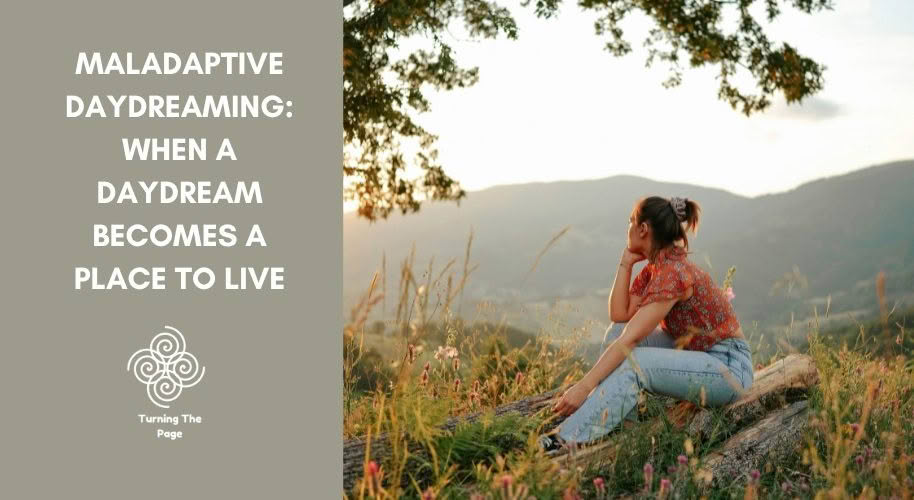
For most of us, a daydream is a short visit. The mind wanders and comes back. But for some, the dream isn’t a place to visit. It’s a place to live.
What is maladaptive daydreaming?
I recently received an email from a young woman who, at the age of ten, was lonely. With her incredible creative ability, she built a new world to live in, a world where she felt seen, loved and held. But not a real world.
There is a term for this: maladaptive daydreaming, a compulsive retreat into vivid inner worlds for hours at a time, to the point that it disrupts daily life (Cleveland Clinic).
She writes this.
Signs a daydream has moved in
| A short visit | Moving in |
|---|---|
| Brief and spontaneous | Hours at a time, often every day |
| Easy to come back from | Hard to stop; it keeps pulling you back |
| Happens to you | Chosen, even looked forward to |
| Useful: planning, creating, problem-solving | Used to escape pain, loneliness, or feeling not enough |
| Fades quickly | Ongoing stories and characters that run for months or years |
| You’re yourself | You’re a better version: braver, prettier, admired |
| Real life carries on | Real life suffers: work, study, sleep, relationships |
| Nothing to hide | Often kept secret, with shame |
Why it’s so hard to leave
This escape is always available, costs nothing, and can’t be physically taken away. That makes it one of the hardest places to leave. And the more often we go, the deeper the path. (It’s the same reason habits are so hard to break.) As Rick Hanson puts it, “The brain takes its shape from what the mind rests upon.”
But it comes at a cost. We become disconnected from the life we actually have.
And underneath every dream is a belief. In the dream we are prettier, braver, applauded more. Underneath it whispers: the real me isn’t enough to be loved.
There’s a Thirst, and It’s Real
David knew this kind of longing. On the run from a king who wanted him dead, hiding in a stronghold while the Philistines held his hometown, he spoke it out loud:
He may well have been physically thirsty. But I think there was more. A longing for what he didn’t have in the present: friends and family, rich conversation, peace without fear of being killed. His loyal soldiers thought he simply wanted a drink. I think his heart wanted something more.
We all want that. C.S. Lewis wrote, “If I find in myself desires which nothing in this world can satisfy, the only logical explanation is that I was made for another world.”
The daydream as a broken cistern
So we create. We try to build a world that satisfies us. We expect others to meet our needs, and when they fail, we either retreat or demand. We dig cisterns.
A cistern was an underground tank, cut into rock or built from stone and clay, to store rainwater. God speaks through Jeremiah:
The daydream is a cistern: a self-made place to meet a need that God wants to meet in God’s ways. Cisterns don’t hold. What they do hold goes stale.
God meets us where we are
Here’s the good news. God does not shame the thirst. The desire is real, and God offers living, fresh water every day. But he offers it in the life we actually have.
God met Job on the rubbish heap, Elijah in a cave, Ruth in a barley field. Jesus meets us at a cross and a resurrection tomb. God meets us where we are, not where we pretend to be or wish we were.
Larry Crabb says it this way:
(More on this in How are you? Where are you?)
The Belief Beneath
Fighting the daydream rarely works. The chief thief is the belief beneath. That belief needs to be seen first, then met with truth.
So what belief is taking you away to fairy-tale land? And is it a short visit or a long stay?
What to say when you notice the drift
Please don’t feel shame for where your brain has formed pathways to go. When you notice yourself drifting, try saying:
(You might like to read I Am Loved, part of the “I am” series.)
Check in with HALTS
What did you need at the moment the drift began? Were you Hungry, Angry, Lonely, Tired, Sick or Stressed?
Ask the deeper questions
- What was the daydream giving me that real life isn’t?
- What does my daydream self have that I believe I need in order to be loved?
A gentle word: if you recognise yourself in the “moving in” column, and it’s costing you sleep, study, work or relationships, you don’t have to work it out alone. Talking to a counsellor may help.
Loved as We Really Are
I recently went to a stage production of Shrek. Princess Fiona is held captive in a tower, waiting for a handsome prince to rescue her and carry her off to happily ever after. The dream consumes her.
But she has a secret. Under a spell, she is the “beautiful” princess by day, and when the sun goes down she becomes her true self: a green ogre. By day she lives in her daydream. By night, in her nightmare.
Then Shrek, an ogre himself, sees her true self and falls in love with her.
I’ve met Prince and Princess Fiona, male and female. They all share one belief: If you really knew me, you would reject me, so I have to be someone else. Someone acceptable. (I explore why we hide like this in The Ancient Path to Your True Self.)
Imagine a community where Fionas don’t have to hide. Where we stop pretending and let ourselves be seen. That’s where the daydream starts to lose its allure: not because we fought it harder, but because we found what we were thirsty for. God’s love for our real selves, honest relationships, and the courage to be present. (That’s what it means to be met at the coal face.)
The dream will always feel more alluring, because it meets a real need. But the spring of living water is here, in the life you actually have.
God meets us where we are, not where we pretend to be.
Quotes to consider
- A good journey begins with knowing where we are and being willing to go somewhere else. — Richard Rohr
- The journey into total mental health begins with a commitment to come out of delusion into reality, no matter what the cost. — David Riddell
- God meets us where we are, not where we pretend to be or wish we were. My job is to pay attention to where I am. When I enter my reality (my red-dot truth), He brings His reality, His truth, into mine. Truth is a two-way street. When I avoid my truth, I nod politely, and I might even smile or say amen when I hear His. But not much happens. God’s truth does not set free a pretending or hiding heart. — Larry Crabb
- “There is no greater disaster in the spiritual life than to be immersed in unreality, for life is maintained and nourished in us by our vital relation with realities outside and above us. When our life feeds on unreality it must starve and die. The death by which we enter into life is not an escape from reality but a complete gift of ourselves which involves a total commitment to reality.” — Thomas Merton
- “It is the acceptance of what reality can and cannot fulfill that leads to real change because, short of the progressive destruction of illusion and consequent mourning, one cannot discover the world as it is.” — Donald Winnicott
- “Reality itself—my limited and sometimes misinterpreted experience—is the revelatory place for God. But for some reason, we prefer fabricated realities to the strong and sensitizing face of what is. The spiritual life begins with accepting and living our reality.” — Richard Rohr
- “The spiritual life is, first of all, a matter of keeping awake.” — Thomas Merton
- “We have to accept that we are all sleepwalkers. We need to awaken and we need to learn to see. Spirituality is about seeing. Once you see, the rest follows. Jesus tells us that if our eye is healthy our whole body will be full of light.” — Richard Rohr
For your thinking compass
How to Build a Thinking Compass
- God meets me where I am, I dont have to run, I dont have to hide.
- Daydreams help us to create, but are not lands to live in. Come back to now and take millimetre movements.
- The real me, warts and all, is lovable. God doesnt make seconds.
- Yes life has challenges, but with Gods help and a few safe and kind others I can find my way through
- Creativity is good and I have a special ability that I can use wisely for the sake of others. How am I being wisely creative today?
- I am seeing the struggle and I am walking in faith, hope, and love. I am not alone. I dont need to run anymore.
Further Reading
- Glory Days: Why the Old Life Keeps Calling You Back — Tempted to go back to the old life? Learn why we romanticise the glory days and how to stay on the path.

- The Ancient Path: Why Habits Are So Hard to Break — Habits cut deep like sheep tracks. See why they’re hard to break, and how to carve a new path. It’s an Ancient Path.
- How are you? Where are you? — God meets you where you are, not where you pretend to be. Stop hiding and find the freedom of “red-dot truth” in your spiritual journey.

- No One Knows Coal Like a Coal Miner: Being Met at the Coal Face — Feeling alone with your pain? Discover why being known, not fixed, matters and how Jesus meets you in the dark.

- I Am Loved — Tired of fragile, store-bought love? Discover how daily meditation on God’s permanent presence fills your secret heart and anchors your soul.

- The Ancient Path to Your True Self: Facing Inner Resistance — Why do we hide, defend, or shut down when we’re truly seen? A look at fight/flight/freeze/fawn through the story of Peter’s denial — and the grace that meets it.
About the Author
Barry Pearman has spent almost 30 years as a mental health support worker, community chaplain, and pastor, and has walked through depression himself. His training includes SoulCare Foundations under Dr Larry Crabb, a Bachelor of Applied Theology, spiritual direction training, and certificates in CBT interventions, pastoral therapy, and integrated mental health care.
Turning the Page offers a grace-filled path to mental wholeness through faith and hope.