There are things about me that I don’t want others to see. In fact, I probably don’t want to see them myself.
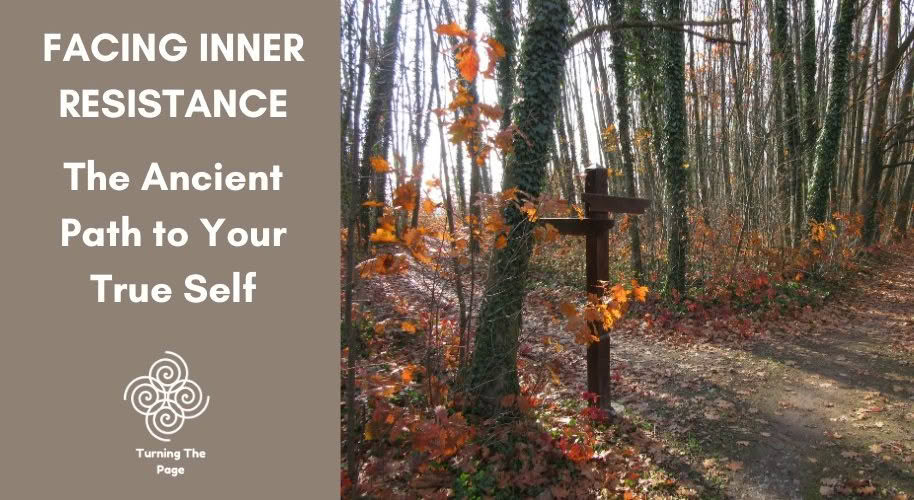
There is a resistance to go “there,” but I have a good shepherd who keeps calling me back to an ancient path intersection. A place where there is grace-filled curiosity.
Not shame or blame. Not to punish or penalise, but more to purify. To pull out the thorns in my flesh that keep me limping instead of loving. But I resist a love that comes and says, “All will be well, and all manner of things shall be well.”
I was listening to someone recently. They were showing resistance to my gentle curiosity. I was genuinely curious why they kept their truest self hidden away. There was such beauty and potential hidden away.
Jesus once talked about not putting your light under a bushel.
I could see something of that light. It was there, struggling to get out, but their life seemed dominated by a carefully woven basket of defenses.
As I listened gently, they slowly opened up.
In This Post
- The Korowai We Wrap Around Ourselves
- Naming Your Resistance: Fight, Flee, Fawn, or Freeze
- The Ancient Path Intersection
- Peter’s Denial and the Path to His True Self
- Face, Feel, Forgive, Follow
The Korowai We Wrap Around Ourselves
While I was writing this, an image and a sentence came to me.
The image was of a Māori lady with a korowai around her. A korowai is a traditional Māori cloak — feathered, woven, precious — but this one was heavy and dark. Beaten and rather tatty.
In my mind it went from head to toe, and the woman was holding it close around herself. Tight. But as I kept showing them kindness, respect and a gentle curiosity, they slowly let it open up.
I had the words: they opened up their korowai.
It’s a rare gift when someone lets you see them like that. And it made me realize that all of us, to some degree, resist being seen.
Perhaps we’ve been vulnerable before, as children, even as adults, in a world with wild wolves in it. We’ve been torn apart, abused, overlooked, punished for our vulnerability — and so, naturally, we stopped opening up to others.
That resistance wasn’t born yesterday. It’s a memory playing its part in self-protection. But those places of resistance have a way of distancing ourselves from truly knowing love and giving love.
The light under the bushel can get suffocated from lack of air to the point where it goes completely out.
Naming Your Resistance: Fight, Flee, Fawn, or Freeze
How does your resistance show up? It might be an overreaction, or it might be an under-reaction.
Something happens. Someone says something, does something, and there is an immediate response.
Event + Response = Outcome
An unbearable feeling hits us and we either fight, flee, freeze, or fawn.
The four responses
- Fight — We get defensive. We argue. We get irritated at whoever brought it up.
- Flee — We leave the room, change the subject, stay busy — anything so we never have to sit still with it.
- Fawn — We smooth it over. We apologize before we even understand what happened. We placate and pretend.
- Freeze — We go blank. We shut down. We feel nothing at all, because feeling something feels like too much. Overwhelm.
You might have a couple of these happening one after the other.
None of those get chosen in the moment. They’re too fast for that. They’re memory triggers firing before thought even catches up — the nervous system remembering the wolf long after the wolf is gone.
What’s your default “F” — fight, flee, freeze, or fawn?
The Ancient Path Intersection: Why We Keep Circling Back
Here’s the pattern: ancient paths have intersections — places where a choice has to be made.
Something happens, and because we’ve got a well-worn road, an “F” path already trampled into our brain, we go down it automatically, as fast as flame catches fuel. That road didn’t get built overnight. Every trip down it pounds it down a little bit more.
We keep circling back to it. That fork in the road.
The prophet Jeremiah described this exact intersection:
And the people’s answer is immediate: “We will not walk in it.”
There is an element of rebellion in it, but there is also a fear-based resistance.
It’s memory talking — I have my own path, and it’s kept me “safe” before, so I’m sticking to it.
We’d often rather be told a comfortable, pleasant story than a true one.
The prophet Isaiah says this:
Peter’s Denial and the Path to His True Self
Jesus had a follower called Peter, and he encountered an ancient path intersection where he met resistance.
The night before Jesus died, Peter denied even knowing him — three times, to a servant girl, by a fire. When it mattered most, he froze into self-protection. He fled into lying and denying. It was a response. We all have them. This was Peter’s.
You might say, “I would never do that,” but in all reality, when the very core of your being is being threatened, you might just react the same way or similar. Old paths emerge in crisis. New ones take effort and time.
A question, repeated three times
After the resurrection, Jesus invites Peter to be by another fire. Jesus didn’t list all the ways Peter had failed him. All he did was ask one question three times. “Do you love me?”
Three questions, answering the three denials — not to humiliate Peter, but to let him say out loud, in the very place he’d failed, what was actually true.
The same invitation he gave the day they met
Each time Peter answers, Jesus gives him something to do: “Feed my sheep.” Not “prove yourself first.” Just — here’s the path, keep walking it.
And the last thing Jesus says, after all of it, is the same two words he said the very first day they met: “Follow me.” Not once you’ve got this figured out. Not once the memory stops firing. Follow me — all the way through, failures included.
Jesus never treats Peter’s denial like rebellion. He treats it like what it is — a pathway doing what pathways do — and meets it with an invitation, repeated as many times as it takes.
Jesus didn’t reject, he recommissioned.
So what do we do with the resistance?
Whenever I think of resistance, I think of this quote from Steven Pressfield about the resistance facing the writing process.
I also think of resistance as a strong wind blowing into my face, telling me not to go into that storm. Stay at home, stay safe in the status quo.
Face, Feel, Forgive, Follow
To walk through the resistance I think there are four further “F’s.”
Face
Face into the wind, notice the resistance, that push back. Notice your default response wanting to rise up — fight, flee, freeze, fawn.
Feel
Feel the feeling. What is it that you are feeling? Anger? Sadness? Fear? Disappointment? Notice them. Feelings are feelings, but they are not facts. Feelings, as David Riddell says, “may in fact only be the ‘leftovers’ of another time, another place, another person,” and that “perhaps it’s time those feelings were told ‘it’s over’ in no uncertain terms.”
Forgive
Forgive yourself for all those times you caved into the magnetic pull of that old path. We grow through what we know, and learning is part of life. Peter had to forgive his failure at the first fire to be fully warmed by the next fire.
Follow
Follow Christ all the way through. I like to envision Jesus with me, close, on the ancient path, Psalm 23 shepherd rod and staff walking through the feeling and holding me while it rushes up and fades away. It will probably take several experiences before the old path is defused of all its power, but you can do this.
There’s a resistance, but there is also an invite.
Follow Him, All the Way Through
Ancient paths always bring us back to intersections where we have to face ourselves. Places where there may be resistance.
Jesus doesn’t ask us to erase the past before we follow. He asks us to follow — all the way through.
What ancient paths are like
- Are more about honesty than performance
- Generally go down before they go up
- Ask us to pray more and do less
- Are well-trodden — worn smooth by others like us who’ve walked them before
- Have push back. There’s resistance built in, because there is an invitation to change.
Quotes to Consider
Further Reading
- To Be Known: Breaking the Cycle of Shame and Stigma — Being known is our deepest need. Discover how shame and stigma build walls, and how to start breaking the cycle.
- Meet Me Hiding in the Shadow — Events happen in our lives. Are you hiding in the shadow of them? Perhaps you need someone to bring some wisdom’d love into the dark.

- The Problem is Not the Problem — The problem is not the problem, its much worse. But when we listen well we can help people leave their self made prison.
- Washing the Memories Free of Trauma — Some trauma memories keep us locked into our past. We need to bring ourselves to the presence of one who will wash us pure.

- No More Plans. Give Me a Foggy Signpost — Plans and blueprints give a sense of certainty. In the fog of relationships we need more Signposts offer direction, an ancient path.
- The Ancient Path: Why the Narrow Way Is Still the Right One — What Jeremiah 6:16’s “ancient paths” mean today — five steps to a slower, harder, more honest way of following God.
Written by Barry Pearman — Community Chaplain, Mental Health Support Worker, and founder of Turning the Page, a resource walking a grace-filled path to mental wholeness through faith, hope, and love.