Quick answer: A “shadow” is any unresolved pain from your past — a hurtful parent, an old shame, a generational pattern — that quietly warps how you see yourself and God today. You begin to remove it by turning to look directly at what’s causing it, naming it honestly, and inviting God’s light and other people into the process rather than staying in the safety of the shade.
Table of Contents
- What are the “shadows” from our past?
- A lesson from pruning the orchard
- Why you have to turn and look at what’s casting the shadow
- Paul’s story: when the shadow itself becomes the wake-up call
- What is casting a shadow over you?
- Making all things new
- Where to from here: 5 steps to dismantle the shadow
- Quotes to consider
- Questions to answer
- FAQ: shadows, past pain and faith
What are the “shadows” from our past?
Have you ever walked in a shadow? Of course you have — but you probably didn’t take much notice of it. We do it all the time. What about filtered light, light that’s been diffused as it passes through cloud? Again, yes. We don’t notice it because we’re used to it. It’s commonplace, the norm.
Taking this metaphor further: we all live with a certain amount of shadow affecting our lives. What I’m talking about are the shadows from the past. She is a grown adult woman, but she can still hear the voice of her father berating her. The man who never knew the fullness of a mother’s love now finds the shadow inviting him online. We grow used to the ambiance of that diffused light — it’s all we’ve ever known. At times we get a glimpse of sunlight, of something different, but it’s so unfamiliar we don’t know what to do with it. We scurry back into the shadow. It’s safe. Normal. Familiar.
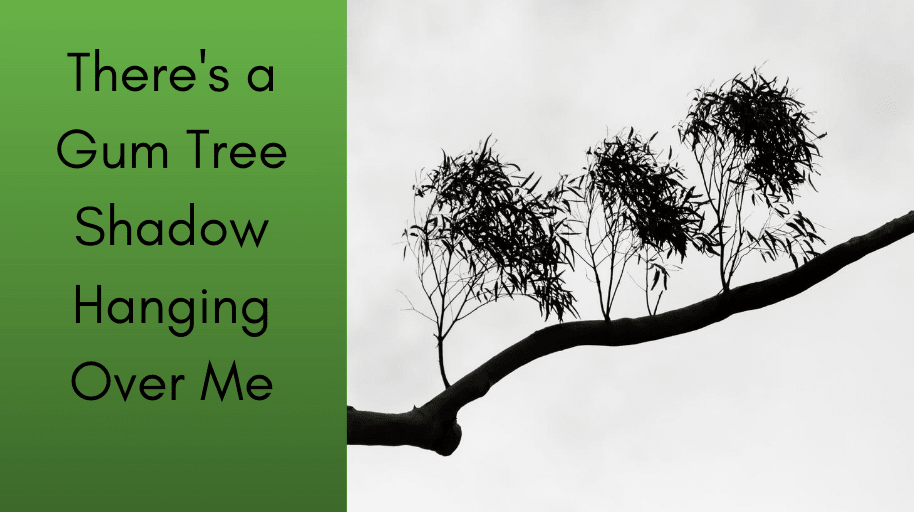
The Beatles sang “There’s a shadow hanging over me” — that rock-solid belief in the power of “yesterday.”
A lesson from pruning the orchard
At the moment I am pruning fruit trees. One of them is an apple tree, but it’s on a lean — not from wind or damage, but because it’s hungry for light. Right above it hang the branches of a large gum tree.
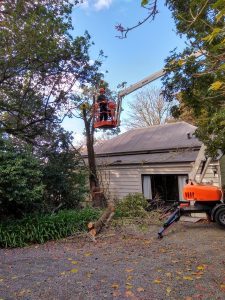
Barry having dangerous fun!
This larger tree casts its shadow over the apple, and the apple compensates by stretching to seek out the light. I really should cut the gum tree down — but to fell it from the base would send it crashing onto the apple tree and destroy it. Instead I need a cherry picker, and to go up into the tree and remove it section by section. I’ve done this before. It’s kind of dangerous, but so rewarding when you see the result: more light flooding into the garden.
Why you have to turn and look at what’s casting the shadow
The cause of a shadow only becomes visible when you look at what’s actually casting it. I can stare at the apple tree all day and never solve the problem — it’s only when I turn my gaze and see what’s shadowing it that I come to understand. When we come into the full light and turn to see what’s cast its shadow on us, it can feel like a gum tree has landed on us. For some of us, that’s exactly what’s needed.
Paul’s story: when the shadow itself becomes the wake-up call
A deeply religious man named Saul had one of those light-shattering moments. He was breathing down the necks of the Master’s disciples, out for the kill. He went to the Chief Priest for arrest warrants to take to the meeting places in Damascus, so that if he found anyone belonging to the Way — men or women — he could arrest them and bring them to Jerusalem.
He set off. When he got to the outskirts of Damascus, he was suddenly dazed by a blinding flash of light. As he fell to the ground he heard a voice: “Saul, Saul, why are you out to get me?” He said, “Who are you, Master?” “I am Jesus, the One you’re hunting down. I want you to get up and enter the city. In the city you’ll be told what to do next.” His companions stood there dumbstruck — they could hear the sound but couldn’t see anyone — while Saul, picking himself up off the ground, found himself stone-blind. They had to take him by the hand and lead him into Damascus. He continued blind for three days. He ate nothing, drank nothing. Acts 9:1-9
Saul thought he had been walking in the light — that he’d been doing exactly what God wanted. Yet he was in the darkest of shadows: the shadow of religiosity. Black and white, rules and regulations, religion and self-righteousness.
What is casting a shadow over you?
This is important work: examining the shadows that are still hanging over you today. We all have them, and naming them requires turning and looking up and back. What is casting that shadow? Is it the shadow of others gone long before — generational patterns passed down from generation to generation? Maybe it was a parent or family member who hurt you, and they may not even be aware of the harm they caused.
Perhaps it’s a shadow of something you’ve done, and you feel shame, guilt, grief, and loss. You’ve been warped by the shadow. You’re stretching and seeking the light, but the shadow remains. Isn’t it time to make things new?
Making all things new
I believe God is on a love mission to make all things new. “And he who was seated on the throne said, ‘Behold, I am making all things new.'” Revelation 21:5
Paul found this newness. A gum tree had to fall on him to wake him up to God’s presence — and for some of us, that’s exactly what’s needed. Better still, though, to cut the gum tree down branch by branch: to slowly dissect the object casting the shadow, and let the light flood in.
Where to from here: 5 steps to dismantle the shadow
1. Ask God to reveal what is casting a shadow
Jesus said this about the Spirit: “The Spirit shows what is true and will come and guide you into the full truth. The Spirit doesn’t speak on his own. He will tell you only what he has heard from me, and he will let you know what is going to happen.” John 16:13
2. Own the shadow
It’s a shadow that’s on you, so you need to take responsibility for it. Avoidance won’t shift it.
3. Ask God for help in removing what is causing the shadow
Imagine that huge gum tree and the enormity of the problem — you can’t do it by yourself. We need someone larger and greater than ourselves.
4. Find others to help you dismantle the tree piece by piece
This will most likely be a journey of a lifetime — removing branches one at a time, safely and securely, allowing new light to flood in. Find someone to help you.
5. Look for the new light and enjoy its warmth
As each small limb falls, new light dances around your life. You can grow straight, produce new fruit, and be enjoyed by others — one who has done the inner recovery work and is now full of fruit.
We all have shadows that limit the light reaching us. Surely we can pray and ask God to help remove the object standing between us and a full awareness of his presence.
Quotes to consider
Questions to answer
- What has been a “shadow” that has seemingly clung to you?
- What would it be like to have some of those shadows removed, and have more light enter your life?
- Are there experiences in your life that you might have recorded well but interpreted poorly? What would the Spirit want you to know as truth? Are you open to another interpretation?
FAQ: shadows, past pain and faith
What does it mean to have a “shadow” from your past?
A shadow from your past is an unresolved hurt — often from childhood or family relationships — that keeps affecting how you think, feel and act today, even when you’re not consciously aware of it. It can feel “normal” simply because you’ve lived in it so long.
How do you know what is causing your shadow?
You typically only see the cause of a shadow when you deliberately turn and look at what’s behind you, rather than staring only at the effects in front of you — much like tracing an apple tree’s lean back to the larger tree blocking its light.
Can God really remove shadows from the past?
This post frames healing as a partnership: praying and asking God to reveal and help remove what’s causing the shadow, while also taking responsibility for it and enlisting the help of other people. It’s rarely instant — more often it’s removed “branch by branch,” over time and in community.
Why did Paul’s shadow have to fall on him so dramatically?
In the Damascus road story, Paul (then Saul) believed he was walking in the light of religious devotion while actually living in the deep shadow of self-righteousness. His conversion illustrates how a sudden, disorienting encounter with truth can be exactly what’s needed to expose a shadow we couldn’t otherwise see in ourselves.
Further reading
- Sitting in the Mental Health Shadow of an Eclipse — A shadow passed over them. An eclipse shadow of the soul, but I didn’t want them to be alone in it, so I sat and listened to the darkness.
- Embracing the Pain Finding the Christ light — Discover how embracing emotional pain opens the door to Christ’s light. Move from hiding suffering to experiencing a healing presence.
- Paul’s Thorn in the Flesh and its Meaning for You — Discover how Paul’s thorn in the flesh—the sting of a shameful past—can become a source of humility and a springboard for God’s grace.
- When the Emotional Pain is too much — Emotional pain can bump our lives into behaviors that can hurt us further. But we can make a change by learning to listen to the pain.
- A Change In Behavior, A Change In the Mind — True behavior change isn’t always dramatic. Explore how “metanoia”—small shifts in the mind—leads to lasting transformation over time.
- God is Going against the Grain and it’s Terribly Good — Discover how God gently works against the grain of our old beliefs to reshape our thinking and heal our hearts through divine intervention.
Photo by Holger Link on Unsplash