We hear words every day. Some words carry an energy that hurts, but there are also words that heal. Let’s focus on words that heal and not hurt.
Quick answer: Words that heal are less about finding the right script and more about the love and presence behind them. A hurting soul rarely needs fixing, advice, or correction. It needs to hear that it is loved, held, and known. Those words come most truly when we quieten ourselves, listen to the Holy Spirit, and offer the kind of connection Dr Larry Crabb called nourishment for the disconnected soul.
In this post:
- What Words Does a Hurting Soul Need to Hear?
- Why There Is No List of Healing Words
- Quotes to Consider
- Questions to Answer
- Further Reading
It wasn’t just the words they said; it was the energy behind them that truly cut me to shreds. It was like a battery-powered amplifier had been plugged into the mains.
Words can heal
Words can power us up
Words can tear us down
Words can bring us hope
Words can steal it away
The word became flesh
And set up tent amongst us (John 1:14)
The word brought truth and life
It healed the sick and broken
Word still lives on within us
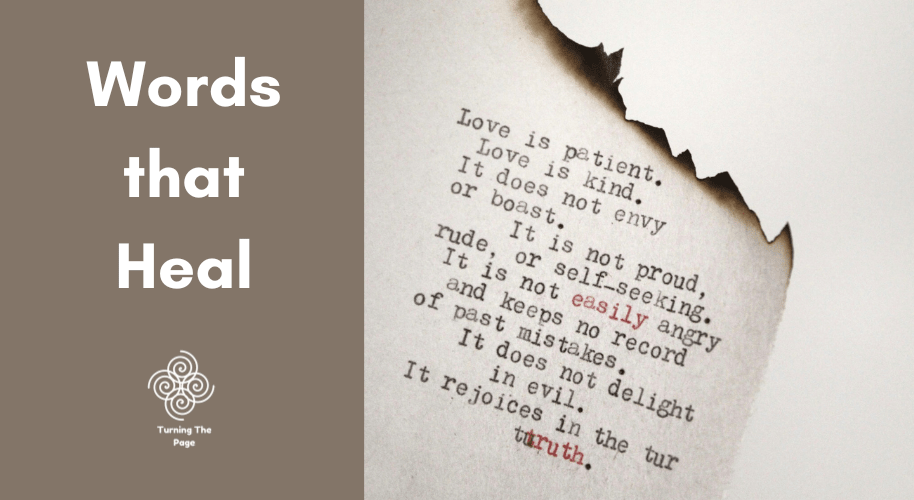
Words of love that must be spoken
Have you had words spoken to you with an energy that has crushed you to dust? If you have been on the receiving end of shouting, you may need to recover your dignity after a shouting bully.
Maybe words have been said that seem to heal the soul. Simple sentences that sift through the scatteredness and bring together some hope.
Medicine to the deepest pains.
You Are Held
You Are Known
Sometimes the most healing words of all are simply “I am with you”.
What has your experience been with words?
What Words Does a Hurting Soul Need to Hear?
When I first started as a pastor helping people with serious mental illness, I was given the book Connecting by Dr Larry Crabb.
The quote below still rings true for much of what I do even now, almost 30 years later.
There is no “disorder” requiring “treatment.”
And, contrary to hard-line moralism, there is more to our struggles than a stubborn will needing firm admonishment.
Beneath all our problems, there are desperately hurting souls that must find the nourishment only community can provide—or die.
We must do something other than train professional experts to fix damaged psyches. Damaged psyches aren’t the problem.
The problem beneath our struggles is a disconnected soul.
And we must do something more than exhort people to do what’s right and then hold them accountable.
Groups tend to emphasize accountability when they don’t know how to relate.
Better behavior through exhortation isn’t the solution, though it sometimes is part of it.
Rather than fixing psyches or scolding sinners, we must provide nourishment for the disconnected soul that only a community of connected people can offer. Larry Crabb, Connecting
What words would a ‘desperately hurting soul’ most need to hear?
What words provide nourishment for a disconnected soul?
Certainly not F.A.S.S. words: no fixing, advising, saving, or setting someone straight. A disconnected soul needs good conversations that don’t leave you feeling judged, and someone willing to meet you at the coal face of your pain.
Why There Is No List of Healing Words
We all want a list of words to say. A program to follow, a system to put into place.
Often the most healing words are not answers at all but invitations, like the three words that build a bridge instead of a wall.
Listening for Spirit words
But perhaps more so, we need a quietness where we can hear ‘Spirit words’ of comfort and hope. Sometimes that is the right word at the right time, a rhema word.
Jesus, the Word, said this.
Words that heal come from a Comforter who knows exactly what the soul needs.
So we listen.
Not to our knowledge, experience, textbooks, or latest guru. Many of those need to be put to the side, at least for a little while. But more so to the Spirit, who leads us into all truth.
That’s the connection that is most needed.
Words that open doors
When we have listened, we can offer words that open doors rather than close them. Safe people ask gentle, curious questions, and that is how we become a safe place for someone who is hurting.
Quotes to Consider
- God’s healing has more to do with learning to worship than it does with getting life fixed. Craig Barnes
- Love acts like a giant magnet that pulls out of us, like iron filings, every recorded injury, every scar. Terrence Real
- Learn to respond to others with honest, open questions instead of counsel or corrections. With such questions, we help “hear each other into deeper speech.” Parker J. Palmer
- When you speak to me about your deepest questions, you do not want to be fixed or saved: you want to be seen and heard, to have your truth acknowledged and honored. Parker J. Palmer, A Hidden Wholeness: The Journey Toward an Undivided Life
- Good work is relational, and its outcomes depend on what we are able to evoke from each other. Parker J. Palmer
- It is usually most helpful to ask questions that are more about the person than about the problem. Parker J. Palmer
Questions to Answer
- What words have helped you most in your journey?
- There is often an energy behind and under words that have been said. What do you pick up on most: the word being said or the energy contained within the word?
- What words do you need to say more to yourself? It may help to notice how the words you say to yourself steer your life.
Formation Exercise
- Reflect on your journal writing. What are the words you have used most? What is the energy under them? Is it criticism, hope, struggle, or delight? Consider what it means to be fed by a diet of words.
Further Reading
- Stop The Bully. Stop The Shouting. — Recover from the words of a shouting bully. Discover your worth, conquer shame, and use the smart B.G.E.S.C. strategy to respond gently.
- Three Words to Build a Bridge — We all have a “secret garden” we protect with walls. Discover how three simple words can build a bridge and invite deeper, safer connection.
- Good Conversations don’t leave you Feeling Judged — Tired of being judged? Discover how to find and create an “oasis of gentle curiosity” where you can be fully known without being condemned.
- No One Knows Coal Like a Coal Miner: Being Met at the Coal Face — Feeling alone with your pain? Discover why being known, not fixed, matters and how Jesus meets you in the dark.
- I Need a Safe Place — Discover how to build safe spaces and practice unhurried listening. Learn to avoid fixing others and cultivate a truly good soul refuge.
- How to Overcome Anxiety Through Solidarity: I Am With You — When guilt isolates, “I am with you” is the only bridge back to hope. Discover the power of solidarity in the face of judgment and shame.
About the Author
Barry Pearman has spent almost 30 years as a mental health support worker, community chaplain, and pastor, and has walked through depression himself. His training includes SoulCare Foundations under Dr Larry Crabb, a Bachelor of Applied Theology, spiritual direction training, and certificates in CBT interventions, pastoral therapy, and integrated mental health care. Read more about Barry Pearman’s background and training.
Turning the Page offers a grace-filled path to mental wholeness through faith and hope.
Photo by Leighann Blackwood on Unsplash