Stop the wild swing between past regrets and future fears. Learn how to ground your thoughts in the “Now” by binding truth to your heart.
Sometimes my thoughts seem to go to another time.
They don’t stay grounded in the here and now. They either swing out into the future or they sweep back into the past.
Sometimes the future has a sense of hope and joy, while the past has the aroma of happy memories. But all too often, with a negativity bias, the swing ends in times of anxiety or depression. It’s those extremes that seem to dominate or cloud today.
To go from depression to anxiety, I have found that I have to go through a place called “Now.”
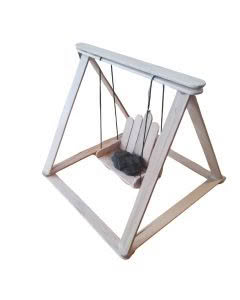
I have a little swing in my toolkit of illustrative life models. I often use this when I am doing Soul Talk conversations with people. We talk about the swing.
The Now
In between yesterday and tomorrow is always today. There is always now.
I want to be grounded.
If we look at the model of the swing, then the swing has to pass through a low arch where it comes close to being settled near the earth.
Ok, I know swings are fun, but do any of us actually want to live on a wild, out-of-control swing? We need to learn how to ground ourselves.
How to Ground Your Thoughts
1. Know What’s Within Your Control
We so often focus our attention on things we have little to no control over.
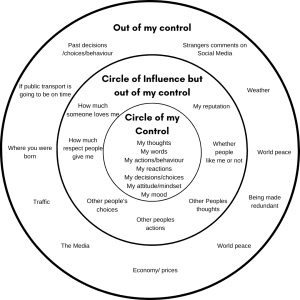
I like the concept of the circles of control and influence. If this idea resonates, I’ve written more on it in Are You Trying to Control the Uncontrollable?
A useful exercise is to make a written list of what has your focus and attention. Just by doing this tangible, tactile exercise, you can radically reduce your stress. You have taken it out of ethereal mind soup and onto earthy, tangible ink and paper.
Then ask yourself:
- Is this within my control?
- Is this outside of my control?
- How much influence do I have on this?
- How much influence do others have?
2. Write the Truth
I like to write in a notebook the truth I need to tell my brain.
My brain has a negativity bias. It always seems to want to head off to the grand canyon of negativity. Rick Hanson explains why:
Your brain is continually looking for bad news. As soon as it finds some, it fixates on it with tunnel vision, fast-tracks it into memory storage, and then reactivates it at the least hint of anything even vaguely similar. But good news gets a kind of neural shrug: “uh, whatever.” In effect, the brain is like Velcro for negative experiences, but Teflon for positive ones. — Rick Hanson, Ph.D.
I want to train my brain so that it is Velcro for the positive and Teflon for the negative. This takes work. This takes practice. It is a millimetre-by-millimetre ministry into the fabric of the brain.
(I’ve written more about how the brain forms — and can unlearn — this bias in Jonah and the … Negativity Bias.)
3. Rehearse the Truth
Then rehearse the truth. As much as an actor rehearses their lines and a musician practices their instrument, so we are to train our brains.
Perhaps these are some truths that you need to rehearse into your brain’s neural networks:
- I am loved
- I am held
- I am known
- As far as the east is from the west, the Lord has removed my transgressions from me
- If God is for me then I need to be for myself
- Nothing can separate me from God’s love
- That was then, this is now, I choose to live in the now
- I am responsible for my choices. Others are responsible for their choices. I am not responsible for other people’s choices
If you’d like a structured way to build this habit, I walk through the process in 7 Steps to Change and Regroove Your Thinking Patterns and in How to Develop a Compass for the Brain.
Case Study: Grounding Anxiety Before a Doctor’s Visit
Just today I was having a Soul Talk conversation with someone and they shared how anxious they were about going to the doctor.
So this is what we did.
I asked them what was within their control. I asked them about their experiences of going to the doctor.
They told me all about the doctor and how kind she was. The doctor listened well, took their needs seriously, and had wise, practical advice.
I then suggested she get a piece of paper and a pen — something I always ask people to have on hand. She then wrote some truth statements:
- “My doctor listens well.”
- “My doctor offers good, practical advice.”
- “My doctor keeps my notes confidential.”
- “My doctor listens to me first before writing notes.”
- “The staff at the medical centre are always very caring and professional.”
- “Whenever I go to see my doctor I come away feeling reassured and heard.”
After she had written these down, she immediately felt better, less anxious, and more grounded. Her swing had come closer to the ground and become settled.
What we did together was give her brain reminders of truth. I suggested she read this list over and over again, and that she write her own list of positive truths into what I call a “Thinking Compass” — a tangible notebook of truth that needs to be rehearsed daily.
This Is an Ancient Practice
There is nothing new here. We find this advice from biblical times.
You shall therefore lay up these words of mine in your heart and in your soul, and you shall bind them as a sign on your hand, and they shall be as frontlets between your eyes. — Deuteronomy 11:18
Let not steadfast love and faithfulness forsake you; bind them around your neck; write them on the tablet of your heart. — Proverbs 3:3
My son, keep your father’s commandment, and forsake not your mother’s teaching. Bind them on your heart always; tie them around your neck. When you walk, they will lead you; when you lie down, they will watch over you; and when you awake, they will talk with you. — Proverbs 6:20-22
The Binding of Today’s World
Today I have literally thousands of messages that want to bind into my brain. I open up my email and BOOM, there are messages that want to bind stuff to the brain. Social media is a storm of binding distractions.
I want to bind truth to my brain. Truth that will ground me, and not throw me into anxiety or depression. I want to ground my thoughts in God.
(For more on resisting the pull toward past or future thinking, see Watching the Wind. Looking at Clouds.)
Quotes to Consider
Change is difficult. Only when the pain that comes from remaining the same becomes greater than the pain of change, do we get serious about getting help. — David Riddell
The key to growing any psychological resource, including compassion, is to have repeated experiences of it that get turned into lasting changes in neural structure or function. — Rick Hanson
Nothing digs ditches like shovelfuls of dirt. — Rick Hanson
The brain is a far more open system than we ever imagined, and nature has gone very far to help us perceive and take in the world around us. It has given us a brain that survives in a changing world by changing itself. — Norman Doidge, The Brain That Changes Itself
There is absolutely no substitute for repeating the right insight when you come under pressure to revert to the old ways. Use it or lose it. — D. Riddell
You are the creator of your thoughts, and it’s your thoughts that can create the future that you want. It really is in your control. — Dr. Shannon Irvine
If it’s been learned, it can always be unlearned — e.g., ways of coping, personal habits, survival kits, and nasty addictions. — D. Riddell
The brain takes its shape from what the mind rests upon. — Rick Hanson
Despair is a spiritual condition. Despair is when you fall under the belief and conviction that tomorrow will simply be a repeat of today. — Rob Bell
Questions to Answer
- Where do your thoughts seem to take you — places of anxiety or depression?
- How tired does it make you if you spend long lengths of time there?
- What truth do you need to rehearse?
Formation Exercise
For today, note the movement of your swing. Where do your thoughts take you? What would it be like to ground your thoughts in the now of today? What truth insights do you need to add to your thinking compass?
Keep Reading
- Are You Trying to Control the Uncontrollable?
- Jonah and the … Negativity Bias
- How to Develop a Compass for the Brain
- 7 Steps to Change and Regroove Your Thinking Patterns
- Watching the Wind. Looking at Clouds
Barry Pearman
Photo by Jon Tyson on Unsplash